
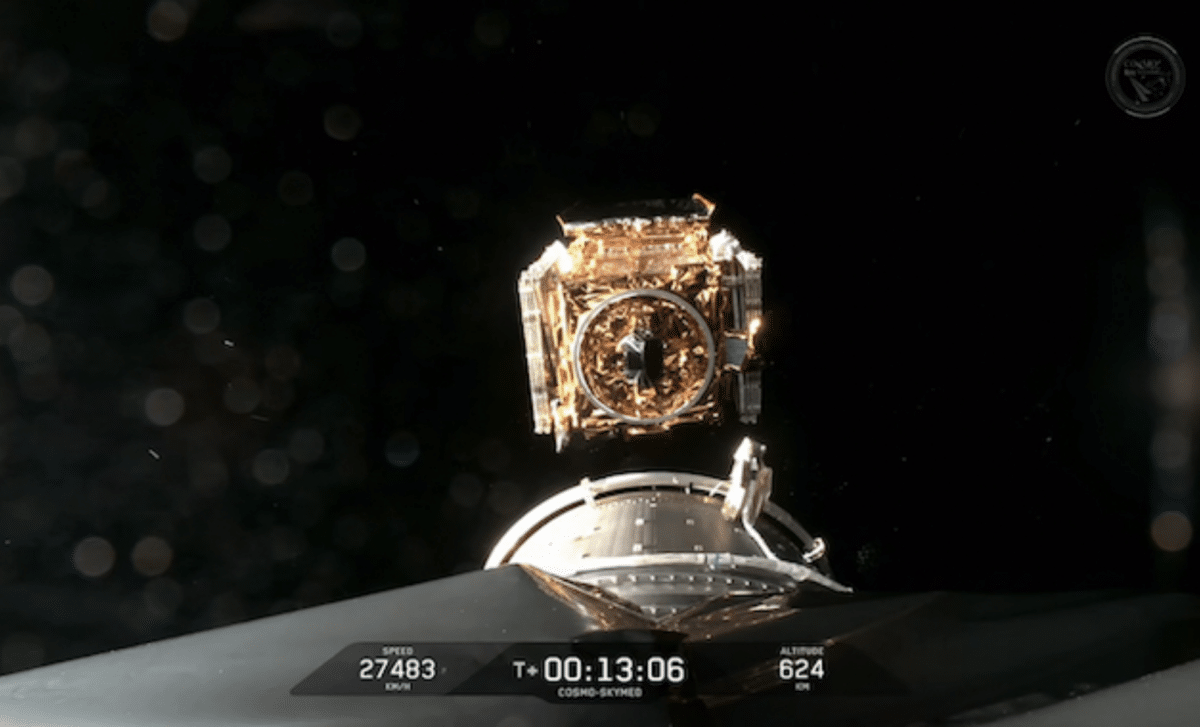
SpaceX began the new year with the successful launch of Italy’s latest Earth observation satellite, part of the COSMO-SkyMed Second Generation constellation, aboard a Falcon 9 rocket from Vandenberg Space Force Base. As reported by SpaceFlightNow, the mission represents a key step forward in Europe’s strategic Earth imaging capabilities and marks a strong start for SpaceX’s 2026 launch calendar.
SpaceX Launches CSG-FM3 From California After Technical Delays
On January 2, 2026, at 6:09 p.m. PST, a Falcon 9 rocket lifted off from Space Launch Complex 4 East at Vandenberg, carrying the COSMO-SkyMed Second Generation Flight Model 3 (CSG-FM3) into low Earth orbit. The launch had been postponed multiple times due to technical issues, including a hydraulic fault in the pad’s hold-down clamps. It was initially scheduled for December 27, 2025, then rescheduled again after further troubleshooting.
Despite these setbacks, the Falcon 9 executed a clean launch trajectory and achieved a successful booster landing just 8.5 minutes later at Landing Zone 4, marking the 554th Falcon booster landing and the 31st at this site. According to SpaceFlightNow, the booster used, tail number B1081, was on its 21st mission, having previously flown for NASA on Crew-7, PACE, and TRACERS missions.
The satellite was successfully deployed around 13 minutes after launch, beginning its mission in a 620 km sun-synchronous orbit, where it will remain operational for an expected five-year lifespan.
Italy’s Strategic Asset In Space: Civil-Military Dual Use Satellite
The COSMO-SkyMed Second Generation (CSG) program is a dual-purpose Earth observation system developed by Italy’s Ministry of Defense and the Italian Space Agency, and built by Thales Alenia Space. The CSG-FM3 is the third of four planned second-generation satellites designed to replace and enhance the capabilities of the original COSMO-SkyMed constellation. Its advanced synthetic aperture radar (SAR) system operating in X-band allows it to capture high-resolution imagery through cloud cover and darkness, a critical asset for both military reconnaissance and civilian disaster monitoring.
In a statement posted on social media, Italian Defense Minister Guido Crosetto emphasized the collaborative nature of the mission:
“The Cosmo-SkyMed program is one of the most outstanding examples of cooperation between Defense, the Italian Space Agency, and national industry. It is a model of public-private synergy that shows how innovation, research, and development can integrate with security and defense needs, generating strategic value for the Country.”
This public-private cooperation reflects a growing global trend where space assets are designed to serve multi-domain objectives, including national security, scientific research, agriculture, urban planning, and climate change monitoring.
A Constellation With Global Reach And Growing Importance
The launch of CSG-FM3 brings the current constellation to five operational satellites, two from the first generation and now three from the second. This configuration enhances the frequency and resolution of global imaging, giving Italy one of the most advanced radar-based Earth observation capabilities in the world.
According to SpaceFlightNow, the CSG satellites are part of a long-term investment strategy to position Italy as a major player in the European space sector, while also contributing data to broader initiatives under the European Space Agency (ESA) and Copernicus program. The data produced by the constellation can support international cooperation on emergency response, environmental monitoring, and peacekeeping operations, in addition to Italy’s domestic and military applications.
The design and manufacturing were led by Thales Alenia Space, a Franco-Italian aerospace manufacturer, which has also supplied similar SAR satellites for other nations and agencies. Their partnership with SpaceX highlights how transatlantic launch providers and European satellite builders are increasingly interdependent in today’s commercial space economy.
An International Start To SpaceX’s 2026 Manifest
The CSG-FM3 mission opened SpaceX’s 2026 launch calendar, ending a 16-day gap in launches, the longest pause in four years. It comes amid a temporary lull in Starlink deployments, as the company addresses recent issues with its satellite buses.
The successful recovery of B1081 and the flawless insertion of the payload into orbit once again demonstrated the maturity and reliability of the Falcon 9 system, which has become the workhorse of commercial spaceflight. SpaceX’s ability to accommodate international clients like the Italian government while maintaining its cadence of Starlink and NASA missions cements its dominant role in the launch industry heading into the new year.
This mission also reinforces California’s Vandenberg site as a strategic launch location for polar and sun-synchronous orbits, frequently used by Earth observation satellites. With multiple launches already booked from the West Coast in 2026, SpaceX is expected to continue setting a high operational tempo throughout the year.
A Platform For Global Collaboration In Earth Observation
The COSMO-SkyMed constellation stands as a prime example of how space assets can serve global interests, blending public and private investment, civil and military utility, and international cooperation. While geopolitical tensions are on the rise globally, missions like CSG-FM3 highlight how space can also be a domain for constructive partnerships and strategic innovation.
As Earth observation satellites grow in technical sophistication and commercial value, nations are increasingly looking to establish independent access to data and secure intelligence infrastructures in orbit. Italy’s COSMO-SkyMed program, now with a third second-generation unit in orbit, positions the country at the forefront of this shift.
The year 2026 has just begun, but for Italy and SpaceX, the COSMO-SkyMed launch has already set the tone for what may be another landmark year in space cooperation.