
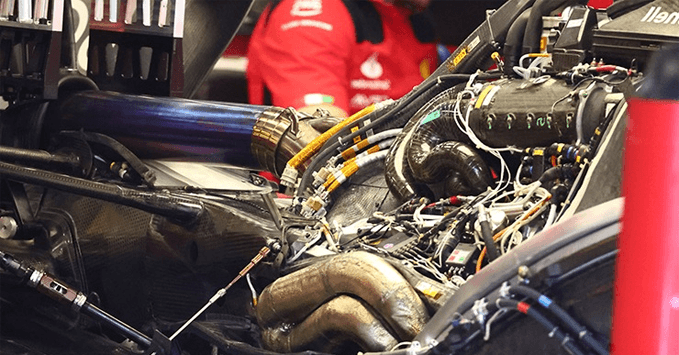
As Formula 1 steadily moves closer to the 2026 season, discussion around the technical direction chosen by Ferrari has intensified significantly, especially regarding the rumored adoption of a steel cylinder head. This particular technical solution has attracted a great deal of attention because it is clearly aimed at optimizing overall engine performance under the radically revised regulatory framework. A careful and detailed reading of the FIA regulations confirms that such a solution is indeed permitted within the rules. However, several important factors must be taken into account, because while there may be potential advantages on one side, there is also a crucial consideration linked to pure vehicle dynamics that could ultimately work against this choice. Understanding how these elements interact is essential in order to form a balanced and technically sound view.
F1 2026: characteristics and functions of the cylinder head on V6 turbo internal combustion engines
It is therefore necessary to clarify, with the appropriate level of technical rigor and objectivity, the various rumors and reports that have been circulating in recent days and weeks. These speculations refer to the Maranello-based team and the alleged work carried out by Ferrari engineers on the engine cylinder head using a steel-based alloy. This topic has effectively turned into a significant technical talking point within the Formula 1 paddock and among fans, making it essential to provide some clarifications, always with the FIA regulations firmly in mind as the primary reference.
In situations like this, the first essential step to avoid misunderstandings or incorrect interpretations is to define the subject in question with absolute precision. The theories concerning the Italian team’s power unit refer specifically to the cylinder head of the internal combustion engine. This is the structural component that closes the upper part of the cylinder block and plays a decisive role in the functioning of the engine itself.
The cylinder head is a component that houses the valves, spark plugs and injector and, above all, contains the combustion chamber, which is where the ignition process takes place through controlled combustion. Because of this specific and demanding role, it is relatively easy to understand why the cylinder head is the most highly stressed area of the engine. It is subjected to extreme loads both from a thermal perspective, due to very high operating temperatures, and from a purely mechanical point of view, as it must withstand immense pressure cycles during engine operation.
Within the 2026 power unit regulations, in the section dedicated to materials and construction for the internal combustion engine, there is a specific rule that governs the materials permitted for this critical component. The FIA regulation clearly specifies that the engine block and cylinder heads may be manufactured from aluminum alloys or iron alloys. Steel, in this context, falls within the broader category of iron-based alloys. With this point clarified and firmly established, it becomes easier to examine Ferrari’s technical approach and the reasoning behind such a choice.
F1 2026, Ferrari engine: the possible advantages of building a steel cylinder head for the Italian power unit

When considering the new-generation power units that will debut in the 2026 Formula 1 season, it is fair and technically accurate to say that the pressures reached inside the combustion chamber will be significantly higher than those seen in the previous regulatory cycle. This aspect represents the first and perhaps most compelling reason why Ferrari’s engine engineers may have opted for steel to manufacture the Italian V6 turbo cylinder head. Higher pressures inevitably demand materials capable of offering superior structural resistance and long-term durability. In this context, it is also important to remember that reliability will be a crucial factor, especially in the early phases of the new regulations, when teams will still be learning how to extract performance safely and consistently.
The second reason behind this potential choice could be linked to thermal insulation and thermal management. Compared to a material such as aluminum, steel has a lower level of thermal conductivity. This characteristic can be particularly useful in reducing energy losses during the combustion phase, allowing more heat to remain within the combustion chamber where it can be converted into useful mechanical work. As a result, this property could represent a meaningful potential benefit for a Formula 1 power unit operating at the limit of efficiency.
This is because a material of this type can contribute to greater efficiency throughout the entire process that takes place within the internal combustion section of the engine. Even marginal gains in thermal efficiency can translate into valuable performance improvements, especially under a regulatory framework that places strong emphasis on efficiency rather than outright power. However, these advantages exist within extremely delicate balances, given that every choice made on a single component of the car can also generate disadvantages in other areas that are just as important for overall competitiveness.
F1 2026, Ferrari engine: the inevitable consequence of a steel cylinder head
At this stage, a consideration of a purely design-related and structural nature must be made. Even if the increase in weight on the power unit were minimal, the choice of material for the cylinder head remains an extremely sensitive issue for every Formula 1 manufacturer, including Ferrari. It must be borne in mind that any increase in weight in the upper part of the engine would inevitably lead to a clear and potentially problematic consequence.
This consequence would involve a significant rise in the center of mass of the internal combustion section. Such a condition is always carefully avoided during the design phase by every constructor, because it risks compromising the vehicle’s dynamic balance. A higher center of gravity can negatively affect handling, cornering stability and overall responsiveness, aspects that are critical for driver confidence and lap-time consistency. It therefore remains to be seen whether this type of solution is actually real and, if so, what kind of advanced engineering work has been carried out to achieve benefits without paying a price in other performance areas.
This issue refers specifically to a noticeable increase in the center of mass of the internal combustion section. It is a critical aspect that every constructor tries to avoid during the design phase in order not to undermine the car’s dynamic equilibrium. In modern Formula 1, where margins are extremely small, even slight compromises in weight distribution can have measurable effects on on-track performance. It therefore remains to be verified whether this solution truly exists, as obtaining reliable information of this kind is always extremely difficult in such a competitive and secretive environment.
Furthermore, if the use of a steel cylinder head were to be confirmed, it would be particularly interesting to understand the engineering work behind it. This would include analyzing how Ferrari’s technical department has sought to maximize the benefits of such a material choice without penalizing vehicle drivability or upsetting the delicate balance between the power unit and the chassis. Solutions could involve compensating measures elsewhere in the car, such as optimized packaging, refined suspension geometry or careful mass redistribution.
What remains clear is that Ferrari appears to be very optimistic about its engine project for the 2026 season. The team is reportedly convinced that it has carried out work that fully meets expectations and is capable of delivering the desired performance from both elements that make up the Italian power unit. This confidence suggests that Ferrari believes it has found a viable compromise between efficiency, reliability and vehicle dynamics, an achievement that could prove decisive under the new Formula 1 regulations.
In a competitive environment where rivals Red Bull, Mercedes and McLaren are all pursuing their own innovative solutions, Ferrari’s technical direction will inevitably be closely scrutinized. Drivers Charles Leclerc and Lewis Hamilton will rely heavily on the effectiveness of these engineering decisions. Ultimately, the true value of the steel cylinder head solution, if confirmed, will only become fully clear once the cars take to the track and the complex interaction between power unit performance and overall vehicle dynamics can be evaluated under real racing conditions.
Jan 7, 2026Luca Marini
Let other Scuderia Fans know about us


