
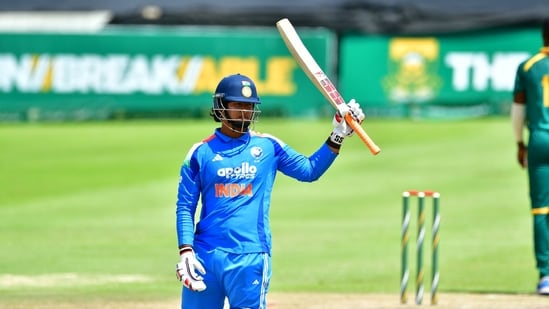
T20I selection debates rarely begin with a 14-year-old. However, Vaibhav Suryavanshi isn’t being spoken about as a future prospect anymore; he is being touted as a weapon because his performances are arriving at the speed of a professional cricketer. Suryavanshi’s “when, not if” moment is arriving faster than cricket is accustomed to. A young teenager opening the batting and bullying attacks is no longer just a social-media buzz; it is a recurring narrative, and it is happening in recognised youth internationals with great consistency.
 Vaibhav Suryavanshi vs SA U19 (BCCI X)
That is why the senior T20I conversation has started. Not because India needs a new opener, but because Suryavanshi is forcing the only question that matters in modern T20I planning: If you have got an elite powerplay weapon, how long do you keep him out?
Why Suryavanshi is talked about now
The numbers are loud. In the recent U19 Asia Cup, Suryavanshi compiled 262 runs at a strike rate of 162, and on the way, smashed 171 off 95 balls against the UAE. Today against South Africa, he has doubled down, blasting 127 off just 74 deliveries in Benoni, with 96 of those runs coming in boundaries.
He has also crossed into senior domestic records, becoming the youngest men’s List A centurion in the Vijay Hazare Trophy with a 36-ball hundred at 14 years and 272 days. And the IPL pathway is already in place. Rajasthan Royals signed him in IPL 2025 for INR 1.1 crore, and he repaid the faith with some blazing knocks at the top for the franchise.
So, the “why now” is simple: repeatability + range. He is not just hitting freak hundreds: he is stacking high-tempo knocks across youth ODIs and domestic cricket, while already being embedded in an IPL environment that mirrors senior T20 expectations.
The what-if in India’s T20Is scenario
If India drafts Vaibhav Suryavanshi into the senior T20I side, the cleanest role definition is straightforward: powerplay aggressor as an opener.
Where does he bat?
He opens. That is where his game is most disruptive: new ball, fielding restrictions, and immediate match-up pressure on opposition captains. Even with the youth setup, the pattern remains the same: get him in early, let him swing the game’s geometry in the power play.
Could he be a number-three power-play extender instead? In theory, yes – especially if India wants to maintain an established opening pair. However, the highest-value use is still opening the inning, as it maximises balls faced in the phase where the boundary percentage matters most.
Who makes way?
The most logical displacement at the current point in time is the wicket-keeper batter, who has been used as a top-order option, and India solves the issue of keeping separately. Hence, Sanju Samson sitting out to make way for Suryavanshi appears to be the cleanest path for the teenager.
Once you park eligibility and focus on cricket, the most interesting part is that Suryavanshi’s role profile does not directly collide with Abhishek Sharma’s selection logic as much as it collides with squad balance. Suryavanshi is a top-order left-hander who changes your first-six-over ceiling. India’s current T20 World Cup 2026 squad already carries Abhishek, plus two wicketkeeper-batters in Samson and Ishan Kishan.
If India wants to inject Suryavanshi without weakening the depth of the side, one clear lever is if Samson goes out, and Ishan Kishan becomes the primary wicketkeeper and number three batter. It’s not a verdict on Samson’s ability; it is a configuration decision.
The immediate tactical gain is obvious: India becomes even more aggressive about controlling the Powerplay. The knock-on is structural: if the top does more damage, the middle order stops playing catch-up. Batters like Rinku Singh and Hardik Pandya are often used for leverage, rather than rescue, and India can choose when to accelerate instead of being forced into it.
The Shubman Gill and Shivam Dube dilemma
Shubman Gill’s T20I profile sits in an awkward middle at present: good enough to be in the conversation, but not so role-unique that he becomes undroppable when India chase specific skill sets. Notably, he has scored 869 runs in 36 T20Is at a strike rate of 138.59.
Now overlay the team-need lens. If Suryavanshi is the new left-handed, high-impact powerplay option, Gill becomes a spare top-order right-handed batter, a valuable cover, but one who is easier to bench if the team demands a specific skill set. Additionally, recent form chatter around him has centred on his game being unsuitable for modern T20 tempo and standards.
Net effect: Suryavanshi’s arrival does not challenge one incumbent; it squeezes redundant roles. Gill could end up being pushed towards a horses-for-courses pick, or even nudged to focus on formats where his game is unquestionably premium.
Shivam Dube is another pressure point because he represents a very specific India T20I compromise: a middle-order left-handed hitter with occasional bowling options. In his T20I career, Dube has scored 639 runs in 457 deliveries at a strike rate of nearly 140.
If India brings in Suryavanshi and wants another wicketkeeper in the middle-order, someone else’s slot gets pinched. That means Dube becomes more condition-specific, or India can keep him and sacrifice a specialist batter instead, betting that Suryavanshi’s powerplay damage reduces the need for late-overs heroics.
Team dynamics shift
Suryavanshi’s biggest impact is psychological and strategic. His presence changes how India plans the first six overs. It encourages risk-friendly batting orders, forces opposition captains into early defensive fields, and can make the rest of the line-up look more stable because the scoring rate is bent in India’s favour.
But the selection cost is real: once you commit to a teenager as a frontline power play option, you are also committing to protecting his role clarity. No random experiments in the middle order, no floating him to fit others. You draft him because you want Powerplay violence, so you have to actually let him do it.