
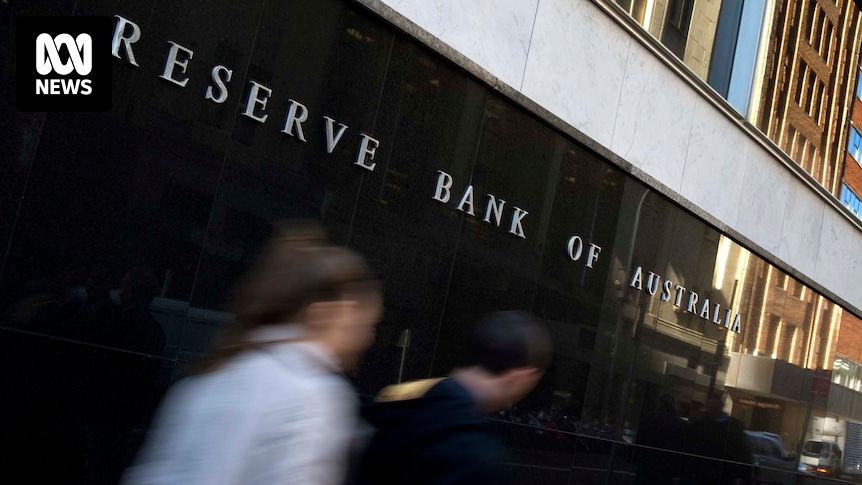
The deputy governor of the Reserve Bank has confirmed the news mortgage borrowers would not have wanted to hear — interest rates are highly unlikely to head lower anytime soon.
In an exclusive interview with ABC News, Andrew Hauser said it was “still true” that Australians had very likely seen the last rate cuts this cycle.
In December, RBA governor Michele Bullock effectively ruled out a rate cut for the foreseeable future and said the central bank’s board had only weighed up keeping rates on hold or raising them.
“The governor said … that the likelihood, at least in the near term, of further rate cuts was probably very low,” Mr Hauser said on Thursday.
“That’s still true, I think, if I’m honest with you.
“I know that won’t be the message that everyone watching this will want to hear.”
Andrew Hauser joined the RBA in 2024 from the Bank of England. (ABC News: Adam Wyatt)
The RBA deputy reiterated that the central bank’s priority was ensuring inflation remained on target, between 2 and 3 per cent.
The consumer price index (CPI), released yesterday, showed headline inflation running at 3.4 per cent in the year to November, while the RBA’s preferred measure of underlying inflation, the trimmed mean, was at 3.2 per cent.
“I think we all remember the pain and the difficulty, many of us are still working that through, of that persistent high period of inflation over the last few years,” Mr Hauser said.
“It’s our job to ensure that doesn’t happen again.”
Inflation too high, but ‘not a lot of news’ in this week’s data
Reactions to Wednesday’s inflation data were mixed, after the CPI eased back more than many economists had forecast.
Mr Hauser talked down the significance, however, describing it as “helpful” but “largely as we expected”.
“Inflation above 3 per cent — let’s be clear, it’s too high,” he said.
“We wish to keep inflation between 2 and 3 per cent, that is currently above that.”
Mr Hauser said there “wasn’t a lot of news in the data yesterday for us”.
He said inflation coming down partly reflected the Black Friday sales in November, but measures around the costs of housing picked up.
“Most of those numbers were broadly in line with our expectations.”RBA takes one-to-two-year view on inflation: Hauser
Mr Hauser also emphasised that the RBA did not target inflation as it stood currently.
“We’re trying to target inflation in a year or two years’ time and judging the outlook for inflation.”
He said that judgement did not just include the current level of inflation, but also “on the pace of demand and conditions in the labour market, on global conditions … and five or six other variables”.
Inflation cools but February ‘remains in play’
November was just the second set of full monthly CPI data released by the Australian Bureau of Statistics (ABS).
The ABS will release the December quarterly CPI data at the end of January, giving the central bank another inflation update before its next meeting.
“We will be waiting for the quarterly inflation number in two or three weeks’ time before we take a view on where we think inflation is today,” Mr Hauser said.
As for what that number would need to be to prompt a rate rise, Mr Hauser offered a tongue-in-cheek response.
“How rude can I be on the ABC?” he asked.
“But we are not targeting Q4 2025 inflation … you can’t even target inflation a quarter out.
“You’re targeting the whole time inflation out a year to two years, and that informs making a judgement.”
The deputy governor said if the number was “spectacularly high or spectacularly low, we’d have to ask ourselves what was driving that, and that might be an important part of our overall judgement”.
“But we don’t have a rule that says if it’s 0.9 we hold, and if it’s 1 we raise and if it’s 0.7 we cut — we take a view of the whole economy.”
RBA’s quandary: To hold or to hike?
Asked about market pricing for the February meeting, which currently sits around two-thirds for rates to remain on hold and one-third for a rate hike, Mr Hauser said he would not comment on whether it was “a sensible estimate of the outcome”.
“It’s true, as you say, that markets are not placing 100 per cent weight increase in February … you pay your money, you take your choice.
“It’s what financial markets have assumed.”