
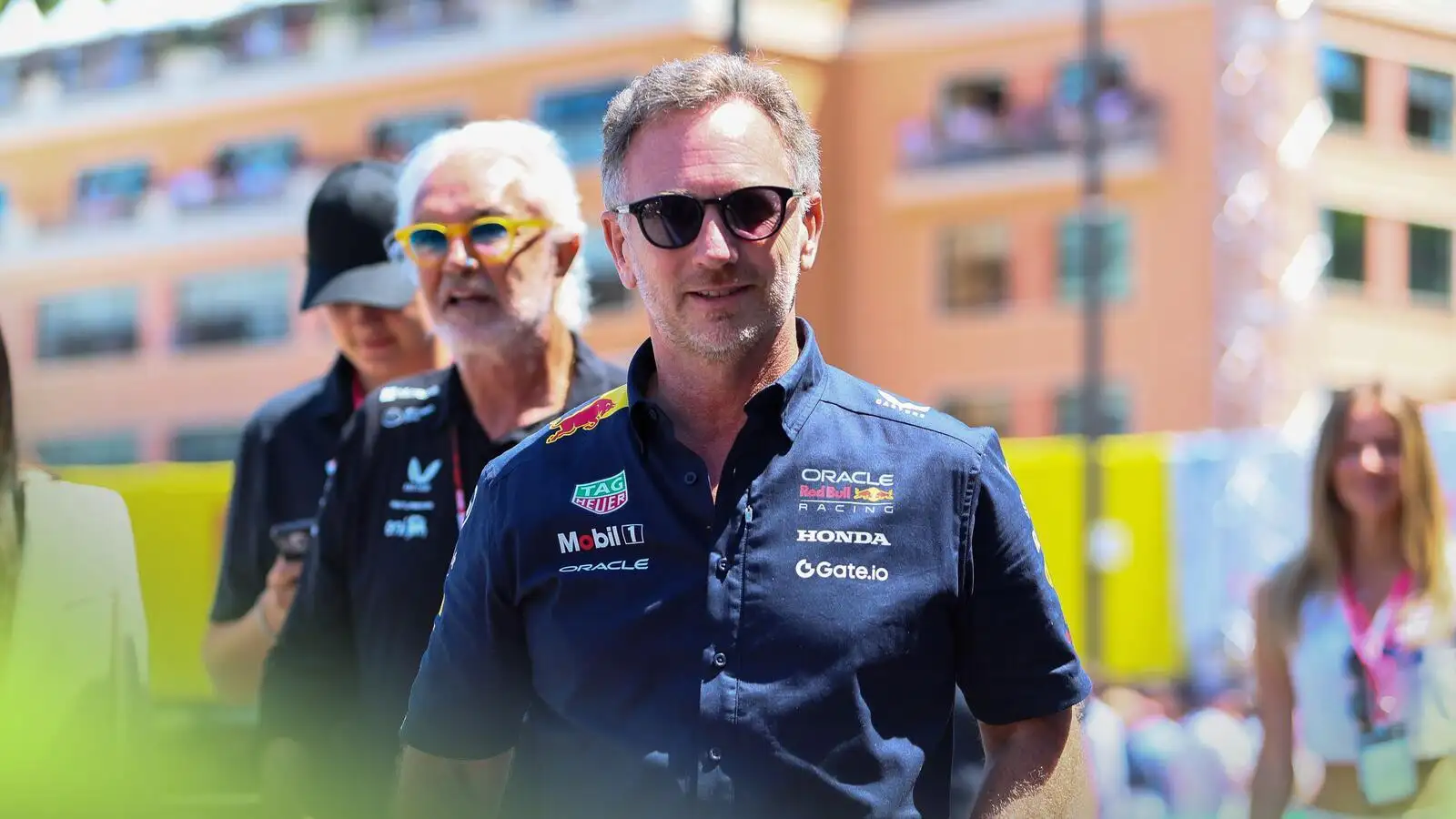
Christian Horner’s return to the Formula 1 paddock could take longer than expected after PlanetF1.com discovered key company documents that could leave him exiled until at least September.
Having been sidelined since last year’s British Grand Prix, the ex-Red Bull boss will be free to return to work within F1 in the coming weeks, should an appropriate opportunity present itself.
Alpine document reveals possible Christian Horner acquisition timeline
Want more PlanetF1.com coverage? Add us as a preferred source on Google for news you can trust.
Horner is one of the most decorated team principals in F1 history, having amassed eight drivers’ and six constructors’ world championships during his two-decade tenure at Red Bull.
Since being axed in the days that followed the British Grand Prix, he has kept a low profile, but is known to harbour interest in an F1 return.
What that looks like remains unclear, though it’s expected it will see him take on a more senior position than he previously held. In addition, it’s understood he considers ownership of the team – even if only a slice of it – a key factor.
Given that criteria, there are two clear candidates: Alpine and Aston Martin.
Of the two, the latter appears to offer the fastest route to success.
It has expansive new facilities, including a state-of-the-art wind tunnel, and workforce that has been supplemented with some big-name arrivals in recent months.
Headline among those is former colleague Adrian Newey, who was tempted from Red Bull with promise of becoming a shareholder at the team that is now Honda’s factory operation.
In many ways, the ingredients are there, waiting for someone to blend them together – something Horner is demonstrably capable of. Moreover, team owner Lawrence Stroll has shown he’s willing to part with equity, but whether that is the challenge that appeals is unknown.
Publicly it has continually reaffirmed that it is not for sale and is fully committed to F1 and has rejected bids of more than $1billion.
As an organisation, Alpine has underperformed in recent seasons and is well positioned for transformation – much as Stroll has instigated at Aston Martin.
Those tasks are not the work of a moment but, over a period, would build not only the team into a more robust competitor but also add significant value to its bottom line.
Hence, acquiring it now, when it is arguably at its lowest ebb, makes a good deal of sense.
Stoking the flames of a Horner-Alpine tie up are reports that its minority investor, Otro Capital (as part of a consortium), is interested in selling.
That consortium acquired a 24 per cent stake in the F1 team in mid-2023 suggesting there is – or at least was – a degree of willingness on Renault’s part to share ownership.
The 24 per cent stake cost Otro €200million (around $216m) in June 2023, with the team as a whole valued at the time at about $900million.
In November 2025, Forbes suggested the team was worth in the region of $2.45billion, a sum which values Otro’s piece of the pie at $588million – a ROI of 170 per cent in little more than two years.
It is therefore logical that Otro offloads its slice to Horner.
However, company documents obtained by PlanetF1.com reveal it is not that simple.
More on Christian Horner
Christian Horner ‘went through fire for me’ as Verstappen opens up on Red Bull sack
Is Christian Horner the final piece in Adrian Newey’s Aston Martin masterplan?
While Horner is thought to have secured sufficient funding to make such an acquisition, and Otro is apparently a willing seller, there are clauses which dictate how – and when – a sale can take place.
Documents discovered by PlanetF1.com specifically note that the sale of Otro’s stake to a third party can only occur “after the date which is three (3) years after the date of adoption of these articles.”
The document is dated September 13 2023.
Furthermore, it outlines that the sale can only proceed with the approval of Renault.
Put another way, Horner cannot directly acquire Otro’s slice in the Alpine F1 team until mid-September and, even then, any such deal must be be approved by Renault Group first.
That is not to say Horner to Enstone is dead in the water, but it highlights a layer of complexity to a process that otherwise seems straightforward.
It also arguably explains why the apparent urgency to return to the F1 paddock has seemingly cooled from the Horner camp.
Of course, this relies not only on Horner’s interest in acquiring a slice of Alpine, and specifically Otro’s share, but also on Otro selling out and Renault green-lighting the deal.
There is still strong room for growth within the team, a process that will be accelerated if the 2026 car proves more competitive, should Otro be willing to hold its stock a while longer.
A 170 per cent ROI is extraordinary, and there’s strong suggestions indicating it will only rise, though the rate is likely to slow.
Of course, Renault could equally decide that it doesn’t want a minority partner and buys back the holding, a move that would seemingly close the door on a Horner buy-in.
In any case, it’s unlikely we’ll see the ex-Red Bull boss at Enstone in any sort of ownership capacity until the Azerbaijan Grand Prix. If at all.
Want to be the first to know exclusive information from the F1 paddock? Join our broadcast channel on WhatsApp to get the scoop on the latest developments from our team of accredited journalists.
You can also subscribe to the PlanetF1 YouTube channel for exclusive features, hear from our paddock journalists with stories from the heart of Formula 1 and much more!
Read next: Toto Wolff outlines future Mercedes intent to cut customer engine supply