
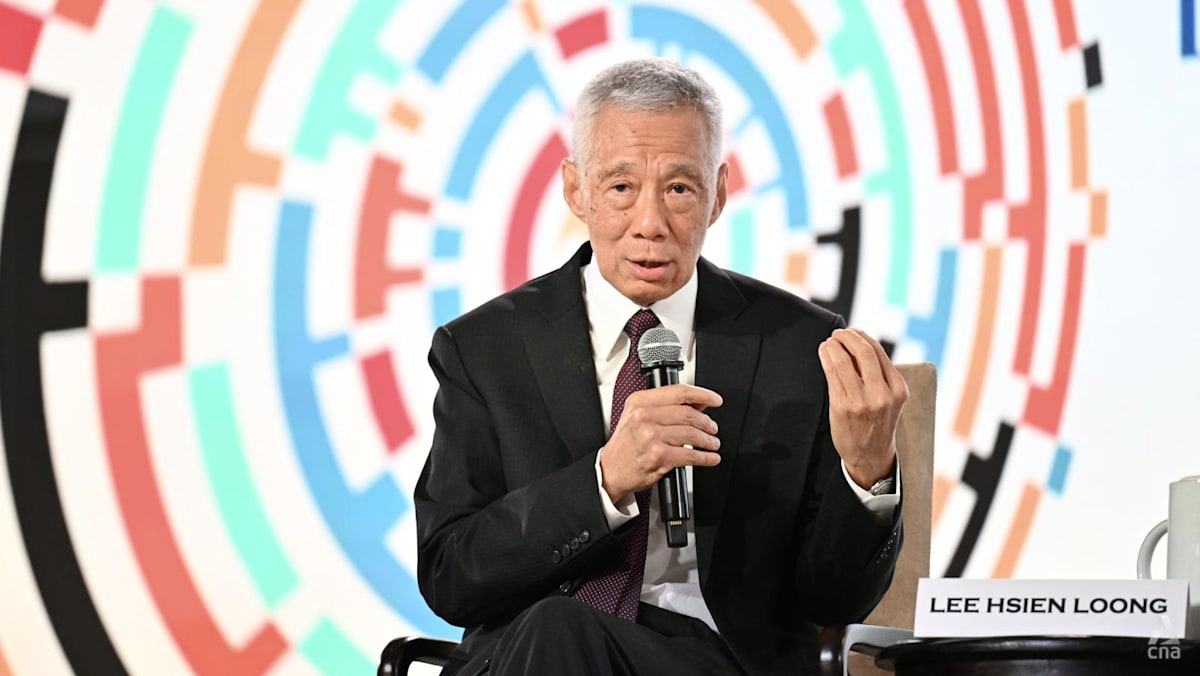
To this end, he raised the examples of ASEAN “diligently working” to cooperate on the economy, infrastructure and the digital economy.
“But at the same time, ASEAN countries have some very difficult problems to resolve. Some of them – Myanmar internally, Thailand and Cambodia with an armed conflict – not really fully resolved,” said Mr Lee.
“ASEAN has to try and resolve them with some difficulty.”
During the dialogue, Mr Lee was asked by Prof Chan whether the US’ and China’s involvement in resolving the conflict between Thailand and Cambodia sets a future trend of conflict settlement within the bloc.
Mr Lee said in response that while ASEAN can influence its members, it does not have “absolute influence”.
“ASEAN is not a supranational body with executive powers – it does not direct its members; it cannot override its members; it works by ASEAN consensus. It is a famous principle, we pride ourselves on it; it is the reason we are able to get along together,” he said.
The 11 member countries all have different policies, priorities, histories and security concerns, so it is not possible for them to operate like one country, he said.
The greatest power and influence actually goes to those who trade with the bloc the most, said Mr Lee. Intra-ASEAN trade among the bloc’s members constitutes only about 20 per cent of their international trade, he noted.
“Our biggest trading partners are with the developed economies − America, foremost amongst them. And in our region with China. And that is where influence can come,” said Mr Lee.
“Apart from the economy, there are also many other ways in which the major powers can exercise influence on ASEAN members. So, it is not surprising that the major powers are able to nudge, encourage, advise, even coerce other countries to do something which they would like to do, to some extent.”
However, even those major powers may not necessarily be able to solve all problems. For instance, the Thai-Cambodian issue goes back historically hundreds of years, and are not “issues which will go away”, said Mr Lee.
“But it is a reality that foreign, external powers have influence over ASEAN countries, and ASEAN has to work together despite that. And in many areas, we are still able to do so. It is a valuable organisation for all of us,” he said.
Another issue in the region which Mr Lee said will likely remain is the Myanmar situation, where elections are ongoing amid a humanitarian crisis.
“We hope that they will be able to find their way forward and work out a solution which will lead to a government which will work,” he said.
Mr Lee also clarified what the guiding principle of ASEAN centrality means in response to a question about the bloc’s role.
“I think centrality has become a term of art. What it means is that we convene a meeting, people come. And it is quite useful that we can convene a meeting because they come and meet each other and discuss with us,” he said.
“It does not mean that we are centrally directing matters even amongst ourselves, much less the rest of the world. You must not mistake a word for reality.”
UNEXPECTED EVENTS
Looking back at the “black swan” events he faced during his time as Prime Minister from August 2004 to May 2024, Mr Lee said that the 2008 global financial crisis and the COVID-19 pandemic were the two that came to mind.
“In both cases, it came quite suddenly. The impact on us was very great, and we had to prepare the population for the impact psychologically, as well as do things which were within our power to secure ourselves and secure our people’s livelihoods and lives,” he said.
“Fortunately, with resources and with support from the people, and with unity, we were able to do that, and come out in both cases, much less scarred than we feared.”
When asked by a member of the audience, former Malaysian Deputy Minister for International Trade and Industry Ong Kian Ming, if Dr Mahathir Mohamad’s return as Malaysian prime minister for a second time was also a “black swan” event, Mr Lee said that “we did not expect what happened in 2018”.
“Some cooperation projects were reconsidered − some continued, some did not. Some new projects which we had hoped to work on, they may not have taken off yet,” he said.
“But well, external policy always depends on domestic politics. If the domestic politics does not support it or does not give you the bandwidth to make major external decisions, well, that is just the way it is, and we have to wait until the politics enables things to restart.”
Mr Ong also asked Mr Lee about how the Singapore government responded during the period from 2018 to 2022 – when Malaysia saw four different prime ministers in office – and whether that experience left Singapore prepared for a Malaysian prime minister from the Parti Islam Se-Malaysia.
“I think whoever forms the government in Malaysia, we have to work with them, just as whoever forms a government in Singapore, you have to work with us,” said Mr Lee, adding that both sides have very different systems.
Singapore is multiracial and operates on the basis of equal opportunity and meritocracy, while Malaysia has a race-based political system based on the bumiputera policy, he said.
“It is the fundamental difference between our two countries. And I think therefore, the relationship is complex, but we have found ways to coexist and to cooperate despite that, and I am quite confident we will keep on doing that,” said Mr Lee.
Asked by Prof Chan if he had fun in his time as Singapore prime minister, Mr Lee laughed and said that he did not think “it is quite the right mindset with which to approach the job”.
“But it is a challenge, and it is one which you look forward to. There is a problem, and we can do something about it – let us move. I think that is a good feeling,” he said.