
This year’s Hart Trophy race doesn’t look too deep, on the surface at least.
Nathan MacKinnon and Connor McDavid are once again putting on a show and proving to be the most valuable players in the league. MacKinnon leads the entire league with a plus-18.9 Net Rating, and McDavid is catching up after a slow start with a plus-16.6. These two dominate play on a nightly basis, on the scoresheet and below the surface. So there really isn’t any reason to get too cute about it: MacKinnon and McDavid currently stand as the most valuable players in the league and to their respective teams.
But what about the players who don’t have as much support around them — the ones whose individual efforts are the driving force behind their team’s success and playoff chances?
Think back to last spring: Zach Werenski and Nick Suzuki technically weren’t the most valuable players in the league — Connor Hellebuyck, Leon Draisaitl and Nikita Kucherov instead drove that conversation. But Werenski was the Columbus Blue Jackets’ best player, while Suzuki was at the heart of the Montreal Canadiens’ turnaround — and that earned players some down-ballot votes.
The 2023-24 race was even tighter at the top, between MacKinnon, Kucherov, McDavid and Auston Matthews. But Roman Josi got some votes behind that quartet, after his all-around game helped fuel the Nashville Predators’ playoff push.
And this year, there are similar standouts behind the McDavid and MacKinnon of it all who are creating space for themselves in the MVP race.
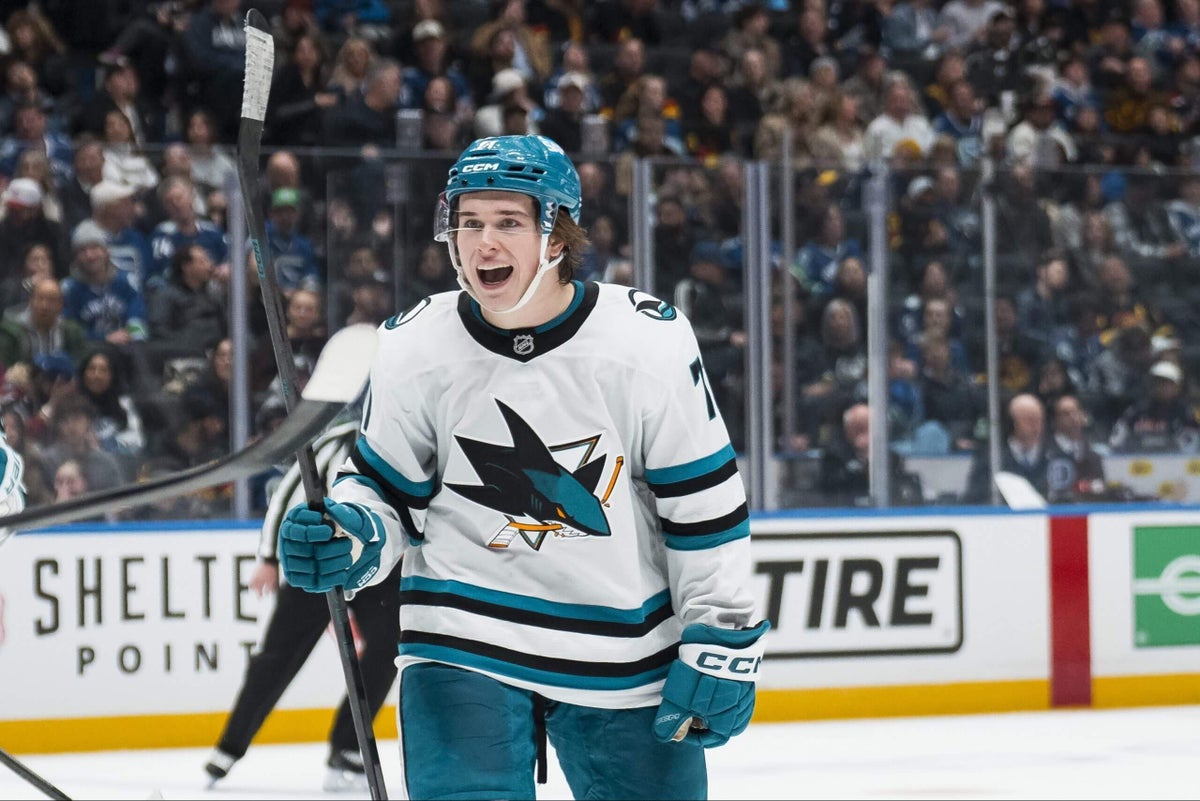
Macklin Celebrini, San Jose Sharks
No one expected the Sharks to be anywhere near the playoff picture this year, let alone in the first wild-card seed. San Jose was originally projected to finish 31st in the league with 73 points. Now, the team should finish somewhere in the 80-point range, and its playoff odds are up to 26 percent — and Celebrini is the biggest reason why.
While there’s a seven-point gap in the scoring race between second (MacKinnon) and third (Celebrini, with 67 points in 43 games), it’s still impressive that a second-year player is that high on the list. And that second-year player is on pace for 127 points across an 82-game season. For context, that threshold has only been crossed six times in the last 10 years (by four players: McDavid, MacKinnon, Kucherov and Draisaitl).
Celebrini is the driver in San Jose, and that’s helping lift the team around him — especially over the last month-plus of action. Since December 1, the Sharks have earned a 57 percent xG rate in his minutes, thanks to how Celebrini controls five-on-five play. It starts with his ability to break the puck out of his own zone with control, transition up the ice, and turn those entries into scoring chances. He sets the pace of play in the offensive zone — he can slow play down or glide around the offensive zone with the puck on his stick to create time and space. And he can up the tempo to generate crafty passes and shots.
That has boosted the Sharks’ expected goal generation by plus-0.25 to 2.78 per 60 ahead of Wednesday night’s game in L.A., and that’s translating to the scoresheet at an even higher clip. San Jose has scored 4.08 goals per 60 with their rising star on the ice — a rate that ranks 14th in the league. The Sharks have scored 1.31 more goals per 60 with Celebrini relative to the rest of the team, which is the sixth-best relative mark in the league.
Relative marks like that tend to come into consideration for voters, who need to see a clear distinction between MVP candidates and their next-best teammates. Celebrini doesn’t have the support of a Cale Makar or Draisaitl to build his case. He doesn’t even have an Alex DeBrincat, as Moritz Seider does in Detroit. The next highest Sharks scorer in San Jose behind Celebrini’s 67 points is Alexander Wennberg, who sits 37 points back with 30 in 33 games. Wennberg’s plus-2.3 Net Rating is the next best behind Celebrini’s plus-11.4, which is a difference of nine goals.

The Colorado Avalanche, on the other hand, have three players in the top 15 in Net Rating. The Edmonton Oilers and Tampa Bay Lightning both have two players in the top 10. In San Jose, it’s Celebrini … and a cast of up-and-comers and supporting players. And that difference was especially clear in December, when the star center stepped up offensively to help the Sharks outscore some of their goalie woes.
Moritz Seider, Detroit Red Wings
Like Celebrini, Seider’s place in the Hart Trophy conversation hinges on the Red Wings’ playoff picture. That’s a reality for most players in the MVP race, especially those on the tier below McDavid and MacKinnon. It’s what likely held Dylan Larkin off a few ballots in the No. 4 and 5 slots in each of the last two seasons.
Defensemen have an even tougher hill to climb to get consideration; they are generally left to fend for just one award, the Norris Trophy. Chris Pronger was the last blueliner to win the award back in 2000 — and also the last to finish in the top three in voting. Before that, the last winner was Bobby Orr in 1972.
There is a difference between being MVP-worthy and checking off all the boxes as the best all-around defenseman. Seider legitimately fits in both discussions as the Red Wings’ backbone.
His defense is the trademark of his game. Seider takes on a heavy workload; he goes head-to-head with the league’s best offensive threats and is tasked with some of the most defensive starts in the league. The Red Wings’ No. 1 shuts down his opponents despite that. He denies entry into the offensive zone, closes passing lanes and blocks a lot of shots to limit his opponents to just 2.30 xG against per 60 (and 2.18 goals against). That five-on-five defense, along with his penalty killing, contributes to a plus-6.4 Defensive Rating that ranks third in the league.
The difference now, compared to years past, is that he isn’t just a defensive plus — he is an all-around threat. The offense may not be as game-changing as Makar’s, but he is still helping facilitate play with a 58 percent xG rate and a 43-30 scoring edge in his five-on-five minutes. All together, he has a plus-12.8 Net Rating that ranks fourth in the league.
What adds to his case is how drastic the downswing Detroit suffers is when he’s on the bench. The Red Wings’ xG differential jumps by 0.76 per 60 with Seider deployed, which is third in the league, and their goal differential improves by plus-12.3.
Without him, the team allows opponents to drive right to the quality areas, the offense is suppressed and the Red Wings have been outscored 64-37. As Dom Luszczyszyn outlined in this week’s Awards Watch, his relative metrics are going to be extra jarring compared to, say, Makar’s, because of the quality of the team around him. Prashanth Iyer measured that earlier this season, with the Red Wings having a major gap between their No. 1 and 2 on the back end, let alone the rest of the bottom four. That same sentiment applies to Celebrini when comparing his numbers (and level of support) to McDavid and MacKinnon.
So two things are important here: the context has to be kept in mind, but Seider also has a game-changing impact on the Red Wings’ five-on-five play.
Ilya Sorokin, New York Islanders
The retooling Islanders have exceeded expectations all season. Matthew Schaefer has done more than make an immediate impact at the NHL level — he has been absolutely fantastic so far, while Mathew Barzal and Bo Horvat have led the way up front. But the Islanders’ MVP has to be Sorokin, who has been brilliant in 25 appearances so far.
Sorokin’s numbers through 25 games are sparkling. He is rocking a .915 save percentage and leads the league with 31 goals saved above expected. In past seasons, those numbers would have been chalked up to the Islanders’ defensive structure … but this is not Barry Trotz’s shutdown group anymore. This team has been a bit leaky this season in terms of shots and scoring chances against, but Sorokin has stood tall behind a challenging workload. That has been especially true on the penalty kill, which is where about a third of his GSAx is from.
Sorokin has given the Islanders a chance to win with a quality start in 20 of 25 appearances this season, or 80 percent of his starts, which is incredibly efficient. He has outright carried his team with seven stolen wins, too — without those 14 points, New York would be closer to 40 points and at the bottom of the Eastern Conference standings.
UNREAL SAVE BY SOROKIN 🤯 pic.twitter.com/jlMMFRYOLJ
— Sportsnet (@Sportsnet) November 17, 2025
Goalies, like defensemen, typically aren’t fixtures in the Hart race. But the reigning winner is Hellebuyck, and in 2021-22, Igor Shesterkin finished third in voting. So the appetite is starting to change, which could open the door to more Sorokin hype. It just will come down to whether 1) he can keep this up across a full season (which he has the chops to do), and 2) it’s enough to push this team into the playoffs.
Zach Werenski, Columbus Blue Jackets
A few other defensemen have been on the fringes of the Hart conversation at points this season. Rasmus Dahlin could find himself in the picture, thanks to his stabilizing all-situation play, if the Sabres can build on their win streak with more sustained success. Adam Fox’s two-way play could have built toward a nod, too, if he didn’t just land on LTIR for his second injury stint of the season. Instead, the defenseman to watch is Werenski for the second straight year.
Werenski is showing last year’s scoring wasn’t a fluke. With 45 points in 38 games, he is actually scoring at a slightly higher pace than last year, for a new career-high rate of 2.67 points per 60 — and that’s despite the Blue Jackets’ power play struggling to convert on its chances consistently this season.
Instead, that scoring is primarily coming at five-on-five. Shooting almost 11 percent is somewhat of a red flag, but there is a ton of substance below the surface (3.28 xG per 60) to support it. While Werenski doesn’t have the offensive support of other top defensemen, he can create a lot himself. He thrives in transition; his zone entry numbers are on another level this year, which has provided a real spark in Columbus, along with his shot volume. That offense has continued to shine while shouldering a tough workload. It adds up to a plus-10.8 Net Rating that ranks ninth in the league.
Werenski’s road to Hart contention is tricky for a few reasons: the defensemen problem, Seider and Makar ahead of him, and the Blue Jackets’ positioning at the bottom of the Eastern Conference. But if Columbus can go on another run this year, Werenski will once again be the engine behind it.
— Data via Evolving-Hockey, HockeyViz, HockeyStatCards, All Three Zones, Dom Luszczyszyn and Natural Stat Trick. This story relies on shot-based metrics; here is a primer on these numbers.