
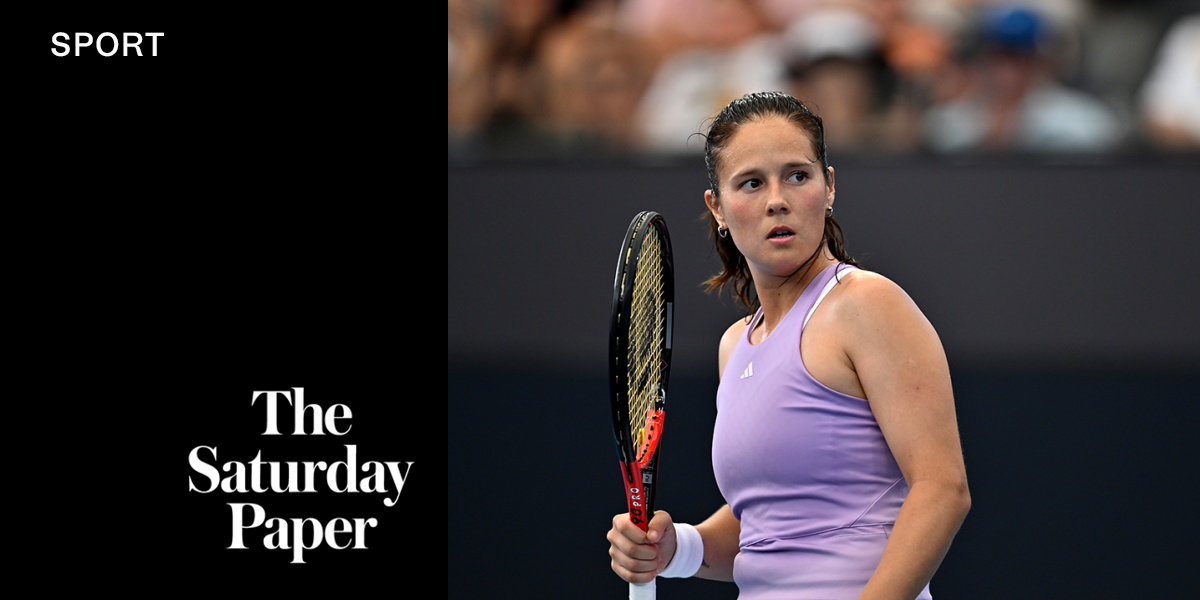
On an uncharacteristically sizzling July day back in 2018, talented Russian Daria Kasatkina could hardly have foreseen that her Wimbledon third-round performance would help to change the course of women’s tennis. As London baked, a similarly hot Ash Barty, the in-form grass-courter of that season, won four of the first five games before imploding, eventually being beaten in straight sets.
Only the next year, when Barty broke a 46-year drought for Australian women at the French Open by claiming her maiden singles major, did Kasatkina – and the tennis world – start to understand the full ramifications of that come-from-behind win. “Thanks to me … after that Ash was the big pain in the ass for everyone,” she later acknowledged with a smile.
Barty’s response to that self-described “rock bottom” moment at the All England Club in 2018 – among other things, she hired renowned mindset coach Ben Crowe – was a major catalyst for her determined ascent to the world No. 1 ranking she held for 121 weeks. Then, after adding the 2021 Wimbledon and 2022 Australian Open titles for a glittering CV, the Queenslander announced her sudden retirement at age 25.
Now, as Tennis Australia – despite its soaring profits and vast resources – struggles to fill the void among its female ranks, Daria Kasatkina is once more making local headlines, but no longer as the opponent of a favourite daughter. The former world No. 8 and semi-finalist in the 2022 French Open has played under the Australian flag since securing permanent residency in March. She is now preparing to represent her adopted nation in a home grand slam for the first time.
With a current world ranking of No. 40, Kasatkina admitted after last Sunday’s first-round loss at the Brisbane International – to another Russian-born player, Austria’s Anastasia Potapova – she was feeling the self-imposed pressure and responsibility of her new status. “I want to pay back to the country,” she said.
Tennis aside, the 28-year-old was motivated to leave Russia for intensely personal reasons.
She had cited concerns for her safety on two fronts. First, she is an openly gay woman, engaged to retired Olympic silver-medallist figure skater Natalia Zabiiako. LGBTQIA+ activism is effectively illegal in Russia, and Kasatkina has not visited her homeland since coming out in 2022. Second, she has publicly condemned Russia’s invasion of Ukraine.
Indeed, Kasatkina cut her season short in October to prioritise her fragile mental health after reaching “breaking point” during a hugely challenging 2025.
“I’ve been far from fine for a long time and, truth be told, my results and performances show that,” Kasatkina posted on social media, citing the “emotional and mental stress” of the nationality change, family separation and a demanding schedule. “Truth is, I’ve hit a wall and can’t continue. I need a break.”
“Considering how small our country is and how hard it is on the world stage to get the competition we need, I think we’re doing all right.”
In Brisbane last week, she said of her defection, with the citizenship process still incomplete: “It was the most important decision in my life, but I would choose it 100 times out of 100 times … I’ve been accepted here as the person I am. I can feel safe here. Not everywhere you can feel that.”
Kasatkina isn’t the only imported player to switch their allegiance to Australia now that Barty is committed to what she recently called her “happy, boring” life at home. There is a distinctly international flavour at the top of Australian women’s tennis, as the three singles players ranked in the top 100 have all previously represented another country.
Rising star and world No. 32 Maya Joint is a Michigan-raised teenager on the cusp of a debut grand slam seeding. Her father, Michael Joint, was born and raised in Melbourne before his career as a professional squash player took him to the United States. Unhappy with the backing she was getting from the US Tennis Association, Maya sought financial and training support from Tennis Australia in 2023.
So too Croatian-born veteran Ajla Tomljanović, who has played with “AUS” beside her name since switching allegiances in 2014. Tomljanović peaked at world No. 32 before a knee injury contributed to a dip to her current slot of 78th.
Rennae Stubbs saw the Kasatkina move coming. While at Indian Wells commentating for ESPN in March, the Australian former doubles world No. 1 noticed the Russian’s management team meeting with key Tennis Australia officials. In fact, a few months earlier they’d had secret discussions at Melbourne Park with TA chief executive Craig Tiley.
“I was like, ‘What’s going on over there?’, and I called it before it happened,” says Stubbs, whose own public coming out was through a far less hazardous interview with this reporter on the Gold Coast two decades ago.
“I was super happy for that, but also because she’s that type of personality that would really embrace being ‘free’. [Given] the situation in Russia … and being gay and speaking up against the government, it didn’t surprise me at all.
“I feel like in a lot of ways we’ve kind of saved her, and that to me is what our country is about … For someone like Kasatkina, who must have felt like she was a bit in limbo about her life in general, I feel really good that we gave her this opportunity.
“This is a former top 10 player in the world, and hopefully we utilise her in a way that helps our other kids get better and better. I always say to use [imports] as resources, so take the time to go and talk to her. And she’s so lovely and open, she would be willing to pass on her own experiences.”
While Stubbs sings the praises of these adoptees, she remains positive about Australia’s homegrown talent.
The brightest prospect is 17-year-old Queenslander Emerson Jones, a former world No. 1 junior who has already achieved a WTA ranking of 147 and earnt an Australian Open wildcard via the local pro tour. Jones joins the more seasoned Kim Birrell and Priscilla Hon, plus promising Western Australian duo Talia Gibson and Taylah Preston, in the main draw.
All eyes will be on Jones’s transition from juniors to the big time – a difficult career stage for most. Even Ash Barty – a Wimbledon girls’ champion at 15 whose senior success came relatively quickly – was almost lost to tennis when she took a well-publicised break in her late teens.
Asked to rate the health of Australian women’s tennis, Stubbs, a six-time major winner in doubles and mixed doubles, first contextualises the achievements of Barty and 2011 US Open winner Sam Stosur.
“Considering how small our country is and how hard it is on the world stage to get the competition we need, I think we’re doing all right,” Stubbs says. “I would like for it to be much better, clearly, but it could be worse.”
Is enough being done to foster homegrown talent in the post-Barty era? And are imports necessarily a good thing? Kasatkina is the 10th woman to switch citizenship to Australia since 2000, continuing an influx dating back to Hana Mandliková in the late 1980s.
“As far as I’m concerned, if they’re on the world stage with the flag next to their name, I don’t see it as a bad thing,” says Stubbs. “As long as they’re playing Billie Jean King Cup [the women’s Davis Cup equivalent] and they’re representing [their adopted country].”
Stubbs says the important thing is for kids to see female players playing for Australia. “They’re not really thinking, ‘Oh, where have they come from?’ ” she says of the young tennis fans.
“And, frankly, if the Aussie girls that were actually born and raised in Australia aren’t cutting it inside the top 100, then I’d rather have [naturalised] Aussie girls in the third, fourth rounds of a major. Maya Joint’s a perfect example. Great mover. Unbelievably tenacious. She’s a true little battler and that’s what I love about her. She doesn’t have a huge game, but she just refuses to lose.
“Yes, it was a shame that Ash pulled the plug so early … But, at the same time, it comes down to what you want in your career and how hard you want to work and how much you’re willing to sacrifice, and I don’t know how much that’s going to come from TA throwing hundreds of thousands of dollars at a kid. In the end they’ve got to want it themselves.”
The dogged Kasatkina clearly has this mindset, while now also fielding questions about Vegemite and munching on media-supplied Tim Tams for the cameras at Wimbledon last year.
She was embraced by the Brisbane crowd to start her first summer as a local, despite the emotion of a disappointing result that included 16 double faults. Having “recharged” after spending much of October in what she calls “a really dark place”, Kasatkina believes she is mentally “on the good path right now”.
Next stop is the Adelaide International before a return to Melbourne Park from January 18 as the host nation’s new women’s No. 2. Kasatkina changed Ash Barty’s life more than seven years ago. Can a move to Australia now prove beneficial for Kasatkina too?
This article was first published in the print edition of The Saturday Paper on
January 10, 2026 as “Making her move”.
For almost a decade, The Saturday Paper has published Australia’s leading writers and thinkers.
We have pursued stories that are ignored elsewhere, covering them with sensitivity and depth.
We have done this on refugee policy, on government integrity, on robo-debt, on aged care,
on climate change, on the pandemic.
All our journalism is fiercely independent. It relies on the support of readers.
By subscribing to The Saturday Paper, you are ensuring that we can continue to produce essential,
issue-defining coverage, to dig out stories that take time, to doggedly hold to account
politicians and the political class.
There are very few titles that have the freedom and the space to produce journalism like this.
In a country with a concentration of media ownership unlike anything else in the world,
it is vitally important. Your subscription helps make it possible.
Send this article to a friend for free.
Share this subscriber exclusive article with a friend or family member using share credits.

Used 1 of … credits
use share credits to share this article with friend or family.
You’ve shared all of your credits for this month. They will refresh on February 1. If you would like to share more, you can buy a gift subscription for a friend.
SHARE WITH A FRIEND
? CREDITS REMAIN
SHARE WITH A SUBSCRIBER
UNLIMITED
Loading…
Sport
Sam Stosur’s legacy of grace
Martin McKenzie-Murray
There were no tantrums or histrionics, no blame games or brattishness in Sam Stosur’s tennis career. Nor was enough credit given to a genuine champion, both on and off the court.