
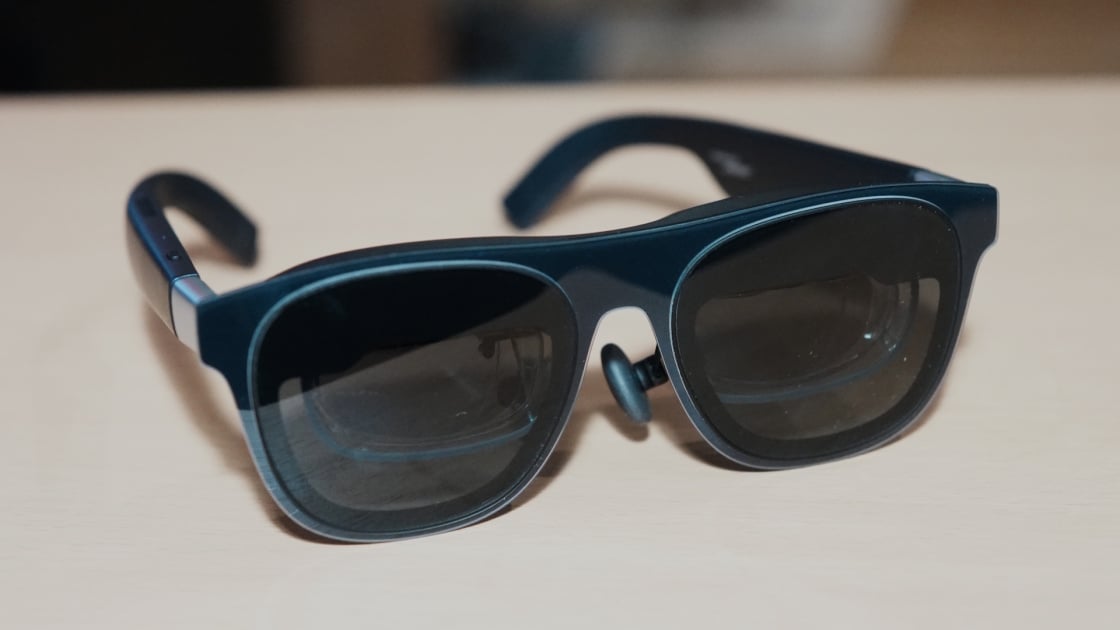
LAS VEGAS—XReal is at CES, unveiling two new pairs of AR smart glasses. The XReal 1S builds on the XReal One, adding Real 3D technology that converts any video or game into a 3D experience. It also introduces an ultrawide mode, a standout feature carried over from the excellent XReal One Pro. The second model, the ROG XReal R1, is the result of XReal’s partnership with Asus’ Republic of Gamers (ROG) and is billed by both companies as the first pair of smart glasses to support a 240Hz refresh rate.
Real 3D on the XReal 1S is surprisingly effective, especially with video games. Mario Kart World and Yooka-Replaylee both have a compelling sense of depth with the mode enabled, and even 2D platformers like Hollow Knight Silksong and Rogue Legacy 2 get a neat pop-out effect that makes the games seem like you’re playing them in a diorama. Considering none of those games are built for 3D displays, it’s impressive how the Real 3D processing handles them in the glasses.
Video converted to 3D is less impressive. I watched some of Fallout on the glasses, and while some shots showed a bit of depth, it was more subtle and less consistent than the games. One shot of a shade-darkened Lucy against the brightly lit wasteland was outright disorienting, because the Real 3D seemed to assume Lucy was the background and the wasteland was the foreground.
Even with games, I turned off Real 3D after 10 minutes or so. It did a number on the framerate, causing some stuttering and flickering. I also saw regular processing artifacts, and across the board, the general picture just looked less sharp than it did in 2D. I started getting a headache, which usually doesn’t happen with smart glasses. (I have experienced that with 3D glasses in theaters, and with TVs during the 3D TV fad of the early 2010s, though.)
There’s a lot of potential here, and XReal will probably improve Real 3D in future firmware updates. If the company can stabilize the framerate and reduce the video artifacts that come from the 3D processing, it could become a must-have feature. In fact, even though I got a headache, the Real 3D processing I tried on the S1 seems to be a bit less stuttery than an earlier version I tried during a demo a few months ago.
XReal Neo
My setup to use smart glasses with my Switch 2, which isn’t as clunky as it looks. (Credit: Will Greenwald)
I played the games on my Nintendo Switch 2, which doesn’t output video to any smart glasses out of the box. This was thanks to the XReal Neo, another new device the company announced along with the 1S.
The Neo is a combination battery pack and video adapter that allows XReal’s smart glasses to work with the Switch and Switch 2. It also provides a USB-C port to serve as a power passthrough, so you can keep your device and the Neo charged even while you use glasses with it. Most Android phones and all recent iPhones and iPads can work directly with smart glasses through their USB-C ports, but since they all only have a single port they can’t plug into a charger at the same time. Considering the frustratingly short battery life of both the Switch 2 and my iPad Air (which I used to test the glasses with Fallout), it’s very useful.

Get Our Best Stories!
Your Daily Dose of Our Top Tech News

Sign up for our What’s New Now newsletter to receive the latest news, best new products, and expert advice from the editors of PCMag.
Sign up for our What’s New Now newsletter to receive the latest news, best new products, and expert advice from the editors of PCMag.
By clicking Sign Me Up, you confirm you are 16+ and agree to our Terms of Use and Privacy
Policy.
Thanks for signing up!
Your subscription has been confirmed. Keep an eye on your inbox!

XReal 1S and Neo (Credit: Will Greenwald)
The XReal Neo isn’t the first device to let you use smart glasses with the Switch, nor is it the first to provide power passthrough. Viture and RayNeo already offer their own Switch-compatible docks with batteries, the Pro Mobile Dock and JoyDock, respectively. At 4.6 by 2.8 by 0.7 inches, however, the Neo is a lot smaller than the Pro Mobile Dock and JoyDock, both of which are closer in size to the original Switch (6.9 by 3.9 by 0.5 inches without Joy-Cons).
The Neo also foregoes the large plastic snap-on brackets of the other docks for a MagSafe-like magnet (sans charging functionality) and two sets of stick-on metal rings to put on your Switch or other device. The magnetic connection isn’t as secure as a chunky piece of plastic that locks onto your system, but it’s a lot less bulky and isn’t limited to fit around only one specific device.
Recommended by Our Editors
Besides the 3D, the 1S feels and works almost exactly like the XReal One Pro. It has the same 700 nits peak brightness and comparable color performance. While its 52-degree field of view is slightly bigger than the One’s 50 degrees, however, it’s noticeably narrower than the One Pro’s 57 degrees.
Asus ROG XReal R1
Asus ROG XReal R1 (Credit: Asus/XReal)
That brings us to the Asus ROG XReal R1 AR Gaming Glasses, which the companies say are the world’s first 240Hz AR smart glasses. The R1’s higher refresh rate is a boon for PC gamers with systems that can push framerates that high, and its 57-degree field of view matches the XReal One Pro was one of the biggest pictures for smart glasses.
The R1 uses the same X1 spatial processor as XReal’s other glasses, and features the same built-in 3DOF motion tracking that can anchor a virtual screen in space relative to your position to feel more immersive. It doesn’t have Real 3D processing, though, or an ultrawide mode. It does, however, have electrochromic exterior lenses, with a new automatic dimming function that darkens or lightens them in response to ambient light. I haven’t seen the R1 up close yet, but I’m keeping an eye out for them on the show floor here at CES.
The XReal 1S and Neo are both available starting today. The 1S is $449, $50 less than the original XReal One and $200 less than the One Pro, while the Neo is $99. Neither Asus nor XReal have announced pricing for the R1, but it’s scheduled to launch in the first half of 2026.
About Our Expert

Will Greenwald
Principal Writer, Consumer Electronics
Experience
I’m PCMag’s home theater and AR/VR expert, and your go-to source of information and recommendations for game consoles and accessories, smart displays, smart glasses, smart speakers, soundbars, TVs, and VR headsets. I’m an ISF-certified TV calibrator and THX-certified home theater technician, I’ve served as a CES Innovation Awards judge, and while Bandai hasn’t officially certified me, I’m also proficient at building Gundam plastic models up to MG-class. I also enjoy genre fiction writing, and my urban fantasy novel, Alex Norton, Paranormal Technical Support, is currently available on Amazon.