
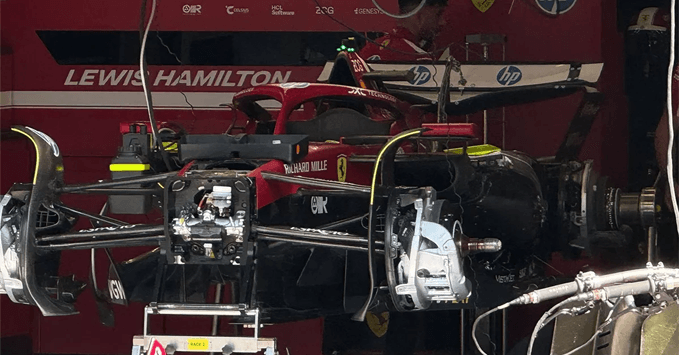
Ferrari is entering a new regulatory landscape that forces many long-standing principles to be carefully re-evaluated and, in some cases, fundamentally reconsidered. In Maranello, the upcoming technical cycle could be approached by deliberately moving away from several design choices that have defined the team’s recent Formula 1 cars. The new rules are not simply an evolution of the previous framework, but a clear break that obliges engineers to rethink priorities, concepts and even philosophical approaches to car design.
It is no longer a secret that the Ferrari to be unveiled at Fiorano on 23 January will be called SF-26, the car that must deliver a clear and convincing response after a disastrous 2025 Formula 1 campaign. Expectations are inevitably high, because the 2025 season represented a major setback for the Scuderia, both in terms of results and overall competitiveness. The Maranello team officially confirmed the name through a social media post, underlining its decision to remain consistent with its recent naming tradition and to preserve a sense of continuity at a time of profound technical change.
Project 678, as the red car that will take Ferrari into the era of more agile and compact single-seaters had been known internally until now, officially becomes the SF-26. This new car will be the eleventh Formula 1 project from Maranello to adopt the SF designation followed by the reference year, continuing a genealogical naming logic that has become familiar and recognisable for fans and insiders alike. While the name reflects continuity, the substance behind it points strongly toward a fresh start.
Expectations around the SF-26 are extremely high because this is the car that will introduce Ferrari to a completely new technical era. The competitive hierarchy seen during the ground-effect years from 2022 to 2025 could be radically overturned under the new regulations, especially after a disappointing season that ended with fourth place in the Constructors’ Championship. That result was widely considered unacceptable by Ferrari’s own standards and has increased internal pressure to react decisively.
The SF-26 will also be the first Ferrari fully overseen by technical director Loic Serra. The French engineer, appointed by team principal Fred Vasseur, has been tasked with guiding Ferrari back into the fight for race victories and championships alongside Charles Leclerc and Lewis Hamilton. The arrival of Lewis Hamilton at Ferrari has added further weight and visibility to this project, increasing both expectations and scrutiny from the paddock and the global fan base.
The introduction of a revolutionary power unit plays a central role in this transformation. The new regulations bring a power unit that combines a six-cylinder internal combustion engine with an electric motor of equal output, delivering a combined figure of around one thousand horsepower. This shift radically alters energy management, car packaging and performance distribution. Alongside the new power unit, the SF-26 is expected to be shorter, narrower and lighter than its predecessors, with active aerodynamics and slightly reduced tyre widths. Together, these elements offer Ferrari’s racing division a major opportunity for redemption and a chance to reset its technical direction.
As Formula 1 transitions into the new regulatory cycle, Ferrari, like the rest of the grid, is preparing for a shift that is not only regulatory but also deeply conceptual. The car could, and arguably should, return to a push-rod suspension layout. According to persistent paddock rumours, this configuration may be adopted at both the front and the rear, marking a clear departure from the SF-25, which instead featured a double pull-rod setup. Such a move would represent a significant change in philosophy compared to recent Ferrari designs.

This choice should not be interpreted as a nostalgic step backwards or a rejection of modern thinking, but rather as a rational adaptation to a technical environment that is fundamentally different from the one that defined the wing-car era. Suspension layouts are not adopted in isolation, but always in response to aerodynamic requirements, packaging constraints and performance priorities dictated by the regulations.
The 2022–2025 cycle forced teams into an extremely aerodynamic-focused approach, with cars heavily dependent on meticulous airflow management to feed a floor that demanded vast quantities of clean air to generate ground effect. In that context, every design detail was evaluated primarily through an aerodynamic lens. Any component that disrupted clean airflow towards the Venturi channel inlets became a potential weakness that could compromise downforce and consistency.
This is why solutions such as pull-rod suspensions, adopted by Red Bull from the very beginning of the ground-effect era and later increasingly copied by other teams, became so widespread. The pull-rod layout allowed engineers to keep suspension elements lower and reduce aerodynamic interference around critical airflow zones. Ferrari itself followed this trend, committing to pull-rod solutions in pursuit of aerodynamic efficiency.
From 2026 onwards, however, the picture changes dramatically. The removal of Venturi channels, the introduction of active aerodynamics and an overall reduction in downforce generated by the floor fundamentally shift where performance is extracted. Aerodynamics remain crucial to lap time, but they are no longer the sole or dominant source of performance. The balance between mechanical grip, energy deployment and aerodynamic efficiency becomes more nuanced and complex.
In this new scenario, the airflow disturbance created by a push-rod layout becomes far less significant and much less penalising than it was in the recent past. The aerodynamic compromises associated with push-rod suspensions lose much of their previous relevance, opening the door to alternative priorities.
This is where Ferrari’s technical reasoning comes into sharper focus. If aerodynamics no longer demand extreme solutions purely for airflow management, the quality and consistency of the mechanical platform once again become decisive factors. From this perspective, the push-rod layout offers several advantages that are difficult to overlook, particularly in a regulatory framework that aims to reduce aerodynamic dependency.
Among these advantages are greater accessibility for engineers and mechanics, more direct management of unsprung masses and, above all, superior setup flexibility thanks to easier access to key components. These characteristics are especially valuable over a long race weekend, where rapid and precise adjustments can make a meaningful difference.
Push-rod and pull-rod suspensions are ultimately two different ways of achieving the same fundamental objective. The distinction between them is not conceptual, but operational. Both systems are designed to control wheel movement, manage loads and handle weight transfer under braking, acceleration and cornering. However, they do so through different compromises in terms of packaging, adjustability and operational convenience.
In a technical framework where the operating window of the tyres has proven to be extremely sensitive, the ability to intervene quickly and effectively on suspension kinematics becomes a strategic asset. Tyre behaviour has been a recurring challenge across the grid, influencing performance swings between teams and even between sessions.
With its more traditional architecture and components positioned higher up, the push-rod layout allows greater freedom in suspension adjustment. This can be decisive under regulations explicitly designed to reduce so-called free aerodynamic load and to make cars more reliant on mechanical behaviour and driver input. A more adjustable suspension platform can help drivers like Charles Leclerc and Lewis Hamilton extract consistent performance across varying track conditions.
The SF-26 therefore emerges as the expression of a philosophy that treats simplification not as a limitation, but as an opportunity to refocus performance development. In a context where performance is no longer extracted exclusively from the floor and sealed airflow structures, the ability to adapt the car to track conditions, tyre degradation patterns and changing grip levels may prove more valuable than pursuing extreme aerodynamic detail.
This approach also aligns with the broader objective of improving predictability and balance, aspects that have sometimes been lacking in recent Ferrari cars. A car that responds consistently to setup changes can provide drivers with greater confidence and allow engineers to work within a clearer development framework.
Returning to a push-rod configuration is therefore not an act of conservatism, but a clear signal of shifting priorities within Ferrari’s technical organisation. In the new regulatory era, competitiveness may depend less on the obsessive search for perfect airflow and more on the capacity to build a predictable, adjustable and coherent car over a wide range of operating conditions.
It is precisely within this operational flexibility that Ferrari, through the work coordinated by Loic Serra, appears to be placing a significant part of its technical bet for the 2026 Formula 1 season. Loic Serra’s background and expertise lie in suspension design and tyre behaviour analysis, areas that are expected to regain prominence under the new rules. By focusing on these fundamentals, Ferrari aims to construct a car capable of delivering performance in a more robust and repeatable manner.
The SF-26, therefore, is not just a new car, but the tangible representation of a broader philosophical shift. It reflects Ferrari’s intention to adapt intelligently to a changing Formula 1 landscape, prioritising clarity, balance and mechanical quality as the sport enters a new era.
Jan 10, 2026Maria Lombardi
Let other Scuderia Fans know about us


