
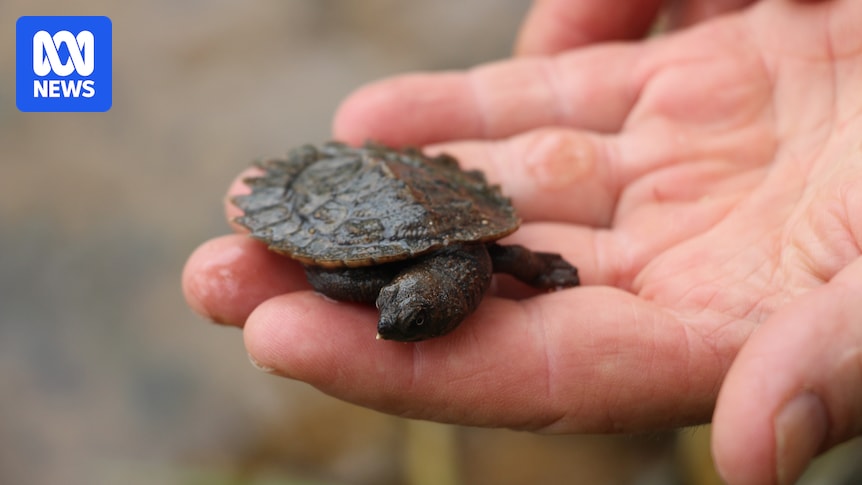
The hum of insects blends with the breeze whispering through the treetops, and the lapping water.
It is peaceful, but a sense of anticipation grows as Brad Crosbie approaches and opens a cage on a bank of the Burnett River.
“Sometimes, you can just push on the ground a little bit, just to see how close they are to emerging,” says Mr Crosbie, general manager of Bundaberg-based WYLD Projects.
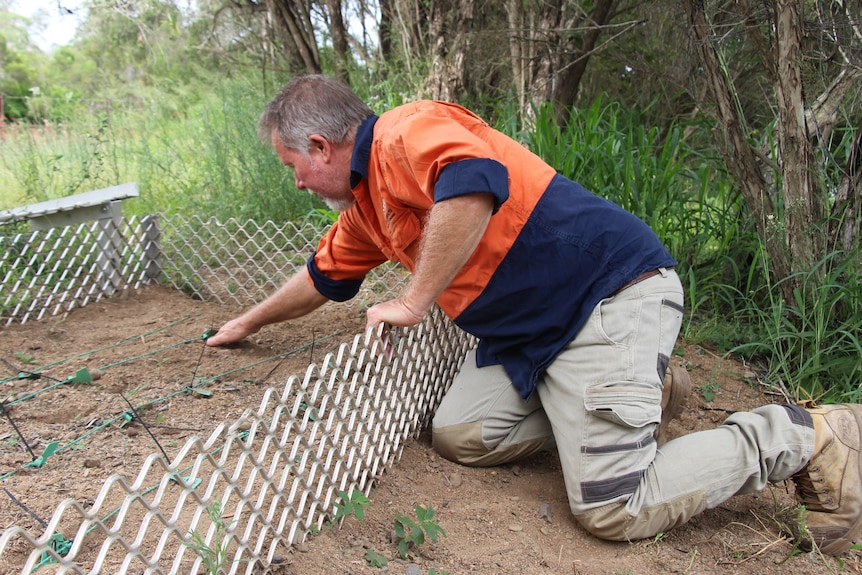
The turtle eggs were relocated to these cages. (ABC Wide Bay: Grace Whiteside)
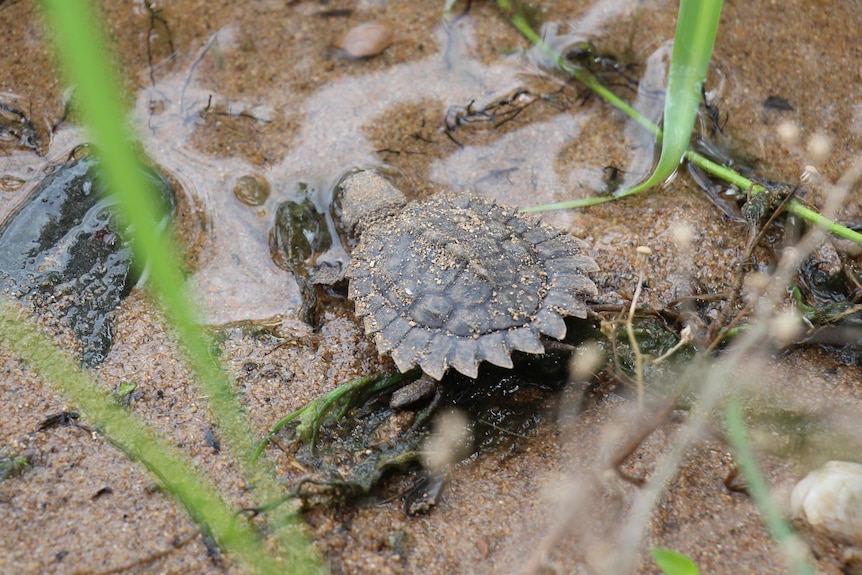
“That ground just collapsed, so now we’re looking at a critically endangered hatchling that’s been underground for six months — it’s super cool.”
Finding and relocating white-throated snapping turtle eggs is a key element of the work of not-for-profit WYLD (Where Youth Live Dreams) Projects.
The turtle’s scientific name is Elseya albagula. It is known as milbi in Taribelang Bunda language.
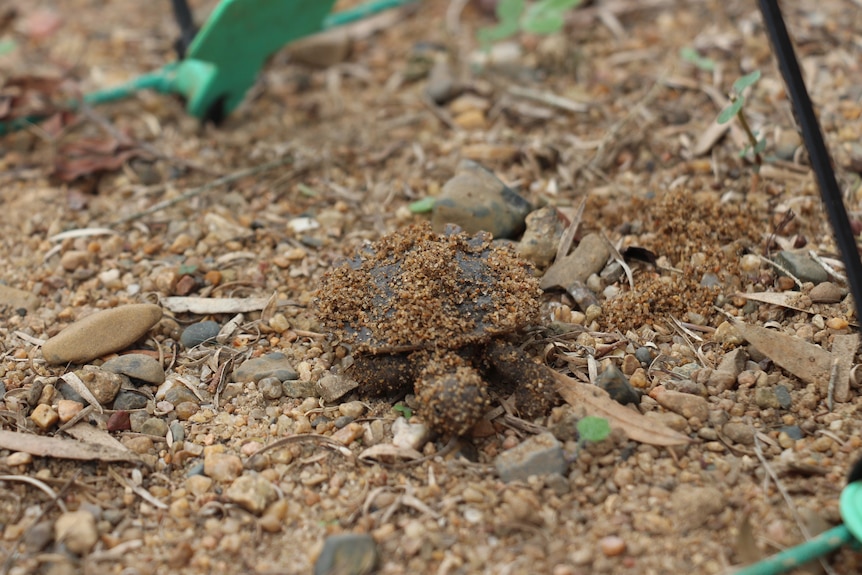
The milbi emerge from their nests in the evenings and at night. (ABC Wide Bay: Grace Whiteside)
The group found 187 clutches this season, and, while 93 had already been destroyed, the remaining 94 were relocated to cages.
In previous years, only 60 to 70 were able to be protected.
Mr Crosbie said this season had been “extraordinary”.
“We’ve never had this amount of clutches before in the last nine years.”
He said an explosion of dragonflies and cicadas signalled a strong laying season, as mothers primarily nesting during rain events.
“We’ve only worked this out in the last couple of years that they [dragonflies and cicadas] were indicators of big rain,” Mr Crosbie said.
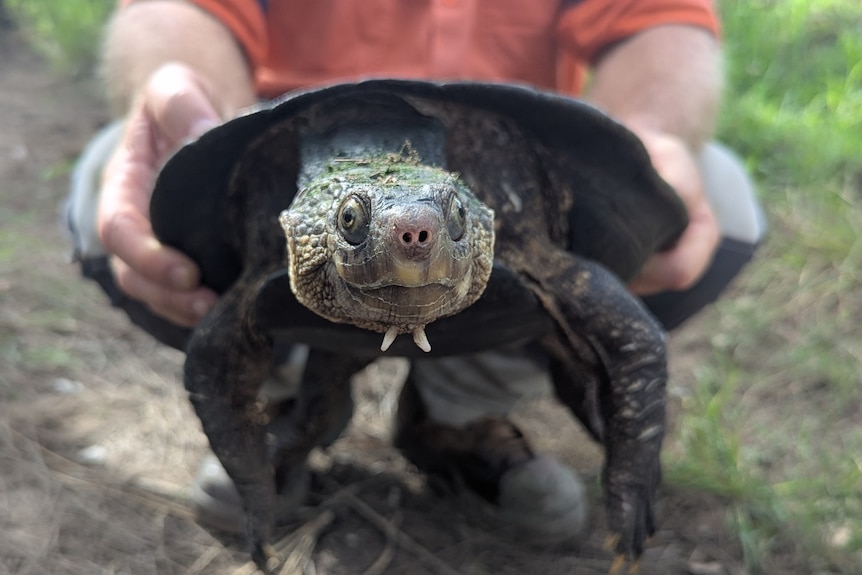
It takes the hatchlings 15 to 20 years to mature to adulthood. (Supplied: Burnett Mary Regional Group)
Also unique to this season was mothers laying eggs outside of wet weather.
“The turtle lays in rain events, and, most of the time, usually only one to two days after a rain event,” Mr Crosbie said.
“But this year, those turtles laid when there was no rain, and they laid for five or six days consecutively.
“That’s never ever happened in the history of the species, so I don’t know why, apart from I suppose there was enough moisture in the ground.”Connecting youth to country
Witnessing the laying of eggs and hatching of the turtles was a “humbling experience” for Bruce Waia, Indigenous project officer with WYLD Projects.
“It’s a reflection time too, because we’re seeing new life and the birth of a species that’s going to, you know, most likely disappear if we don’t do the work we do,” he said.
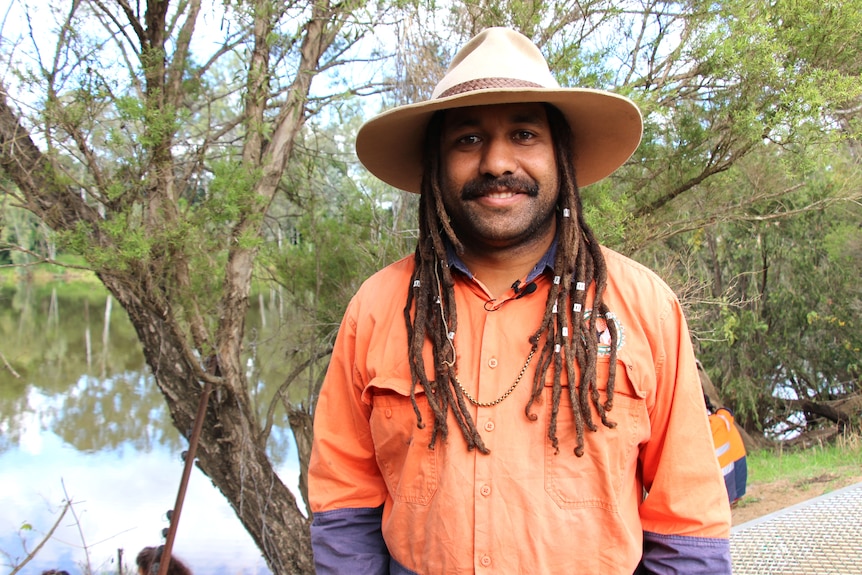
Bruce Waia says it is humbling to watch the turtles’ journeys. (ABC Wide Bay: Grace Whiteside)
Out of the 25 species of freshwater turtle native to Australia, about half have a conservation status of vulnerable or worse.
Aside from physical conservation work, WYLD Projects educates young people about caring for country and culture.
Mr Waia said he noticed similarities between the turtles’ journey and the young people.
Brad Crosbie says 100 per cent of the clutches would be predated without their intervention. (ABC Wide Bay: Grace Whiteside)
“They’re looking at these babies coming out of the ground and going to the water and seeing straight away [that] they’re in survival mode,” he said.
“Same as our youth, all this history that they’ve got … I get to be that one to hold the space so that the youth can see their struggles are quite real.
“It just mirrors.”
Variable clutch numbers
Marilyn Connell has been involved in conservation work for freshwater turtles in the Mary River, south of the Burnett River, for 25 years.
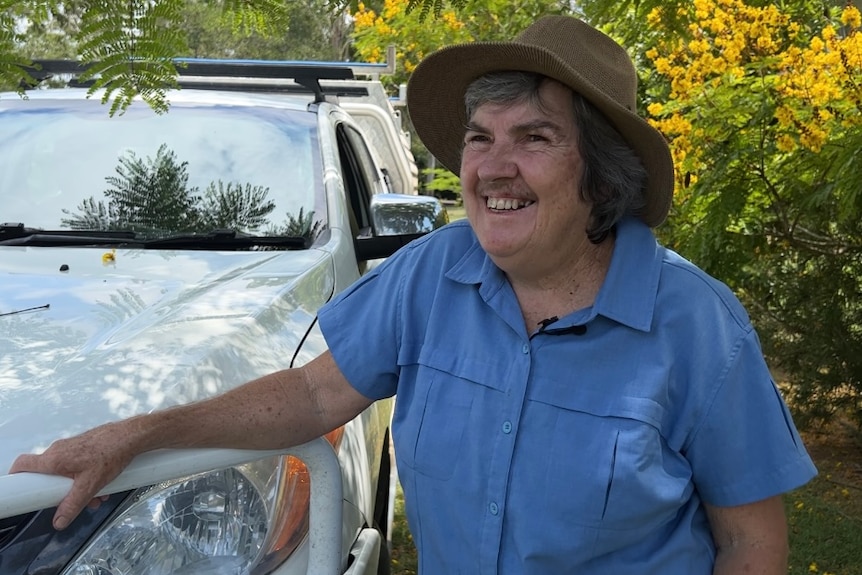
Tiaro Landcare, with Marilyn Connell, protected 59 nests this season. (ABC Wide Bay: Lucy Loram)
She is project manager with Tiaro Landcare, which secured 59 clutches this season.
“[We] protect the clutches with mesh … some clutches we relocate into protective cages,” Ms Connell said.
She said the group concentrated its efforts on the also critically endangered Mary River turtle.
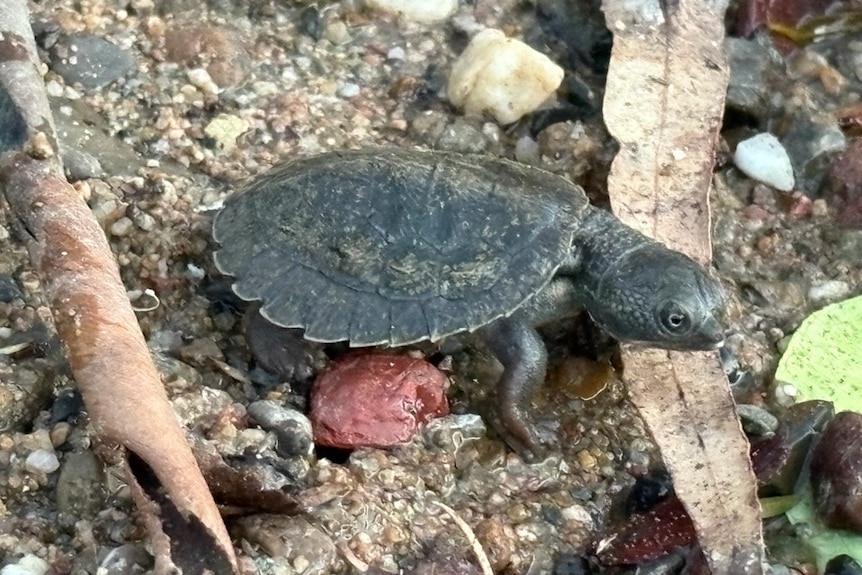
A Mary River turtle hatchling protected by Tiaro Landcare this season. (Supplied: Marilyn Connell)
“We had less [clutches] last year, but some years we get over 80, close to around 100, so it’s really, really variable,” Ms Connell said.
“If we didn’t protect nests … the recruitment would just be basically next to zero.”
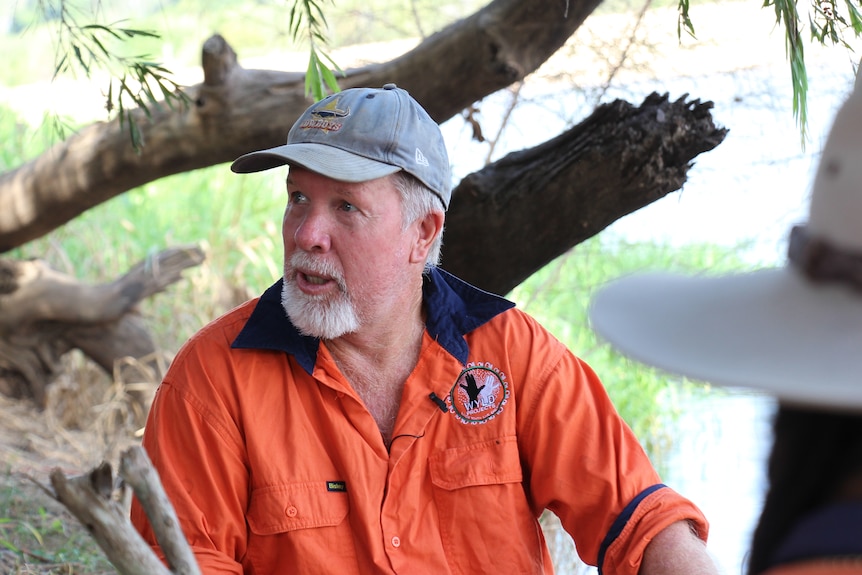
Brad Crosbie says WYLD Projects has a love language for the milbi. (ABC Wide Bay: Grace Whiteside)
Back on the banks of the Burnett River, Mr Crosbie sits and stares out at the water after releasing the hatchling.
“We haven’t got PhDs. We just got a connection to this turtle,” he said.
“If we talk about people, we’ve got a love language [to describe that], and we’ve got a love language and that’s why we’re doing this for this turtle.”