
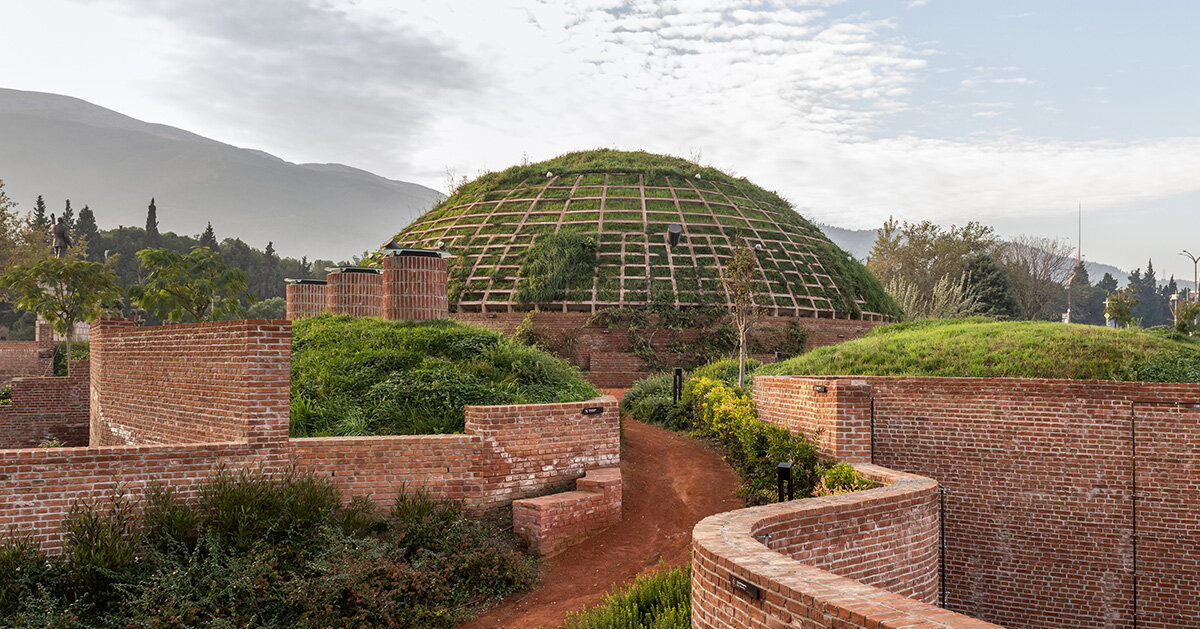
brick, earth, and topography shape Liberation Museum of Manisa
In Manisa, western Turkey, the Liberation Museum by Yalin Architectural Design is a memory space shaped by absence, loss, and collective resilience. Developed for the Greater City Municipality of Manisa, the 3,800-square-meter project narrates the local civil resistance movement that emerged independently of central authority between 1918 and 1923, during and after the First World War. The museum is conceived as an experiential landscape, guiding visitors through a spatial narrative of occupation, destruction, liberation, and rebuilding.
Earth-covered domes, brick vaults, and sunken courtyards give the building a grounded, almost geological presence. Instead of standing apart from its context, the museum appears embedded within it, its green roof folding into the surrounding landscape. Brick, used extensively throughout the project, forms thick walls, stepped seating, arched ceilings, and long corridors. The repetition of vaults produces a rhythmic spatial sequence.
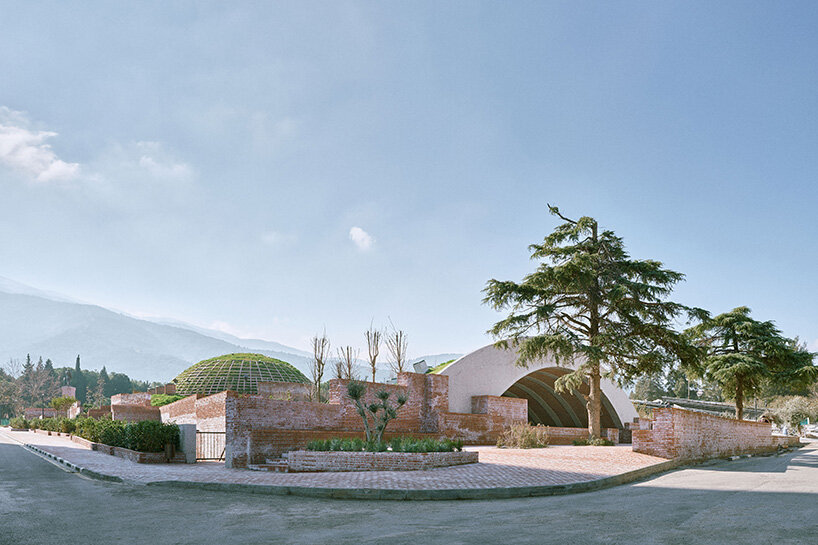
all images by Egemen Karakaya, unless stated otherwise
Yalin Architectural Design shapes lived memory
The museum by the Istanbul-based team at Yalin Architectural Design focuses on Manisa’s lived experience of war, the gradual encroachment of occupation forces, the burning of the city during their retreat, and the long process of reconstruction that followed. This local perspective shapes the curatorial approach of the project, foregrounding the everyday courage of unnamed civilians who risked their lives, families, and futures for the ideal of independence.
This narrative unfolds across 14 independent, load-bearing brick chambers, each designed to register a different emotional and historical intensity. Narrow passages open into larger chambers, while filtered daylight enters through openings. These transitions are meant to mirror emotional shifts from uncertainty and compression to endurance and cautious hope. According to the narrative framework of the project, the exhibition avoids dramatization, instead aiming to sustain a mood in which optimism persists despite destruction, pain, and scarcity. Spatial contrasts such as dark and light, narrow and expansive, low and high are deliberately staged, allowing visitors to sense historical tension through bodily movement rather than textual explanation alone.
The architectural shell of the Liberation Museum participates in the storytelling of the exhibition, with its curved roof structures, ribbed brick ceilings, and stepped platforms functioning as spatial metaphors. Visitors move through spaces that feel protective, heavy, and enclosed before encountering openness and light.
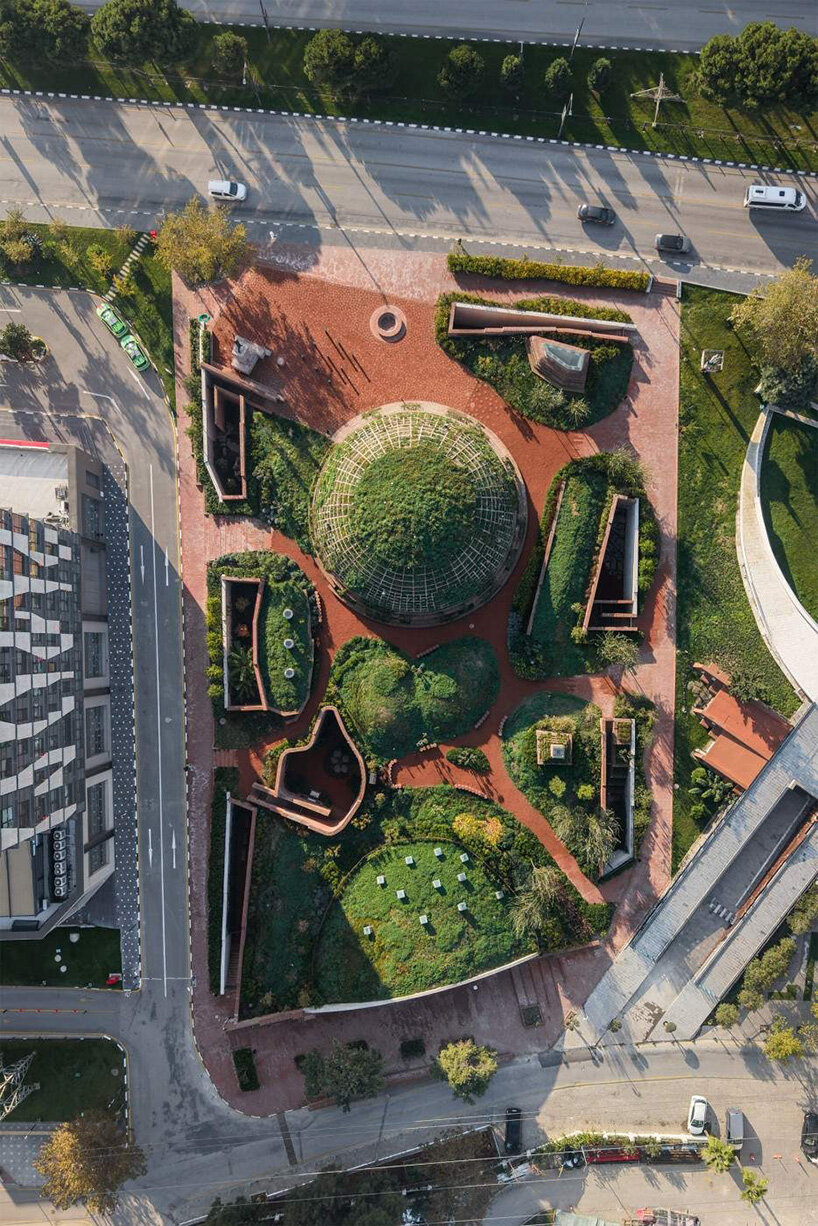
a topographic composition of paths, voids, and planted surfaces | image by Hacer Bozkurt
construction becomes part of the narrative
Each chamber rests on a concrete base and is built using two different brick dimensions. Wooden molds were prepared for the vaulted, tent-shaped, and domed rooms, and the load-bearing brick walls were laid directly onto these temporary supports. When the molds were removed, the rhythmic patterns of the brickwork were revealed for the first time, giving each interior surface an unexpected texture and intensity.
Visitors descend into this semi-underground narrative landscape via a three-pronged ramp, marking a physical and psychological threshold. The main entrance hall is conceived as a semi-elliptical, undefined volume, characterized by concrete vault slabs and brick arches. Often described by the architects as recalling the interior of a whale’s belly, this space functions as a central foyer that gathers visitors before dispersing them into the museum’s narrative sequence. From here, the story of Manisa, from the First World War to the city’s burning and eventual reconstruction, unfolds across nine interconnected story rooms, each shaped by a different spatial and emotional register.
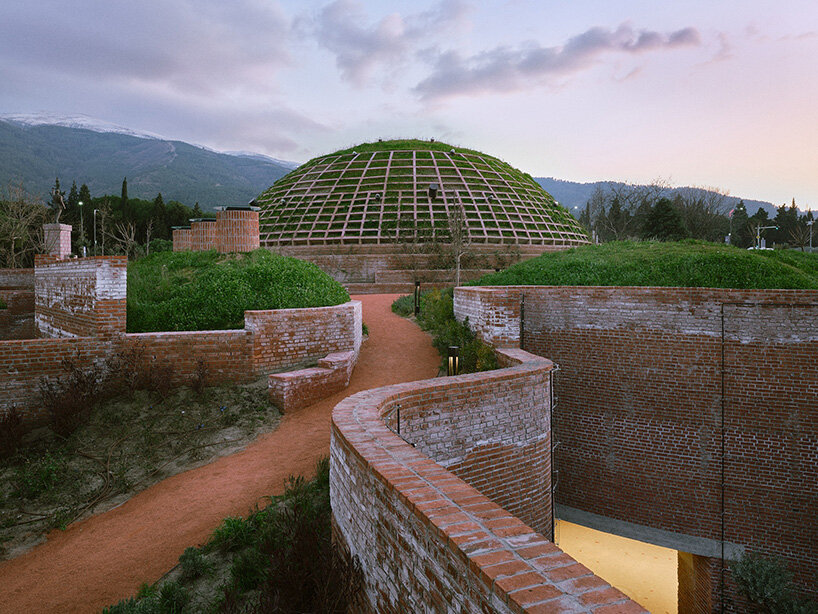
earth-covered domes and sunken courtyards shape the museum as a landscape
a public park layered over a buried history
The upper level of the museum is designed entirely as a public park. City dwellers cross this landscape daily, often unaware of the historical weight beneath their feet. Yet the museum subtly emerges within this terrain as mounds, voids, and obstacles, transforming the park into a fragmented garden of enclosures and paths. In this way, everyday life and historical memory coexist, layered but never fully reconciled. The primary goal of the museum is to transmit the immense trauma Manisa experienced, and its subsequent resurgence, to citizens and visitors of all ages. To achieve this, the project employs a wide range of architectural and narrative devices, from information-oriented rooms to highly sensory spaces, and from subdued installations to moments of spatial intensity. The result is neither a monument nor a neutral container, but a carefully choreographed environment where architecture becomes an active narrator.
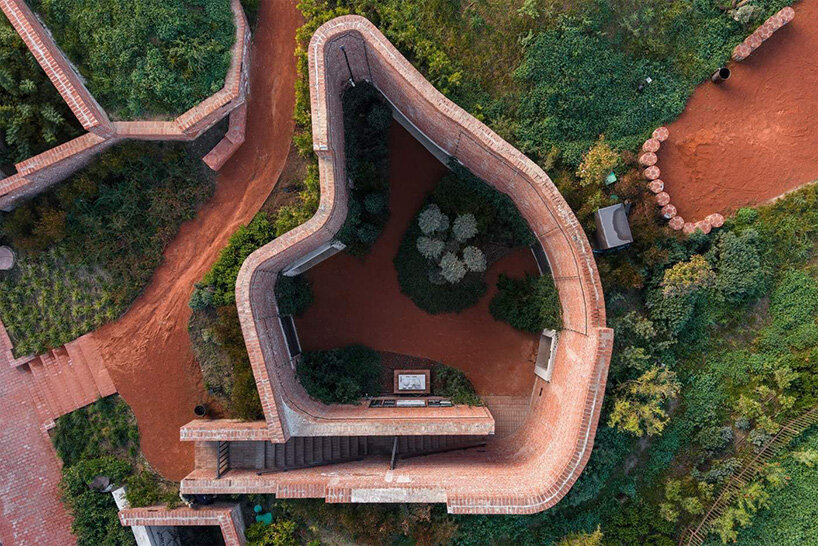
curved retaining walls and planted enclosures carve out contemplative outdoor rooms | image by Hacer Bozkurt