
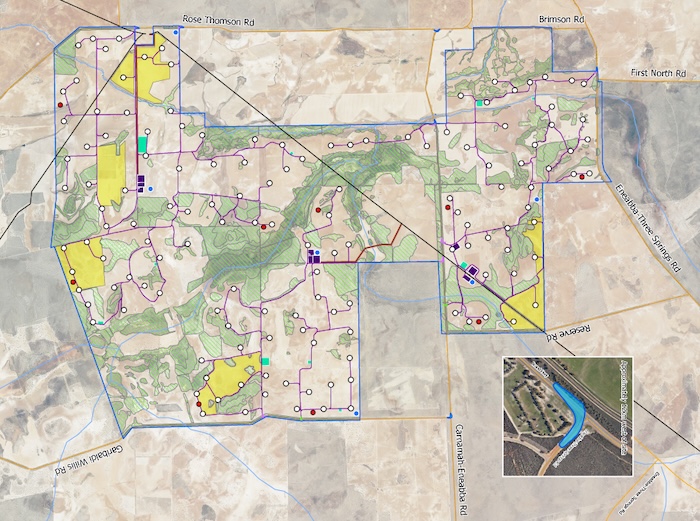
The wind element of the massive 2 gigawatt (GW) Tathra project in Western Australia has been waved through by the state’s environmental regulator, with all approvals in hand within an astonishing four months.
Developers Synergy, the state-owned gentailer, and Bright Energy Investment lodged the planning application with the state on September 12.
It had planning approval for all three elements of the project by December 9 with minimal conditions, and last week the state Environmental Protection Authority (EPA) waved the wind section through.
The EPA said the environmental consequences, which include impacts on several threatened flora and fauna, weren’t significant enough to warrant a formal assessment.
It recommended mitigation efforts including avoiding habitat trees and setting up a bird and mat management plan to handle the risk of collision.
Synergy says it still plans to refer the project to the federal environmental process, the EPBC, so doesn’t yet have a timeline for when it might start construction.
But it means Synergy has state planning approval to install 140 turbines totalling 1 gigawatt, along with a 500 megawatt (MW) solar farm which will be split over five locations, and three batteries totalling 500 MW with the storage element yet be decided.
The Tathra project will criss-cross a clutch of farms covering almost 16,000 hectares approximately 15km east of Eneabba, and about 300km north of Perth.
It’s one of more than two dozen projects clustering around the state’s forthcoming Western Power-owned transmission line, a 330 kilovolt (kV) upgrade that will link Perth to the Three Springs substation in the northern Wheatbelt region.
For Synergy, the speedy approval is a Christmas gift.
It plans to shut the ageing 240 megawatt (MW) Collie A coal power station in 2027 and the Muja 7 and 8 (both 227 MW) in late 2029.
If it can get some, or even all, of the Tathra project running by the end of the decade that could help address questions over whether it has enough generation to replace those coal units.
Synergy has four wind projects in development or under construction, including the Tathra proposal, but its biggest wind project to date is the expanded Warradarge wind farm, which is right next to the Tathra project, where work is underway not to lift capacity to 283 MW in 2027.
It owns two operating wind farms that are less than 2 MW each and the two-stage Kwinana battery, which totals 300 MW and 1000 megawatt hours (MWh) of storage.
The company’s experience with grid-scale solar is the 47 MW, two stage Greenough River project. Most of its recent efforts have been focused on battery storage.
Synergy is currently commissioning one of the country’s biggest battery projects, the 500 MW, 2,000 MWh facility at Collie, adding to the two big batteries it has built at the site of its Kwinana gas generator (and former coal plant) that total 300 MW and more than 1,100 MWh.
The Collie battery – located just up the road from Neoen’s even bigger 560 MW, 2,240 MWh battery at Collie – will take Synergy’s total big battery capacity to more than 800 MW (and nearly 3,200 MWh).
If you would like to join more than 28,000 others and get the latest clean energy news delivered straight to your inbox, for free, please click here to subscribe to our free daily newsletter.

Rachel Williamson is a science and business journalist, who focuses on climate change-related health and environmental issues.