
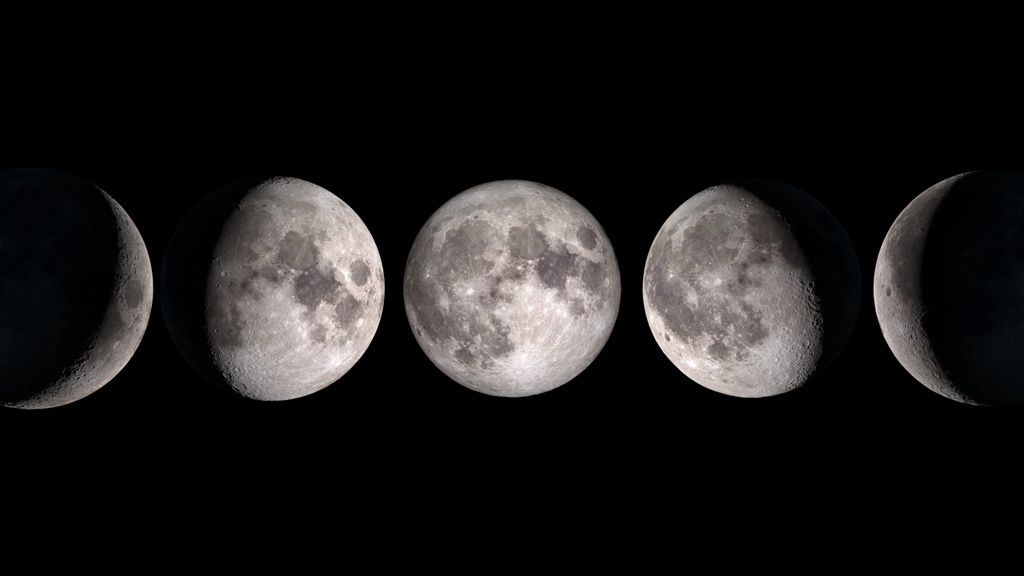
What is the moon phase today?
Today, Jan. 12, 2026, the moon is 23 days old and is in the Waning Crescent phase of its lunar cycle. It is 33% illuminated.
Swipe to scroll horizontallyJanuary 2026 moon phases and dates
Moon phase
Date
Full Moon
Jan. 3
Third/Last Quarter
Jan. 10
New Moon
Jan. 18
First Quarter
Jan. 25

Tariq Malik
Editor-in-Chief
Tariq is the Editor-in-Chief of Space.com and joined the team in 2001. He covers skywatching, human spaceflight, exploration as well as space science and entertainment, and enjoys observing the moon through a tabletop Celestron telescope when the weather is clear.
What’s the moon phase tonight?
While the moon has four primary phases each month, it is always changing. As you observe the moon during the month, watch as it grows from a new moon to a first quarter moon. As it grows, it is known as a waxing moon, and gradually increases from a waxing “crescent” (for its shape into the first quarter moon. As it continues to brighten, it takes on an oblong, or “gibbous,” shape until it reaches the full moon stage. Then it will repeat the steps in reverse as it heads back to a new moon. You can see what today’s moon phase is here with the embedded widget on this page, courtesy of In-The-Sky.org.
You may like
What is the next moon phase?
The next moon phase milestone in September will be the “New Moon“. It will occur on Sunday, Jan. 18, at 2:52 p.m. EST (1952 GMT).
The new moon is the so-called “invisible phase of the moon,” according to NASA, because the illuminated side of the moon is facing away from Earth, toward the sun. The moon is also in the sky during the day, and without its Earth-facing side illuminated by the sun, observers can’t really see it.
Occasionally, the moon’s orbit does bring it directly between the Earth and the sun during a new moon, causing a solar eclipse or, even more amazingly, a total solar eclipse. But because the moon’s orbit is tilted with respect to the Earth, this alignment does not occur every month.
The lunar disk will pass less than 4 degrees of the sun as it reaches its new moon phase on Jan. 18 — less than the span of your three middle fingers held at arm’s length — at which time it will be entirely lost from view from our perspective.
Moon phase calendar for 2026
Here are the moon phases for 2026, according to NASA’s SKYCAL. If you need equipment for viewing the moon, check out our guide to the best telescopes and the best telescopes for kids.
You can also check out our guide on how to photograph the moon, as well as how to photograph a lunar eclipse for major moon events. There’s even a guide on how to photograph a solar eclipse.
If you’re looking for imaging gear, our best cameras for astrophotography and best lenses for astrophotography guides can help prepare you for the next lunar sight.
You may like
Swipe to scroll horizontallyMoon phases 2026
New moon
First quarter
Full moon
Last quarter
Jan. 18 – 2:52 p.m. (EST)
Jan. 25 – 11:47 p.m. (EST)
Jan. 3 – 5:03 a.m. (EST)
Jan. 10 – 10:48 a.m. (EST)
Feb. 17 – 7:01 a.m. (EST)
Feb. 24 – 7:28 a.m. (EST)
Feb. 1 – 5:09 p.m. (EST)
Feb. 9 – 7:43 a.m. (EST)
Mar. 18 – 9:23 p.m. (EDT)
Mar. 25 – 3:18 p.m. (EDT)
Mar. 3 – 6:38 a.m. (EST)
Mar. 11 – 5:39 a.m. (EST)
Apr. 17 – 7:52 a.m. (EDT)
Apr. 23 – 10:32 p.m. (EDT)
Apr. 1 – 10:12 p.m. (EDT)
Apr. 10 – 12:52 a.m. (EDT)
May 16 – 4:01 p.m. (EDT)
May 23 – 7:11 a.m. (EDT)
May 1 – 1:23 p.m. (EDT)
May 31 – 4:45 a.m. (EDT)
May 9 – 5:11 p.m. (EDT)
Jun. 14 – 10:54 p.m. (EDT)
Jun. 21 – 5:55 p.m. (EDT)
Jun. 29 – 7:57 p.m. (EDT)
Jun. 8 – 6:00 a.m. (EDT)
Jul. 14 – 5:43 a.m. (EDT)
Jul. 21 – 7:06 a.m. (EDT)
Jul. 29 – 10:36 a.m. (EDT)
Jul. 7 – 3:29 p.m. (EDT)
Aug. 12 – 1:37 p.m. (EDT)
Aug. 19 – 10:46 p.m. (EDT)
Aug. 28 – 12:18 a.m. (EDT)
Aug. 5 – 10:21 p.m. (EDT)
Sep. 10 – 11:27 p.m. (EDT)
Sep. 18 – 4:44 p.m. (EDT)
Sep. 26 – 12:49 p.m. (EDT)
Sep. 4 – 3:51 a.m. (EDT)
Oct. 10 – 11:50 a.m. (EDT)
Oct. 18 – 12:13 p.m. (EDT)
Oct. 25 – 11:12 p.m. (EDT)
Oct. 3 – 9:25 a.m. (EDT)
Nov. 9 – 2:02 a.m. (EST)
Nov. 17 – 6:48 a.m. (EST)
Nov. 24 – 9:53 a.m. (EST)
Nov. 1 – 3:28 p.m. (EDT)
Dec. 8 – 7:52 p.m. (EST)
Dec. 17 – 12:43 a.m. (EST)
Dec. 23 – 8:28 p.m. (EST)
Dec. 1 – 1:09 a.m. (EST)
Dec. 30 – 1:59 p.m. (EST)
Phases of the moon
The moon, like Earth, is a sphere, and it is always half-illuminated by the sun. As the moon travels around Earth, we see more or less of the illuminated half. Moon phases describe how much of the moon’s disk is illuminated from our perspective.
New moon: The moon is between Earth and the sun, and the side of the moon facing toward us receives no direct sunlight; it is lit only by dim sunlight reflected from Earth.
Waxing crescent: As the moon moves around Earth, the side we can see gradually becomes more illuminated by direct sunlight.
First quarter: The moon is 90 degrees away from the sun in the sky and is half-illuminated from our point of view. We call it “first quarter” because the moon has traveled about a quarter of the way around Earth since the new moon.
Waxing gibbous: The area of illumination continues to increase. More than half of the moon’s face appears to be getting sunlight.
Full moon: The moon is 180 degrees away from the sun and is as close as it can be to being fully illuminated by the sun from our perspective. The sun, Earth and the moon are aligned, but because the moon’s orbit is not exactly in the same plane as Earth’s orbit around the sun, they rarely form a perfect line. When they do, we have a lunar eclipse as Earth’s shadow crosses the moon’s face.
Waning gibbous: More than half of the moon’s face appears to be getting sunlight, but the amount is decreasing.
Last quarter: The moon has moved another quarter of the way around Earth, to the third quarter position. The sun’s light is now shining on the other half of the visible face of the moon.
Waning crescent: Less than half of the moon’s face appears to be getting sunlight, and the amount is decreasing.
Finally, the moon is back to its new moon starting position. Now, the moon is between Earth and the sun. Usually, the moon passes above or below the sun from our vantage point, but occasionally it passes right in front of the sun, and we get a solar eclipse.
Moon phase Q&A with an expert
We asked Italian amateur astronomer, astrophotographer, and author Giuseppe Donatiello some questions about the moon and its phases.
 Giuseppe Donatiello
Social Links Navigation
Giuseppe Donatiello is an Italian amateur astronomer, astrophotographer, and author who is known for his discovery of six nearby dwarf galaxies and several planetary nebulas.
Why does the moon have phases?
The phases of the moon are a consequence of its motion around Earth in relation to the geometry assumed with respect to the sun. To better understand how it works, let us, first of all, remember that the moon does not emit its own light but reflects that of the sun and partly that reflected by the Earth–phenomenon of ashen light.
Of the moon, we always see a hemisphere and a little more because its rotation is synchronous and blocked by the tide. This means that one lunar rotation on its axis corresponds to the time of revolution around Earth, equal to 29.5 days. On a daily basis, the moon appears to move eastward in the sky by 12°, and this determines different angles of its illumination by the sun. As it orbits Earth, the moon will show different illuminated parts based on the angle to the sun and hence the phases of a lunation. Although these lighting variations are gradual, traditionally, only four moments are identified, which are also useful for regulating the ancient calendars.
They are in order, New Moon, First Quarter, Full Moon, and Last Quarter.
What is the difference between Full Moon and New Moon?
The substantial difference is in the illumination percentage of the side facing the Earth. In the new moon phase, this percentage is 0% and becomes 100% at Full moon, about 14 days later. Thanks to the regular repetition of these moments, since ancient times, the lunar phases have been the basis of the lunisolar calendar.
However, it was difficult to establish the exact moment of the new moon, therefore, many ancient civilizations started the lunar month with the appearance of the first crescent after sunset. However, this is a very simplified description since the lunar motion is actually very complex, and the perspective with which we see the near side constantly changes, getting to see almost 60% of the lunar surface thanks to the phenomenon called libration.
How do the phases of the moon affect moonrise and moonset?
The production of the phases depends on the Earth-moon-sun geometry and on the revolution motion of the moon around the Earth. Moving towards the east, our satellite rises later every day, and this is the reason why we see it in different positions at the same time. Approximately every day the moon delays its rising (and setting) by about 50 minutes, and this explains why the waxing becomes better visible a few days after the new moon as the elongation from the sun increases and further and further eastward.
According to this reasoning, the maximum delay is at the new moon (24 hours) but also the minimum (0 hours) with the start of a new cycle.
Do the phases of the moon affect the tides?
Tides are periodic changes in sea level known since ancient times. The phenomenon was explained satisfactorily by Isaac Newton, attributing it to the gravitational attraction exerted by the moon and the sun. We can consider the gravitational attraction exerted by the other planets to be negligible, therefore the greatest effects on the Earth will be those produced by the sun and the moon. These three bodies attract each other, however, the greatest effect is in the Earth-moon interaction.
Both the moon and the Earth undergo a deformation along the line joining them, however, it is the fluid masses of the oceans that undergo the most significant deformations with the formation of a swelling.
In addition to the swelling along the joining line, a diametrically opposite one on the other side of the Earth is formed due to the centrifugal force. The bulges move with the rotation of the moon around the Earth. An observer on the Earth’s surface as the bulge approaches will see the sea level rise and then fall after it is exceeded. This observed phenomenon is called a tide. When the sea level is minimum, it is called low tide, while when it is maximum, it is a phase of high tide.
The difference in height between the height of high tide and low tide is defined as a tidal range. The behavior of the tides is influenced by the orography and shape of the basins, size, and depth. Two to four tides can occur in one day. If there is one high and one low tide, we speak of diurnal tides, while if there are two high and two low tides, these are called semi-diurnal tides. During diurnal tides, the excursion is minimal, while for diurnal tides, the difference in level can also be considerable. It also depends on the height of the moon above the equator as a result of its inclined orbit. The sun also affects the tides, albeit less so than the moon, by attracting masses of water. The solar role is additive to the lunar one therefore, the respective geometry also influences the tides.
When the moon is New or Full, the tides are maximum because the attraction forces of the sun and the moon add up. When the moon is in the First or Last Quarter, forming a 90° angle with the sun and the Earth, the tides are minimal because the attractive forces of the sun and moon oppose each other. To predict the magnitude of the tide we will also consider the position of the sun.
Additional moon phase resources
NASA’s SkyCal Events Calendar offers a comprehensive calendar of moon phases, lunar and solar eclipses and more for the entire calendar year. You can see more about the full moons of 2024, in Space.com’s Full Moon Calendar. Our night sky guide has a list of events for skywatching this month.
Bibliography
SkyCal – SkyEvents Calendar, NASA Goddard Spaceflight Center
https://eclipse.gsfc.nasa.gov/SKYCAL/SKYCAL.html
What’s Up – Skywatching Tips from NASA
https://solarsystem.nasa.gov/skywatching/whats-up/