
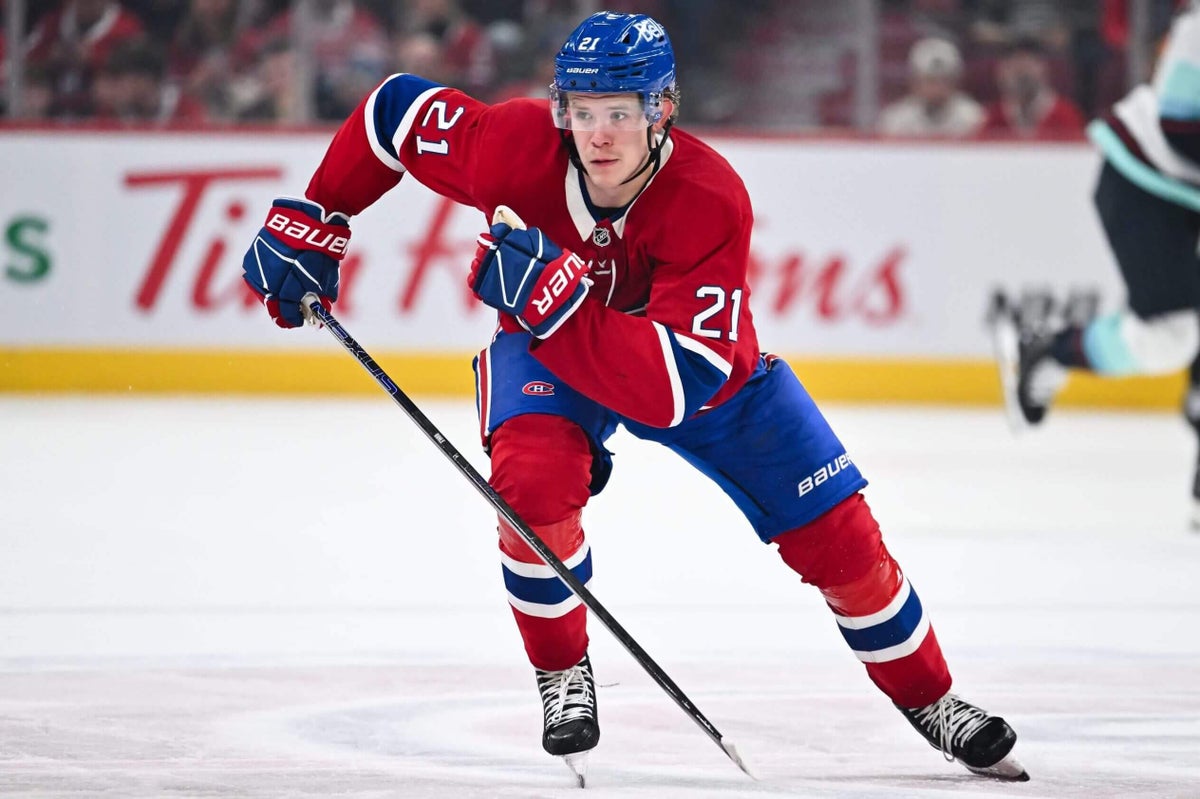
As Kaiden Guhle prepared to play his first game since Oct. 16 on Saturday morning, he was asked what the most difficult challenge is for him to enter the lineup at this stage of the season.
“Unfortunately I’ve done it a few times before,” Guhle said, “so I kind of know what to expect and what to do going into these games.”
Guhle missed 39 games with an adductor injury, bringing his career total to 116. He’s played only 175, including Saturday’s 4-0 loss to the Detroit Red Wings. That is the context for this latest absence.
Two offseasons ago, Guhle spent his summer working on taking hits so he could avoid injury. He literally had friends come on the ice with him and hit him. Last summer, Guhle tried to bulk up in the gym, working out daily with Kirby Dach in the Edmonton area. Again, the goal was to avoid injury.
So when an issue with his adductor flared up in the preseason, Guhle opted to rest it. But when the regular season started, he wanted to play. He’d missed enough time to injury.
“Ultimately, a little bit of it is on me. I wanted to come back and play and maybe didn’t give it enough time,” Guhle said. “I know I have the mindset that if I can put on the skates and I can skate and I can manage it, then I’m going to play. A little bit of a tough lesson for me to have to learn. Unfortunately, I had to miss a lot of time to learn that lesson. Definitely going forward we’ll manage that stuff way better.”
Bonne nouvelle en ce mardi matin: Kaiden Guhle est de retour avec le groupe!
Good news Tuesday: Kaiden Guhle is back with the group!#GoHabsGo pic.twitter.com/UHRTX0RyIW
— Canadiens Montréal (@CanadiensMTL) January 6, 2026
To be clear, Guhle’s decision to play when the regular season began was his to make, he said. The decision to initially rehab it and not operate right away was his to make. And the decision to ultimately have that surgery was his to make. It’s his adductor, after all.
But a player will always look for the path of least resistance to playing. A team can’t necessarily stop that from happening, but it could encourage the learning of that lesson, and perhaps the team did and simply did not find a receptive student. But the fact this might have been avoided by simply dealing with the problem when it first arose in the preseason is not a great look.
And now, Guhle’s long history of extended injury absences is something that has come to define him, which is unfortunate because he’s an excellent young defenceman, a key part of what the Canadiens are trying to build here.
But at least he is not letting it define him. Despite his games played-to-games missed ratio skewing too close to 50 percent, Guhle chooses to look at things in a positive light and looks to a former teammate for inspiration.
“I think you look at a lot of guys around the league, guys that have dealt with injuries,” he said. “I always think of Sean Monahan. He was here for a bit, and he dealt with a bunch of injuries. He was basically injured for three or four years. I think he missed a few games last year, but besides that, he hasn’t missed much time. I think of him a lot whenever I’m going through stuff like this.”
Monahan missed 28 games with the Columbus Blue Jackets last season, but Guhle is correct that there are examples of players who were labeled as injury-prone who ultimately became reliably healthy players.
“These are just the cards I’ve been dealt, and you’ve just got to roll with the punches,” he said. “There’s no secret sauce to feel good about it. You feel like s— for a couple of days. You feel bad for yourself for a couple of days, and then let’s just get back to work and try to get back.”
One theory on Slafkovský’s success
Since Dec. 20, Juraj Slafkovský is tied for eighth in NHL scoring with 15 points in 11 games and leads the Canadiens in scoring over that period.
An answer to a question last week about whether he finds it easy to find Oliver Kapanen on the ice gave some insight as to why his line with Kapanen and Ivan Demidov might work better for him than his previous line with Nick Suzuki and Cole Caufield.
“Especially with two lefties playing with a righty,” Slafkovský said. “When I was playing with Suzy and Cole, they would work in the left corner so they would face their forehand side. I work in the right corner, and just coming out of the corner, (Kapanen’s) always open in the middle of the ice, trying to be ready for the one-timer. Sometimes it’s there, sometimes it’s not. Even off the rush, he’s always on the weak side in a good spot. I feel like it’s really good to have.”
See, Slafkovský is now on the strong side of the ice more often, the side where the puck is more often, because both he and Demidov are left shots, so they prefer to play out of the right corner. Previously, Slafkovský played on the weak side, waiting for Suzuki and Caufield to create out of the left corner.
It’s a big difference, and it’s a dynamic Slafkovský often creates himself by carrying the puck from his left wing side across the ice to the right side, often slowing down in the neutral zone to allow the traffic to move past him and using the width of the ice to create confusion and an effective zone entry on the other side of the ice.
When he played with Caufield in particular, Slafkovský would often try to create that same confusion by hitting Caufield with a rink-wide pass, and more often than not, that pass would run into an obstacle such as an opposing stick or leg and become a turnover.
“I think he’s forcing less things. I think he’s letting things evolve more,” coach Martin St. Louis said. “He’s using his size, his length, his reach to buy time, to let things evolve around him. I think he’s a little more patient with the puck, especially in the neutral zone. I think he’s comfortable with the puck on his stick unless he has an obvious play that’s not going through two or three guys. When you’re doing cross-ice plays through two or three guys, you’re rolling the dice, you’re playing with fire. I think he’s gotten away from that a little bit.”
And finally, in Kapanen, Slafkovský has a centre who is more than happy to play off the puck, to be essentially a permanent F3 and play high in the zone in case the puck comes back the other way. And in doing so, Kapanen is better able to scan the ice for empty pockets he can slide into from that high ice so he can get that one-timer feed from either Slafkovský or Demidov.
“Those two are pretty good with the puck, protect the puck and win some battles,” Kapanen said. “Of course, I want to do that, too, but when I know those two guys are on the boards, I don’t have to go there. That makes some space for them, and then I get space somewhere else. So, yeah, that’s pretty much how I’ve been scoring and hopefully it keeps going that way.”
Deux buts en 54 secondes!
Kappy Holidays!#GoHabsGo pic.twitter.com/jipij9DR69
— Canadiens Montréal (@CanadiensMTL) January 2, 2026
The line with an average age of 21 is still a work in progress, but the dynamic that has allowed Slafkovský to thrive on that line basically comes down to the fact that he has another lefty on his line, and one as dynamic as Demidov, as opposed to playing off two dynamic righties in Suzuki and Caufield.
“I want to make sure I’m comfortable everywhere, but obviously that (right) side of the ice is where I should be good,” Slafkovský said. “It’s where I should dominate.”
Todd McLellan’s take on Lane Hutson
Preparing to face the Canadiens on Saturday morning, Detroit Red Wings coach Todd McLellan was asked what he looks for when instructing his team to try to stop Lane Hutson.
McLellan basically said that was impossible.
“One, I don’t think you’re going to stop a player like that. He’s too dynamic, and it’s not like he needs 10 chances a night to be effective; he only needs one or two, really,” he said. “His ability to escape and create with his legs is unique, Quinn Hughes-like in my opinion, Dan Boyle-like when he was playing with us in San Jose — he has those legs.
“I think what’s even advanced more in his game is he’s doing all of that, but he has great vision now to find people in the open. So he’s just getting better and better as his career goes on, and obviously the fans here are real fortunate to watch him play night in and night out.”
It should be noted that McLellan’s Red Wings did a pretty good job of at least containing Hutson on Saturday night. But that is pretty high praise for Hutson.