
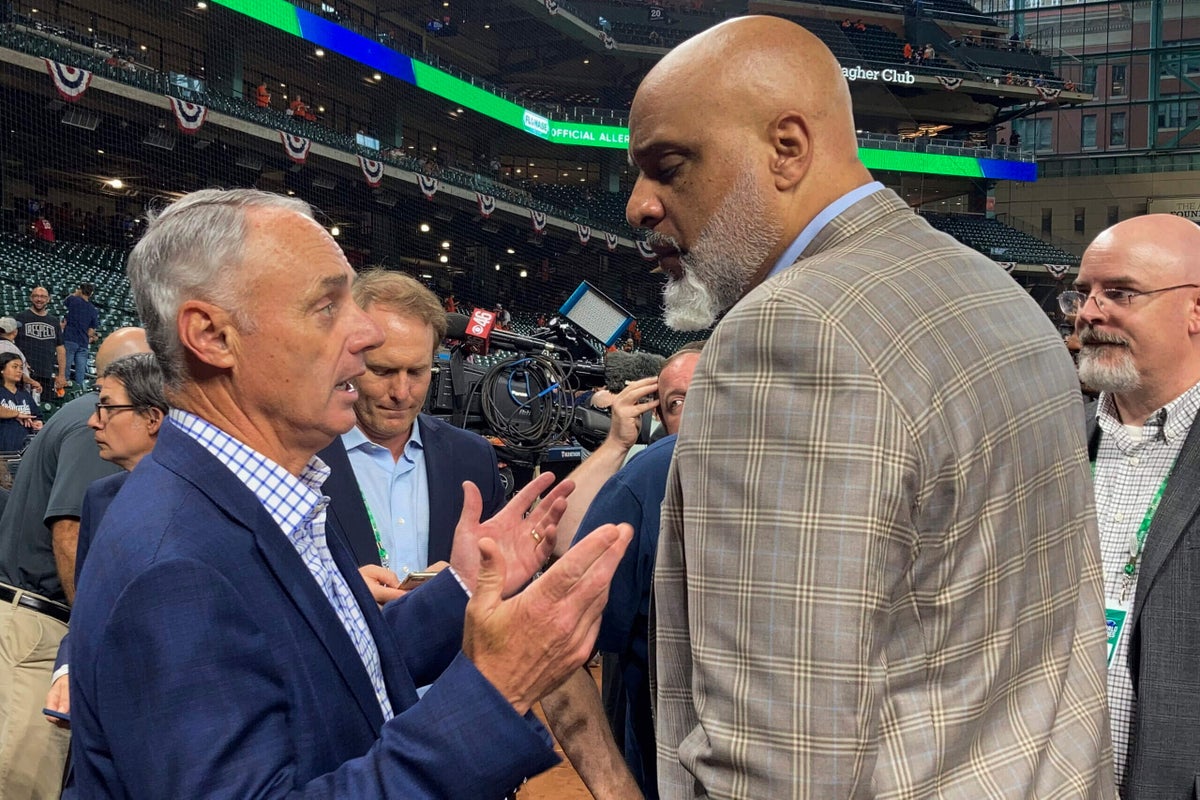
Whether a salary cap will be a dealbreaker in Major League Baseball’s upcoming labor negotiations is a question best directed across the aisle, league commissioner Rob Manfred said last week on the radio.
“That’s a Tony Clark question, I mean, it really is,” Manfred said, referring to the head of the Players Association. “Until I got elected commissioner, all I did was labor relations. That’s how I made my living. I’ve never been in a negotiation where, before the first piece of paper went across the table, I, or anyone I represented, was out there saying, ‘This, we absolutely will not talk about.’ I just think it’s a hard way to begin a negotiation.”
The union, however, doesn’t seem to worry it’s jumping to conclusions too quickly. Its position has been unchanged for decades.
“Players and fans want a full season of competitive baseball,” the MLBPA said in a statement to The Athletic when asked about Manfred’s comments. “The league and owners say they want to avoid missing games but at the same time they appear to be dead-set on trying to force players into a system that, the last time they proposed it, led to the most missed games ever and a cancelled World Series.”
Manfred’s conversation on WFAN in New York was another in a series of interviews the commissioner has given in the past year where he has hinted at his desire for a cap and then simultaneously said he’s not committed to the polarizing idea.
MLB’s current labor deal expires in December, and formal talks between owners and players are expected to begin early in the 2026 season, likely no later than May. They began in April last time.
“I do think there has been a rush to negativity by a lot of the media,” Manfred told WFAN when asked about the upcoming negotiations. “We see things that need to be addressed. That doesn’t necessarily mean you’re going to make this proposal or that proposal. I think we have to wait and see how things unfold at the table.”
Yet, Manfred has repeatedly described changes that are part and parcel to cap structures in other leagues such as the NBA, NFL and NHL. That’s significant to fans and industry officials because talk of a cap — which would bring an upper limit to individual player salaries and a bevy of other changes — portends a nasty labor fight.
Baseball players held a 232-day strike to ward one off in 1994-95, and industry fears for another messy stoppage have grown over the last year. Another December lockout is likely.
On WFAN, host Chris McMonigle asked the commissioner how low-spending clubs could be incentivized to spend more on their rosters. In response, Manfred directly pointed to a key component of cap systems: the salary floor that would go hand in hand with a ceiling.
“The question of incentivization is a really important one. Three other sports have dealt with it by having a rule: you got to spend,” Manfred said, referring to basketball, football and hockey. “Everybody talks about the cap piece. The cap piece comes with another piece where you have to spend. And I think mandating a certain level of commitment in terms of spending in the right kind of economic system can be a good thing.”
Manfred had been a little less direct previously. Over the summer, he told players in meetings across the league that they had lost billions because they hadn’t agreed to a revenue-split system, which would distribute a fixed percentage of industry revenue to the owners and players annually. That structure is typical of cap leagues, and in one such meeting, star slugger Bryce Harper of the Philadelphia Phillies confronted Manfred on suspicion the commissioner was pushing for a payroll limit.
A couple weeks before the Harper incident, Manfred said he never actually strings the words “salary” and “cap” together.
Manfred has also repeatedly said how important it is to play a complete schedule in 2027. But if he proposes a cap, a full ’27 season would only be possible in one of two scenarios: if the players back down from their long entrenched stance and accept the new system, or if the owners relent and pivot to an alternative with enough time left in negotiations.
A deal was reached in mid-March 2022 during the 2021-22 lockout, narrowly preserving a full slate of games. But the sport is in a different place than it was in ’21. The pitch clock has helped revitalize fan interest, which Manfred called “a huge positive.”
“When you have momentum like we have that you’ve worked as hard as we have to get, you know that is a force that puts people in a frame of mind that they should understand they need to make an agreement, OK?” Manfred said on the radio. “Despite that momentum, we have a couple of issues that we hear about from our fans all the time: blackouts and the perception that some teams are not competitive.
“We got to address those issues. How we figure out the way to address those issues is the challenge of the bargaining process, and jumping to the idea that it’s going to be salary cap, no salary cap is a premature thing to do. To maintain the momentum we all understand we have, I think we need to address those two issues and I think we’ll figure out a way to do it.”
Yet, at the same time, Manfred is drawn to the idea of a major overhaul.
Crumbling club income from regional sports networks and the rise of streaming companies sets up a world where Manfred wants to sell not only the typical game-of-the-week national packages to companies like Netflix and ESPN when he strikes new deals for 2029 and beyond, but local rights as well. If an RSN won’t pay much to carry, say, the St. Louis Cardinals for 120 games a year, maybe a big streaming company will — particularly if it acquires many teams’ rights at once.
“People often say that when you make a (labor) deal bigger, it’s harder to get it done,” Manfred said in June. “This is one of those areas where a bigger deal, in terms of media, labor, revenue sharing, actually gives you trade-offs to accomplish things.”
When he praised a salary floor on WFAN, Manfred also said small-market teams are not best described as “unwilling” to spend.
“I want to quibble with one word, ‘unwilling,’” Manfred said to host Craig Carton. “I think ‘unable’ is really a better word.”
In baseball’s history, a commissioner’s lament for the plight of small-market teams has often been followed by calls for a cap. But not always. Manfred and the owners could propose major changes without that system. Whether they will is, eventually, a Rob Manfred question.