
The final inflation report of 2025 showed that prices rose 2.7% in December from a year ago, a sign that cost pressures for consumers remain slow to ease, particularly for everyday items.
A drop in the price of gasoline helped slow overall inflation, falling 0.5% in December compared to a month earlier.
This partially offset a sharp increase in the cost of food. Prices at the supermarket jumped 0.7% in December as grocery costs climbed across most categories, according to the Bureau of Labor Statistics.
Tuesday’s report follows the longest government shutdown in U.S. history, which lasted from the beginning of October to the middle of November. Economists say its lingering effects could be to distort some economic data, including inflation reports, in the months ahead.
It also comes as the Trump administration has reversed course recently to prioritize affordability, announcing a series of policies aimed at driving down prices for everyday goods.
It’s a task made more urgent by the politics of an election year in Washington. Some members of Congress will face their first round of party primary challengers as soon as March.
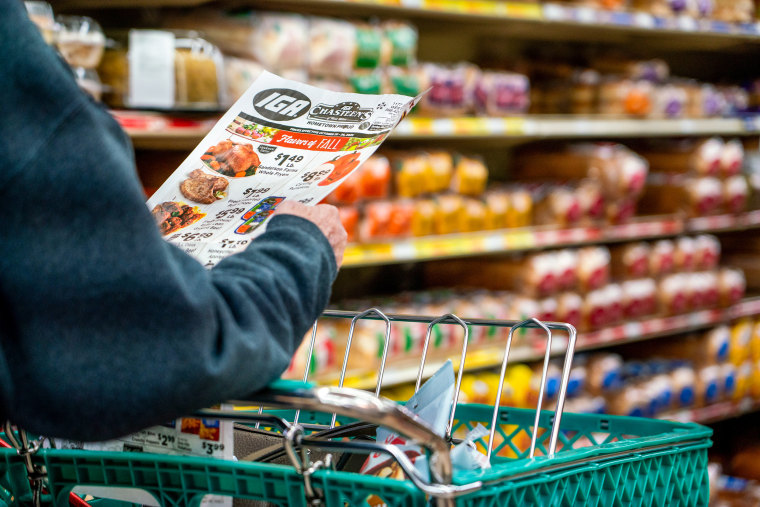 A shopper looks at a sales advertisement at a grocery store in West Milton, Ohio, on Oct. 21.Kyle Grillot / Bloomberg via Getty Images
In just the last few days, President Donald Trump has demanded that major U.S. oil companies invest in and export Venezuelan oil, as part of a broader effort to drive down gas prices.
He has also ordered $200 billion worth of mortgage bond purchases aimed at reducing residential mortgage rates, and he has instructed credit card companies to cap interest charges at 10% for one year.
Yet, Trump’s economic proposals have been overshadowed since Friday by the administration’s decision to escalate its pressure campaign on the Federal Reserve.
The U.S. central bank, tasked with balancing inflation and unemployment through its influential interest rates, and its chairman, Jerome Powell, now face an investigation from the Justice Department over a building renovation.
Powell says the investigation is not about a building, but about “intimidation.” Trump has routinely attacked Powell and the Fed, calling for it to push interest rates lower, a move that can stimulate the economy but risks reigniting inflation.
Shortly after the December inflation report was released, Trump again targeted Powell in a social media post.
The data from BLS “means that Jerome ‘Too Late’ Powell should cut interest rates, MEANINGFULLY!!! If he doesn’t he will just continue to be, ‘TOO LATE!'” he wrote.
News of the probe into the central bank initially drove interest rates up, which is the opposite of what the administration is trying to do. Economists widely believe repeated assaults on the Fed could continue to raise rates.
The Fed cut rates three times last year, but expectations of more cuts ahead are dwindling. For the time being, the labor market appears to have stabilized and inflation remains above the Fed’s 2% target. The central bank will hold its next policy meeting at the end of the month.
“Perhaps the most important takeaway from the inflation data is that the window on a near term Fed rate cut is rapidly closing,” Joseph Bruselas, chief economist at consulting firm RSM, said in a note to clients Tuesday
While inflation has declined dramatically from its heights during the Biden administration, it has remained higher than the 2% target. At that rate, it generally goes unnoticed by consumers, as long as wages continue rising at the same pace.
For consumers, food prices remain a key issue.
Grocery prices rose broadly in December, with five major grocery store food categories posting increases.
Within the meat, poultry, fish and egg category, an 8.2% decline in egg prices helped contain an increase in the price of beef.
Eating out also became more expensive. Food away from home rose in December, with both full-service meals and limited-service meals ticking up in price. On an annual basis, grocery prices rose 2.4% over the 12 months ending in December.
Food inflation has been a particularly “sticky” category over the past year, meaning prices have been slow to moderate even as other categories ease.
Housing prices also edged higher last month and was “the largest factor” in the overall increase in inflation, BLS said, after the agency counted it as zero in the prior report, in which many numbers had to be estimated because of the government shutdown.
Several services categories also moved higher in December, including airline fares.