

the European Space Agency (ESA) and ClearSpace unveiled a bold new initiative: PRELUDE, an in-orbit servicing and debris removal mission set to launch in 2027. The mission will send two small spacecraft into low Earth orbit to test advanced close-proximity operations and autonomous navigation, laying the groundwork for a future where orbital servicing becomes routine and space becomes safer and more sustainable.
A Mission Engineered for Autonomy and Safety
PRELUDE is more than a technical trial. It is a strategic leap forward in spacecraft independence. The mission is designed to validate autonomous rendezvous and proximity maneuvers under real flight conditions, using high-precision tracking, vision-based sensors, and a sophisticated onboard guidance, navigation, and control (GNC) system. These systems allow PRELUDE to operate independently of Earth-based commands.
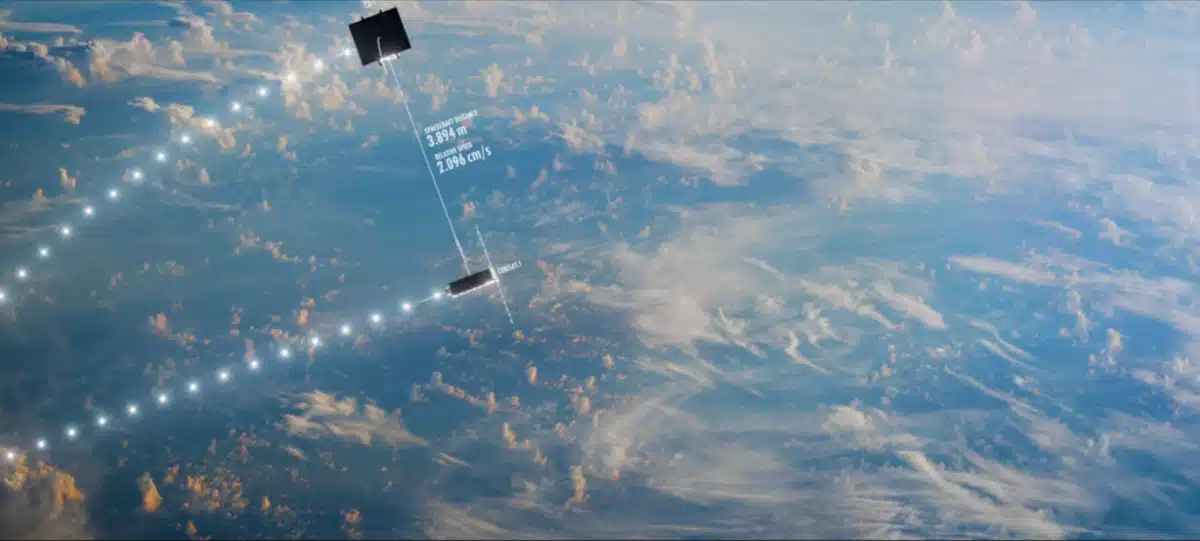 A screenshot from ClearSpace’s promotional video for PRELUDE, showing two spacecraft maneuvering near each other in orbit. Credit: ClearSpace
“The PRELUDE spacecraft will be able to see, understand and precisely track another object in space on its own, without ground intervention,” ClearSpace CEO Luc Piguet told SpaceNews. This level of autonomy is essential for future missions that might involve satellite repair, life extension, or debris removal, especially in the context of growing satellite constellations and increasing orbital congestion.
Equipped with fault-tolerant systems and intelligent onboard software, the spacecraft will be capable of performing repeatable and safe maneuvers around a target object. This is a first step toward building confidence in spacecraft that can operate safely in close proximity to others, a major challenge in orbital robotics.
A Strategic Collaboration Led by ClearSpace and Backed by ESA
ClearSpace is leading the charge on PRELUDE’s design and system engineering, taking responsibility for the GNC development, ground operations, and overall mission management. The spacecraft’s propulsion systems and onboard sensors will be co-developed with partners across Europe’s aerospace sector.
According to SpaceNews, the mission will operate for seven to twelve months, depending on the number and complexity of proximity maneuvers carried out. A spokesperson for ESA’s Space Safety team explained, “The goal is to comprehensively test and validate GNC through structured proximity operations, repeated maneuvers and a gradual validation of autonomy and safety features.”
This measured, step-by-step approach reflects the mission’s dual focus: proving the technology while reducing operational risks. PRELUDE is not a one-off demonstration but part of a broader ESA strategy to position Europe at the forefront of the growing market for in-orbit services.
Setting the Stage for Europe’s Orbital Servicing Future
ESA sees PRELUDE as a vital mission that supports its long-term vision of sustainable and commercial space activity. “This mission,” said Tiago Soares, head of ESA’s Clean Space and Circular Economy Office, “reinforces Europe’s leadership in sustainable and safe space operations and paves the way for commercially viable in-orbit services.”
As satellite launches multiply and space becomes increasingly crowded, the need for active debris removal and servicing capabilities has never been more urgent. PRELUDE fits directly into ClearSpace’s roadmap, which aims to develop spacecraft that can extend the lifespan of satellites, reposition them, or safely deorbit them at end-of-life.
Piguet noted the importance of continuity in developing this market, saying, “We see PRELUDE as part of a continuous transition, not a binary switch from ‘testing’ to ‘commercial.’ In-orbit servicing is an emerging market, and ClearSpace is already running institutional and commercial programs. Our commercial readiness is built on a broader portfolio of missions, system engineering maturity and ongoing customer engagement.”
Prelude Builds on ClearSpace’s Growing Mission Portfolio
ClearSpace, founded in Switzerland in 2018 and now based in Luxembourg, has been steadily expanding its role in the orbital servicing sector. In 2020, the company was awarded a contract by ESA for ClearSpace-1, a mission to remove a piece of space debris. Originally targeting a VESPA adapter, the mission was updated in 2024 to deorbit the Proba-1 satellite. That mission is now scheduled for launch in 2029.
PRELUDE acts as a technical and operational stepping stone. The insights and validation gathered during the mission will directly support the success of ClearSpace-1 and future initiatives. “In this way,” Piguet added, “PRELUDE significantly reduces risk and strengthens confidence across the broader ClearSpace mission portfolio.”
With space traffic increasing and the dangers of orbital collisions rising, the ability to track, approach, and interact with objects in space autonomously could soon become a standard capability for satellite fleets. PRELUDE moves that possibility closer to reality.