
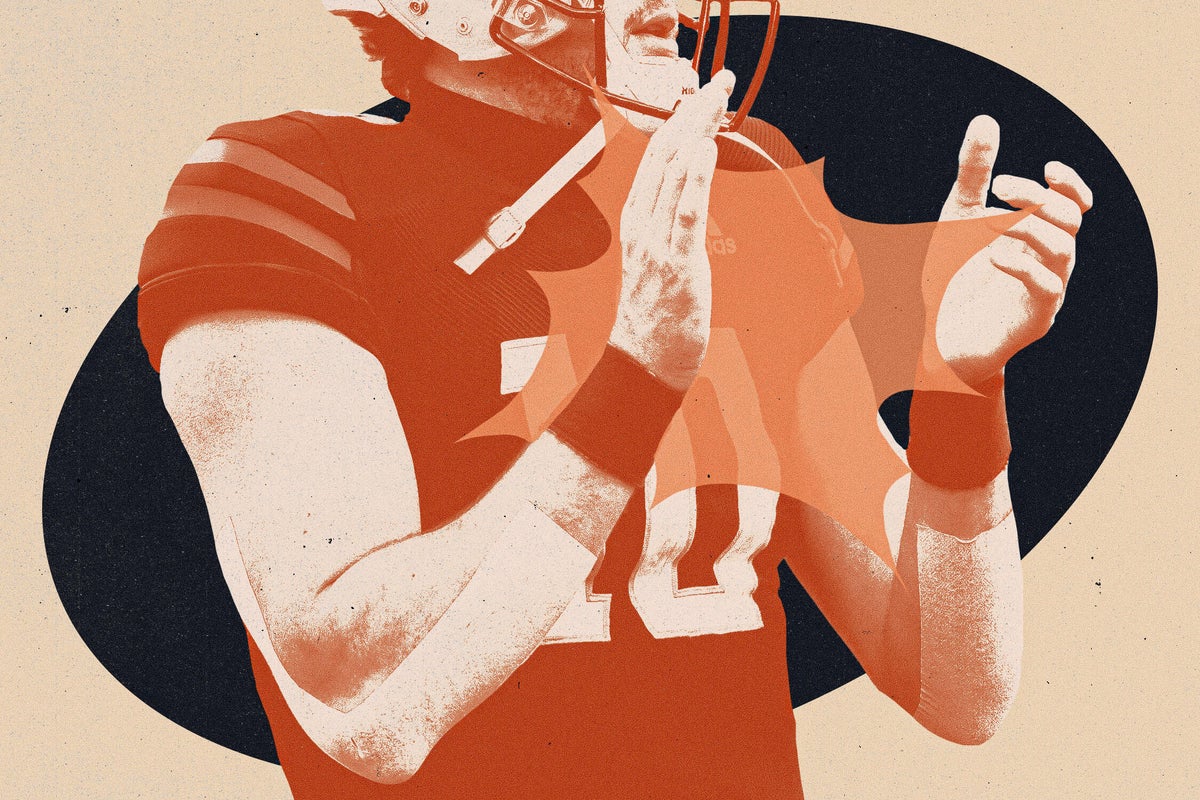
Remember when it was your turn to be quarterback?
In the cozy confines of a backyard or in the sprawling green space of afternoon recess, you stood in shotgun formation as you looked across at the defense, finally ready to ask the poor sap blocking for you to send the ball. It was, for many, a rite of passage to be able to proudly grumble those three buzzwords synonymous with football:
“Hut-hut-hike!”
The poor sap flung the ball at you, and from then on, the show was yours — at least for one play.
Even the most uninterested in football know of the spoken signal required for the quarterback to ask for the ball. It’s like a dunk in basketball or a home run in baseball. But if you will be one of the millions tuning into Monday night’s College Football Playoff national title tilt between the unbeaten No. 1 Indiana Hoosiers and the hometown 10th-seed Miami Hurricanes, you won’t hear either quarterback deepen the pitch of their voice before gesturing to the center to hike them the ball.
In fact, you likely won’t hear either use their voice at all.
Instead, you’ll see Miami’s Carson Beck and Indiana’s Fernando Mendoza smash their palms together, creating a clap with a ringing echo so loud it will cut through the raucous crowd that, at times, creates deafening decibel levels.
The clap signal is now so ubiquitous in college football that it’s increasingly rare that any team in the shotgun formation tries to deceive a defensive line into jumping offside with only their voice. And with offenses now so tailored to play out of the shotgun rather than under center, the clap signal is en vogue. So much so that some middle school quarterbacks enter high school having learned only to clap when ready for the ball.
“It’s simple: You’re going to have to use your hands to catch the ball. It creates a little bit of focus, and your eyes are already focused on your hands,” said TCU head coach Sonny Dykes. “To me, it’s just one less thing you’re trying to coordinate where you’re trying to do something with your voice and trying to do something with your hands.”
The clap signal first entered the football zeitgeist in the early 2000s as a method for visiting teams to combat rowdy stadiums. Rather than trying to hear a quarterback’s call for the ball, the bang of a clap allowed offensive linemen to stay on the same page more easily. It was rare for teams to employ, and the origin remains unclear. Some point to Bob Stoops’ star-studded Oklahoma teams in the early 2000s, others to Urban Meyer’s Florida teams. Baylor under Art Briles’ controversial tenure was another inflection point mentioned.
Dykes said he messed around with installing it when he was the head coach at Cal, but former No. 1 pick Jared Goff didn’t like not using his voice. He preferred to stay with a cadence, which is a term for a set of verbal cues utilized by the quarterback to signal to the rest of the offense when he is ready for the ball to be snapped to him. It wasn’t until Dykes arrived at SMU in 2018 that he started to see the benefits of the clap signal.
“You think about it, you clap your hands, the ball gets snapped,” he said. “Now, if you do it the other way, your center is standing there with the ball looking at the defense, your right guard normally is looking over his left shoulder, and then the quarterback gives that guy a signal and that guy reaches over to the center and the center snaps the ball. You’re creating all of these scenarios that can lead to something bad happening. It kind of cleans up that whole process.”
It also has its loud detractors.
When former coach Jon Gruden had former Ole Miss quarterback Jaxson Dart in for his annual quarterback 1-on-1 interview show last spring, Gruden asked Dart to stand up and show him his snap count. Dart stood up and clapped once. Gruden was perplexed. Dart, who started his career at USC before ending at Ole Miss, was never asked to learn a cadence to offset or interpret what the defense was doing.
“For three years you’ve been clapping?” Gruden said.
At the NFL level, the clap signal is nonexistent. Those same uninitiated sports fans who know about the “hut-hut-hike!” have also been subject to decades of the continued cadence of Patrick Mahomes screaming “WHITE 80!” or Aaron Rodgers repeating “GREEN 19!” or in Peyton Manning’s heyday, “OMAHA!” Seven-time Super Bowl champion quarterback Tom Brady is in a new commercial for Pizza Hut, yearning for the days he yelled “HUT!”
Former NFL offensive lineman and CBS Sports analyst Kyle Long said college offenses using the clap signal to eliminate a precious weapon that offenses at the pro level have.
“There are a dozen ways I’ll kill you with a cadence,” Long said. “There’s only one way you can do it with the clap. While it may be a benefit for other position groups and it simplifies things for the quarterbacks and coaches, as an offensive lineman who really liked to take advantage of the cadence, it’s a detriment to my game.
“Now we’re all playing on an even surface. You’re supposed to have an advantage on offense. You know when the ball is going to be snapped, you know which direction you’re going, you know whether it’s run, pass or screen — these are all advantages, and you’re taking one away with the clap through the sake of simplification.”
Long also mentioned that with the flurry of activity in the NCAA transfer portal every year, it’s easier for offensive coordinators and play callers to keep it simple.
“Even more so now, because of the advent of transient football players and non-continuity as it pertains to your roster, you have to keep things vanilla,” he said. “You’re not speaking the same language, because you’re not sitting next to the same guy you were last year, for the most part.”
Cadences have traditionally allowed quarterbacks to diagnose what type of coverage the defense is deploying on each play. Raising your voice while you test the defense’s patience can lead a linebacker to show they’re planning to blitz, or a safety might drop down closer to the line of scrimmage. That is harder to anticipate with the clap signal.
But Dykes said the fake clap signal — where quarterbacks will widen their arms and bring their hands together quickly before stopping short of making contact — allows quarterbacks to see what the opposition’s plan is on that down.
Some quarterbacks will inform their center that the plan is to snap the ball on two claps or sometimes even three.
But Quincy Avery, a quarterbacks coach who has worked with the likes of C.J. Stroud, Jordan Love, Jalen Hurts and others, said the clap signal has allowed play callers in college football to have more control over in-game adjustments rather than forcing quarterbacks to learn in real time. For example, Avery points out that often, a single clap doesn’t equal an immediate snap of the ball; sometimes it allows the play caller to see how the defense reacts to the clap and can result in an audible call to change the play call. But that comes from the sideline, not from the quarterback.
“It’s simplified because the coach handles everything,” Avery said. “There’s no information for the quarterback to discern on their own in order for the quarterback to be successful.”
Which means the quarterbacks of the 2026 NFL Draft class will roll into Gruden’s studio in the coming months and be asked the same question as Dart. And, odds are, most, if not all, will stand up out of their chairs and smack their palms together.