
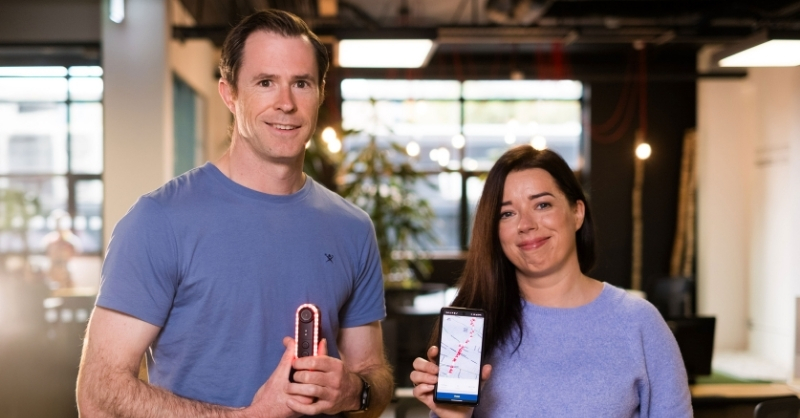
Luna Systems has secured €1.5 million in a late seed round to bring its first AI-powered safety camera hardware to market, marking a shift in how rider safety technology is built and delivered. The round was led by Fundracer Capital and EIT Urban Mobility, with additional backing from Enterprise Ireland.
This funding round accelerates its transition into a full system provider, pairing its AI with purpose-built hardware. This move expands the company’s commercial reach, allowing it to work directly with vehicle manufacturers while also addressing everyday riders.
From university lab to global roads
Luna Systems was founded in Dublin City University in 2020 by Andrew Fleury, Ronan Furlong, and Maria Diviney. It is a deep-tech pioneer in camera AI (computer vision) Advanced Rider Assistance Systems (ARAS), tackling the safety gap in cycling and global motorcycle markets. It leverages cutting-edge techniques to deliver high-performance monocular 3D reconstruction and low-latency edge inference, optimised for constrained compute environments.
ARAS models operate on minimal silicon footprints, enabling deployment on entry-level SoCs for scalable safety. By integrating real-time risk alerts, post-ride incident analytics, and SDK-level OEM integration, While cars have steadily gained collision alerts, blind-spot detection, and other safeguards, cyclists and motorcyclists have largely been left behind, despite rising fatality rates in both segments.
Full safety systems powered by AI
Until now, Luna focused solely on supplying intelligence through software. Two products, one mission: safer rides. Its 2026 roadmap includes two distinct product launches targeting different parts of the mobility ecosystem.
The first is a dual AI camera system designed for direct integration by vehicle manufacturers. Built for both bicycles and motorcycles, the system offers collision warnings, blind-spot detection, headway monitoring, and other safety features that riders typically only see in cars. This OEM-focused product positions Luna as a long-term technology partner rather than a standalone gadget maker.
The second launch brings Luna directly to consumers. Its rear-facing AI camera for cyclists connects to a smartphone app, creating a new category in cycling safety. Like radar-based cycling products, it alerts riders to nearby vehicles, but adds a deeper layer of intelligence. The device records incidents automatically and maps post-ride data to identify dangerous road blackspots, turning daily commutes into actionable safety insights.
Aimed at road and commuter cyclists, the product is designed to boost confidence in traffic-heavy environments. It will be sold directly and through selected European distributors later this year.
Andrew Fleury, CEO of Luna Systems, said: “ADAS technology for cars advances daily. We believe that, just like cars, ARAS will be just as commonplace on bikes and motorbikes in the coming years. Six in ten people are still too afraid to cycle in their area. Fear of mixing in traffic is a crucial barrier preventing people from getting on a bike — especially in busy cities. ARAS can help the bike industry capture new segments, particularly commuter cyclists, where the element of fear is highest. In most countries, people will wait years for perfect cycling infrastructure. Meanwhile, technology is already here that can play a huge role in bridging that gap, helping everyone feel safer as they move through their city.”
René Wiertz, Founder and Managing Partner at Fundracer Capital, said: “Luna’s technology and philosophy exactly align with our vision. To date, high-level innovation has focused significantly on supporting the needs of professional and experienced cyclists, but to support the industry’s growth as a whole, everyone needs to feel safe navigating busy urban environments. After our market consultation, we were impressed by Luna’s ambition and technological competence, and feel they are well placed to lead this mission with their solutions. While radar solutions have captured market attention over the past decade, advancements in AI make vision a better choice from our perspective. Vision AI doesn’t just detect — its data capture capabilities help identify risk blackspots resulting from unsuitable cycling infrastructure, empowering cyclists to map safer routes.”
Peter Vest, Investment & Portfolio Manager at EIT Urban Mobility, said: “We are proud to continue supporting Luna, a company that embodies EIT Urban Mobility’s mission to make urban mobility safer. We are equally delighted to welcome Fundracer, whose deep expertise in the cycling industry brings invaluable insight. With both investors actively engaged in advancing mobility innovation, I am confident we can help Luna scale across Europe and beyond to make cycling more accessible for all.”
Donnchadh Cullinan, Head of Enterprise Solutions at Enterprise Ireland, said: “At Enterprise Ireland, we understand the importance and necessity of emerging deep-tech that offers solutions to global problems. Luna Systems’ highly innovative and disruptive Advanced Rider Assistance Solution addresses a gap in the market, providing cyclists and motorcyclists with the technology to feel safe while navigating busy and congested urban roadways. Enterprise Ireland is proud to invest in the team and looks forward to continuing to work with Luna Systems as it executes its plans. Today’s announcement will further allow Luna Systems to grow and compete, bringing its technology solution to the global market.”