
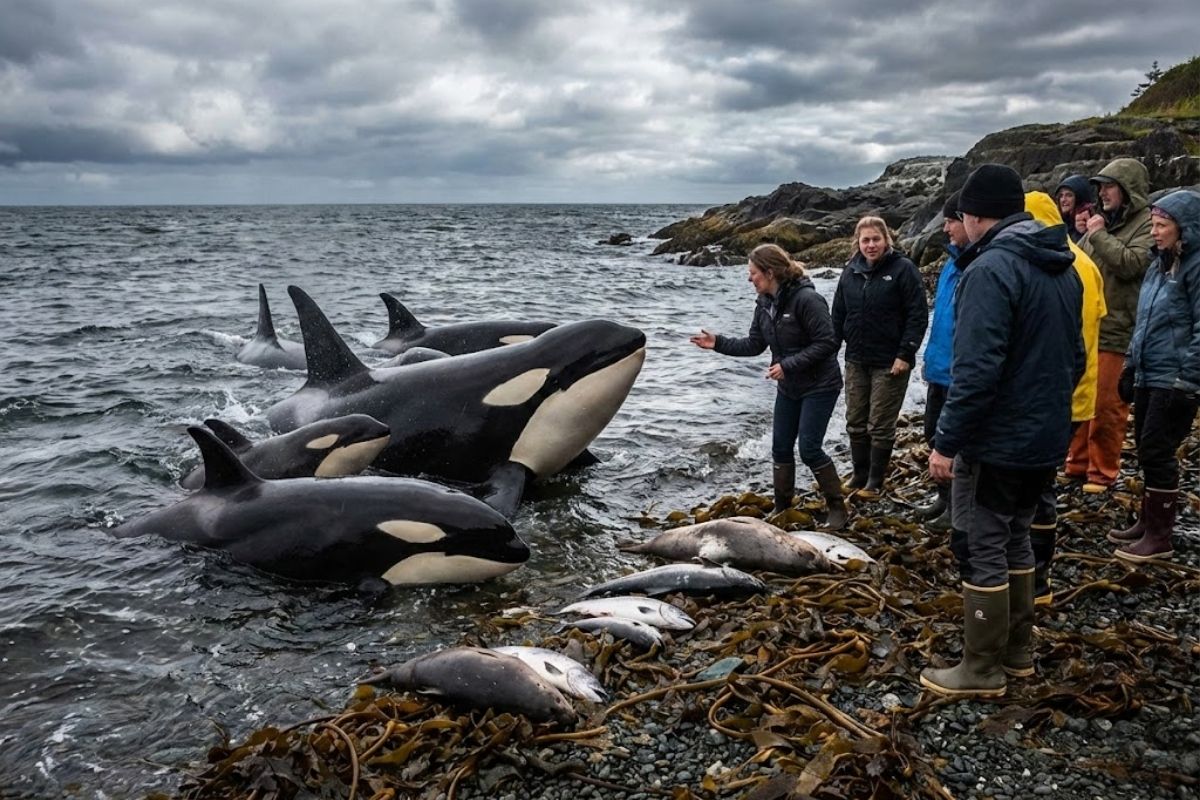
Observations recorded between 2004 and 2024 show wild orcas bringing fish, seals, and birds to swimmers or boats in New Zealand, Norway, Mexico, and Argentina. In 34 episodes, they almost always waited for a reaction and tried again when refused. The pattern reignites alerts and scientific questions about intelligence and curiosity.
The encounter begins in the open sea, in shallow waters near the surface, when wild orcas They approach people who are swimming or watching from the boat and place something they are carrying in their mouths in front of them: a dead animal or a recently captured preyInstead of moving away, they stay nearby, observe, wait, and in many cases, repeat the gesture long enough to transform the moment into an ongoing interaction.
The behavior was recorded on 34 occasions over 20 years, between 2004 and 2024, in four different regions of the planet: New Zealand, Norway, Mexico, and Argentina. In about a third of the cases, humans were swimming in the sea; in the remainder, they were in boats. The most unsettling point is that… as Wild orcas not only deliver They expect a human response from their prey; they anticipate a human response.as if the outcome of the scene were an essential part of what they are trying to do.
Where did these interactions take place and why is this noteworthy?
The occurrences were distributed across four distinct areas, separated by oceans and by different orca cultures. This matters because the pattern does not appear to be an “eccentricity” of a single location.
— ARTICLE CONTINUES BELOW —
The same type of gesture was seen in New Zealand, Norway, Mexico, and Argentina., suggesting that the initiative can emerge in different populations when certain conditions of perception and behavior are present.
Another consistent detail is the context: the wild orcas Observed fish offering food, they live in shallow waters, hunt prey on the surface, and rely heavily on their vision.
However, groups that hunt in deep waters, relying heavily on echolocation, did not exhibit the same behavior.
This difference reinforces the idea that The way they perceive their environment can shape how they choose to interact with something unusual.including humans.
What is the “offer” like and why does it seem deliberate?
This is not a quick and random approximation. In 97% of cases, the wild orcas They waited for a human reaction.
Sometimes for five seconds. At other times, for five minutes. This waiting period changes everything, because it indicates that the act doesn’t end with “putting the food down.”
The central point is the expectation of a response….as if the orca were observing a choice, an acceptance, a refusal, or any sign that confirms that the human understood what was put there.
Repetition also plays a role. When people refused, many orcas would take the item back, share it with other orcas, or swim to someone nearby and try again.
This sequence of events demonstrates persistence and flexibility, characteristics that, in practice, transform a “delivery” into a social behavior with a beginning, middle, and end.
What happens when humans refuse, and why does this reinforce strangeness?
Most people refused the gift. In about 88% of cases, the food was not accepted, which is understandable given the shock and the risk involved.
Even so, wild orcas often insisted, retrieving the prey and resuming the attempt at interaction.
In the few episodes where the human accepted, something even more revealing happened: people threw the item back to the orcas, and they immediately offered it again.
This cycle creates a pattern similar to a “trade game,” in which the prey becomes an object of communication, a marker of attention and response, more than just food.
One episode described as particularly impressive involved researchers: an orca delivered a dead bird, the human returned it, and the orca brought it back repeatedly.
The persistence transforms the scene into a kind of conversation through gestures., in which the prey functions as a message.
What types of prey were delivered, and what does this suggest?
The items offered were varied: fish, seals, seabirds, turtles, jellyfish, and even seaweed.
Some were alive, others already dead. This diversity matters for two reasons.
First, she shows that Wild orcas do not limit their “offering” to a single type of hunting.This weakens the interpretation that it would be strictly feeding behavior or a discarding of food.
Secondly, the presence of algae alongside animal prey suggests that, in certain cases, the object may function as a “gift” in the broadest sense, something that is brought to the human to elicit a response, not necessarily to provide food.
When more than one orca is involved, the behavior takes on a more habitual appearance.
In some cases, more than one orca from the same family participated in the action. This is a crucial detail because it points to… a social and potentially learned componentIf the behavior involves related individuals and is repeated with collective participation, it may be being observed, imitated, and incorporated as a practice within the group.
Another point that reinforces this interpretation is that the offers did not come only from young animals. Adult males, females, and even puppies participated.
The presence of different ages and genders increases the likelihood that food sharing will be a solid cultural foundation., already existing in the species, which in certain situations extends to contact with humans.
Among orcas, sharing food within the community is a known and socially relevant behavior.
When wild orcas When animals bring food to humans, some scientists interpret this as a rare example of widespread reciprocity, where one animal helps another without expecting an immediate direct benefit, understanding that such actions strengthen bonds over time.
The hypothesis gains strength because, in most cases, researchers did not record clear signs of playfulness accompanying the delivery.
Typical play behaviors, such as blowing bubbles or performing acrobatics, were observed in the minority. This inclines the interpretation towards sharing and social investigation.and not for random fun.
Why the nickname “killer whale” confuses more than it explains.
Despite their popular name, orcas are not true whales but giant dolphins, the largest member of the Delphinidae family, which includes most of the animals known as dolphins.
And the nickname “assassin” comes from a linguistic misunderstanding: Spanish sailors used an expression that meant “whale killers,” because in groups they hunted even larger whales.
Over time, the words were reversed and the meaning changed.
This distinction matters because The image of indiscriminate violence hinders the understanding of real behavior..
Orcas are efficient social hunters, but they also live in structured families, transmit cultural knowledge, recognize themselves in mirrors, and use their own vocal dialects.
Some populations maintain hunting traditions passed down from generation to generation.
In this context, an “offer” may be less about aggression and more about communication, learning, and response testing.
Curiosity and investigation: when humans become objects of study.
Another strong hypothesis is that of exploration. Orcas are naturally curious and may offer food as a way to test how humans react.
In this scenario, the prey becomes an instrument of experimentation: approach, surrender, waiting, observation, repetition.
What appears to be “kindness” may also be an investigation., an attempt to understand who is on the other side of the encounter.
This angle aligns with the fact that orcas wait for a response for seconds or minutes. This waiting period acts as a window for observing human behavior.
If the human refuses, the orca learns something about refusal. If it returns the animal, it learns something about exchange. If it catches and releases, it learns something about hesitation. The behavior, then, is not just the gesture, but the entire process.
This doesn’t mean it’s safe, even without aggression.
The observations also reinforce a crucial point: Wild orcas do not appear to see humans as a threat or as food. in these episodes.
However, this does not make the interaction safe.
Orcas are extremely strong and intelligent, and the warning is clear: this type of interaction should not be encouraged.
Accepting a “gift” may seem harmless, but it can confuse animals and increase the risk for both sides.
The practical advice is to observe and enjoy the moment without interacting, maintaining distance and avoiding reinforcing a pattern that could become more frequent and riskier.
What is most disturbing about this behavior?
When a giant ocean predator chooses to approach, deliver prey, and await a reaction, the scene begs an uncomfortable question: How far does the capacity for social intention in a wild animal extend?.
The dataset, repeated over two decades across multiple countries, awaiting a response and persistence after refusal, points to something beyond mere chance.
The result is a stark message regarding how many people still view these animals: Wild orcas may be curious. enough to attempt structured contact., with their own rules, as if they were trying to understand our response in the same way that we try to understand theirs.
What if an orca left prey at your feet in the sea? Would you return it, ignore it, or instinctively accept it?