

The federal government has introduced a new bill to tackle racial hatred and antisemitism, as well as further tighten gun control laws. The timing is tight, with just one week given between the proposed bill being made public and the vote in parliament. The explanatory memorandum is 319 pages long.
There are four key elements: criminalising and increasing penalties for hate speech; increasing the grounds for a minister to cancel a visa through the character test; listing certain organisations as hate groups; and establishing a new gun buy-back scheme along with greater import controls on guns.
Let’s see what the bill proposes.
How would hate speech changes work?
Until now, racial hatred has been dealt with by civil laws at the federal level. The centrepiece of the government’s bill would introduce a new offence criminalising the promotion or incitement of hatred.
The law would require a court to find that an individual charged with that crime had “intent” to cause hatred, and the conduct would cause a “reasonable” person from that targeted group to “fear harassment, intimidation or violence, or for their safety”.
Sign up: AU Breaking News email
The offence would have a maximum penalty of up to five years’ imprisonment, with higher sentences available where offences are aggravated, including where a religious official or preacher is involved.
While NSW is considering whether to ban specific phrases, including “globalise the intifada”, heard at protests globally, these federal laws would not do so. Pressed at a hearing on Wednesday on whether phrases could be banned in the bill, the attorney general’s department said it was “not possible” to comment on whether certain phrases would be considered unlawful, and that an alleged offender’s state of mind would be considered by the court.
Luke McNamara, a law professor at the University of NSW, says the new offence follows a similar structure to laws that were introduced last year in NSW, and that the onus to show both intent by an individual as well as fear within a community is an “important safeguard”.
“I think without that safeguard, there would be a risk that a person could be convicted of this offence and punished where they had no intention to incite hatred,” McNamara said.
“It seems really critical that we emphasise that we need to establish an intent to promote or incite [violence], because we’ve heard these arguments from protesters say: ‘that’s absolutely not what we intend when we use those phrases, it’s an expression of solidarity with the people of Palestine’,” McNamara said.
The draft bill also includes a proposed legal defence that states the legislation does not apply to an individual directly quoting a religious text, a carve-out the opposition and some groups including the Executive Council of Australian Jewry have raised concerns over.
McNamara said the proposed legislation sets a “high bar” for prosecution, particularly in response to concerns around limiting free speech. He said the legislation allows individuals to express their political views but limits “where you intentionally set out to promote or incite violence [towards] another group”.
He said the law would not be a “magic fix”.
“The criminal law [has] never magically changed societal attitudes or practices so that all harms and risks are dissolved … [but it] will provide a level of reassurance to some parts of the Australian community, particularly parts of the Jewish community, and that’s an important objective in itself,” McNamara said.
What will be included in the migration character test?
The changes will increase the grounds that the home affairs minister can cite to cancel or reject a visa if they believe an individual has engaged in hate, vilification or extremist conduct. These grounds would sit within the already existing character test, but would not give a minister more powers.
Under the draft bill, a person could now have their visa cancelled or rejected if they have been associated with a terror group or prohibited hate group; been involved with a hate crime – whether or not they have been convicted of a hate crime offence; if the person has made or endorsed statements involving the “dissemination of ideas based on superiority over or hatred of other persons on the basis of race, colour, or national or ethnic origin”; or if the person’s conduct may create a risk of harm to the Australian community or a segment of the community.
These grounds will also apply to those applying for a temporary safe haven visa, which is for people seeking asylum.
If a person is refused a visa on character grounds, that refusal is permanent unless revoked by the minister.
Will there be tighter checks on gun owners?
Many of the changes will be implemented at the state and territory level, but the federal government will introduce a few new regulations.
Background checks for current and prospective gun owners will become more rigorous and more frequent under the legislation, which will allow for more information sharing between states, territories, the commonwealth and security agencies.
The bill would allow the Australian Security Intelligence Organisation (Asio) and the Australian Criminal Intelligence Commission (ACIC) to provide intelligence to AusCheck, the agency charged with administering the scheme, when they are conducting an assessment. It will also enable AusCheck to verify an individual’s citizenship.
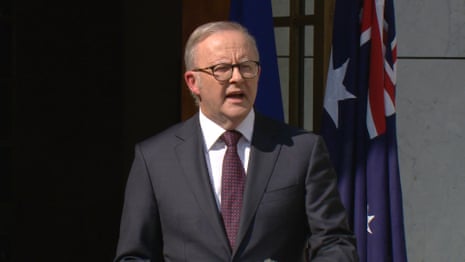 Anthony Albanese announces royal commission after Bondi beach terror attack – video
There will also be two mechanisms for ongoing background checks: a “point in time” assessment that can be done by AusCheck, and an “own motion” check where security agencies will be able to initiate investigations. This would allow agencies to respond if any new intelligence comes to light.
As part of the omnibus bill, the government will create a national buy-back scheme, promised in the immediate aftermath of the Bondi terror attack.
The bill also tightens the importation of a range of firearms including guns with belt-fed ammunition, magazines of more than 30 rounds, firearm sound suppressors and speed loaders, and it ends the use of open-ended import permits.
What is the new ‘hate group’ listing?
The fourth element of the hate speech bill will create a new “hate group” listing, which would criminalise an individual being a member, recruiting, training or providing any support to a hate group.
The director general of security, who is also the head of Asio, would make a recommendation to the home affairs minister to designate an organisation as a hate group.
The minister would then need to gain agreement from the attorney general, provide a brief to the opposition leader, and take that recommendation to the governor general for listing.
An individual “intentionally” directing the activities of a designated hate group would face a penalty of 15 years’ jail, whereas a person who directs activities of a group while “reckless” to the fact that it is listed, faces up to 10 years. An individual who is found to intentionally be a member of a hate group will face up to a seven-year jail term.
Two groups, the National Socialist Network, and Hizb ut-Tahrir have been identified by the government as targets for the hate group list. Both have been flagged by security agencies, and on Tuesday, the NSN said it would disband before 11.59pm on 18 January, the day before the bill will be introduced to parliament.