
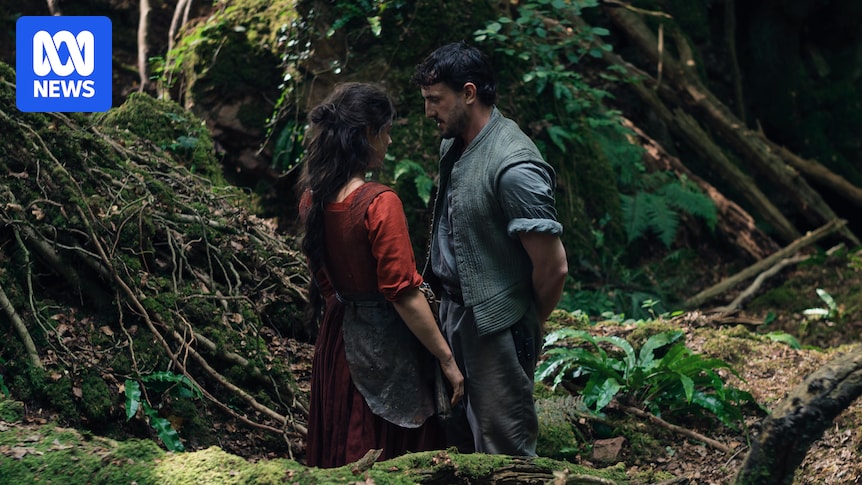
Rarely do biopics rise above the standard of bad fan-fiction.
Fast facts about Hamnet
What: A historical drama centred on the family tragedy that would inspire the creation of Hamlet
Starring: Jessie Buckley, Paul Mescal, Jacobi Jupe
Directed by: Chloé Zhao
Likely to make you feel: In need of a few tissues
Take a great artist, discard any inconvenient facts, and you can distil the enormity of their existence into a calcified, Oscar-ready formula: the traumatic childhood, precipitous fall, chronic infidelity and miraculous comeback.
Historical figures, like superheroes, make for lucrative IP; it makes sense that the movies are predisposed to treat them like toy dolls (or, in Robbie William’s case, a CGI ape).
Hamnet, an adaptation of Maggie O’Farrell’s 2020 bestseller, is at least honest about being a work of fiction.
The script, co-written by O’Farrell and director Chloé Zhao, is loosely bound by the few concrete facts that remain of William Shakespeare’s life: his marriage to Anne Hathaway in the late 1500s, the birth of their son Hamnet, that child’s young death at age 11, and the fruition of his great tragedy Hamlet (a name interchangeable with Hamnet during its era, the film explains) several years later.
Hathaway is reconfigured as Agnes (Jessie Buckley, I’m Thinking of Ending Things), the latest in a line of unruly “forest witch[es]” who — like many of Zhao’s soulful outsiders — harbours an ineffable connection to the natural world, though spends her time under the care of a disapproving stepmother (Emily Watson, Small Things Like These).
Beyond her extensive knowledge of herbal remedies and love of falconry, she’s been gifted with psychic foresight.
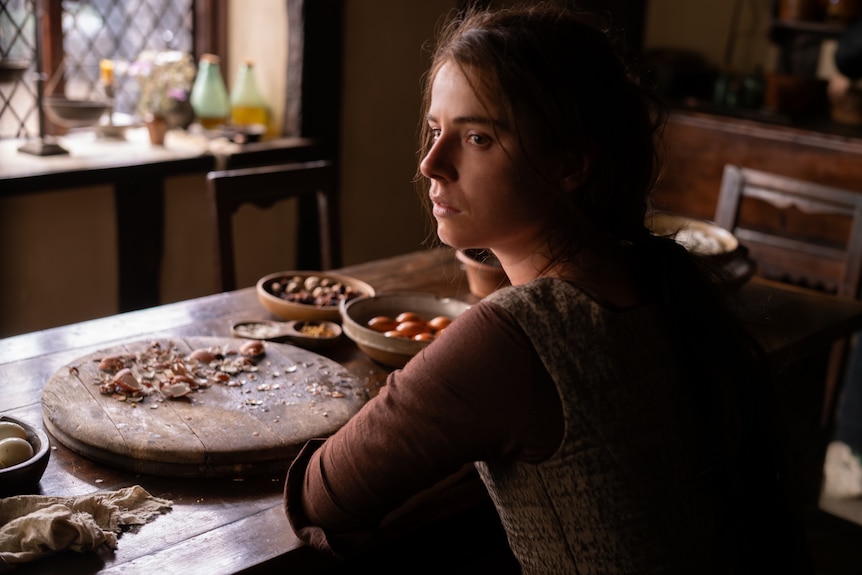
Jessie Buckley won a Golden Globe and a Critics Choice award for her performance as Agnes in Hamnet. (Supplied: Universal)
It’s a radical re imagining that not only aligns Agnes with the audience’s foreknowledge — dramatic irony be damned — but imbues the creation of Hamlet with a sense of magic amid the mundane.
The Bard himself is brought down to earth.
Played by Paul Mescal (Aftersun) — the poster boy for indie tear-jerkers in the 2020s — Will is introduced as the meek Latin tutor of Agnes’ step-siblings, working to pay off his father’s debts, and staying up late to write by candlelight.
This is a Shakespeare who broods, cowers and stumbles over his own words; Mescal struggles to find the right note, his muted delivery often sounding bored.
He playfully courts Agnes, regaling her with the tale of Orpheus and Eurydice — this is not a movie light on portent — and Agnes soon finds herself pregnant. A wedding hastily follows, and Agnes gives birth to their first child in the woods, the reverberations of which carve a crater into the earth.
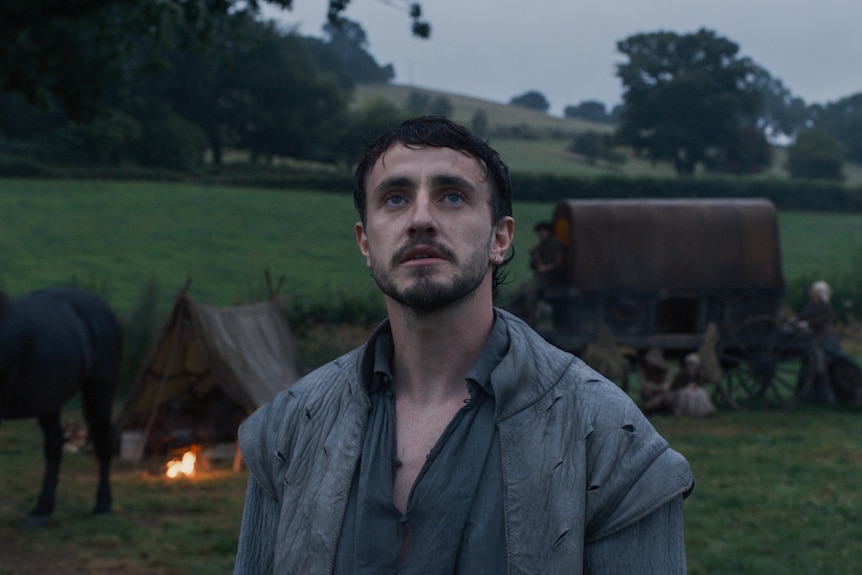
Paul Mescal plays a fictional version of William Shakespeare. (Supplied: Universal)
Though brevity may be the soul of wit, Hamnet’s erratic pacing ends up rushing between its emotional peaks, demanding an endless torrent of tears from its audience.
In a series of quick vignettes, we lurch forward in time to witness the taxing, protracted birth of twins Hamnet (Jacobi Jupe) and Judith (Olivia Lynes), then another eleven years later to the days preceding Hamnet’s death.
Hamnet is at its most vibrant in depicting children as both a conduit and source of creativity.
The Shakespeare household offers a bustling portrait of domestic bliss, in which naturopathy and Latin lessons are interspersed with stage combat practice and play-acting. The twins channel the slippery mischief of their father’s work, swapping identities, clothes, and voices with one another; the three children later run amok as the weird sisters.
Chloe Zhao & Maggie O’Farrell talk Hamnet on The Screen Show
When Will — now working as a successful playwright — is called to London, the plague roars through the house, claiming the life of his only son.
If a mediocre blockbuster is nothing without its action scenes, Hamnet is nothing without the spectacle of Buckley reaching for the firmaments as Agnes endures her child’s passing. It’s a bruising depiction of motherhood wrenched from the actor’s volcanic depths; grief as a heaving, full-body exorcism.
There are too many overlapping strands in Hamnet for anything to linger beyond its intense emotional gauntlets.
The title character, enlivened by Jupe’s twinkling curiosity, is only a fleeting presence in his own film.
The domestic fallout of his death is elided by another time jump, in which Zhao diverts focus towards the creation of Hamlet.
There are only scant glimpses of Agnes as the suffering wife of an avoidant genius who, having missed his son’s death, continues to devote himself to his work away from home.
In the film’s climax, set at the nascent globe theatre, O’Farrell and Zhao collapse the divide between the artist and his art, revealing the creation of Hamlet as its own Orphic journey: a process of a father searching beyond the veil.
Hamnet is retrieved from the underworld, reconfigured as the Prince of Denmark. The tragedy is reframed as one of grief over revenge.
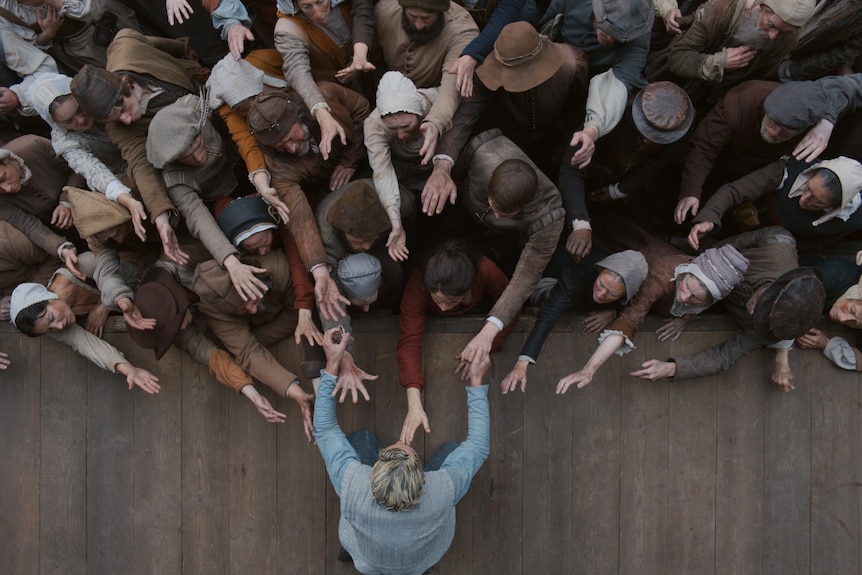
Chloé Zhao’s Hamnet climaxes at the historical Globe Theatre. (Supplied: Universal)
Hamnet’s thesis feels too neat but is undeniably moving in its portrayal of theatre as a form of resurrection.
Too bad, then, that Zhao — once a director known for her earthy, documentary-like minimalism — smothers the whole film with Max Richter’s grandiloquent score, culminating in a groan-inducing deployment of On the Nature of Daylight — one of the most overused orchestral works of recent years, having been ladled over anything from Arrival to The Last of Us (and ripped off in countless more examples).
Hamnet’s raw power is refined into awards-worthy pabulum; any hope of meaningful catharsis is instantly dashed. Its momentous historical figures are painstakingly brought to life, only to be robbed of depth.
Hamnet is in Australian cinemas now.