
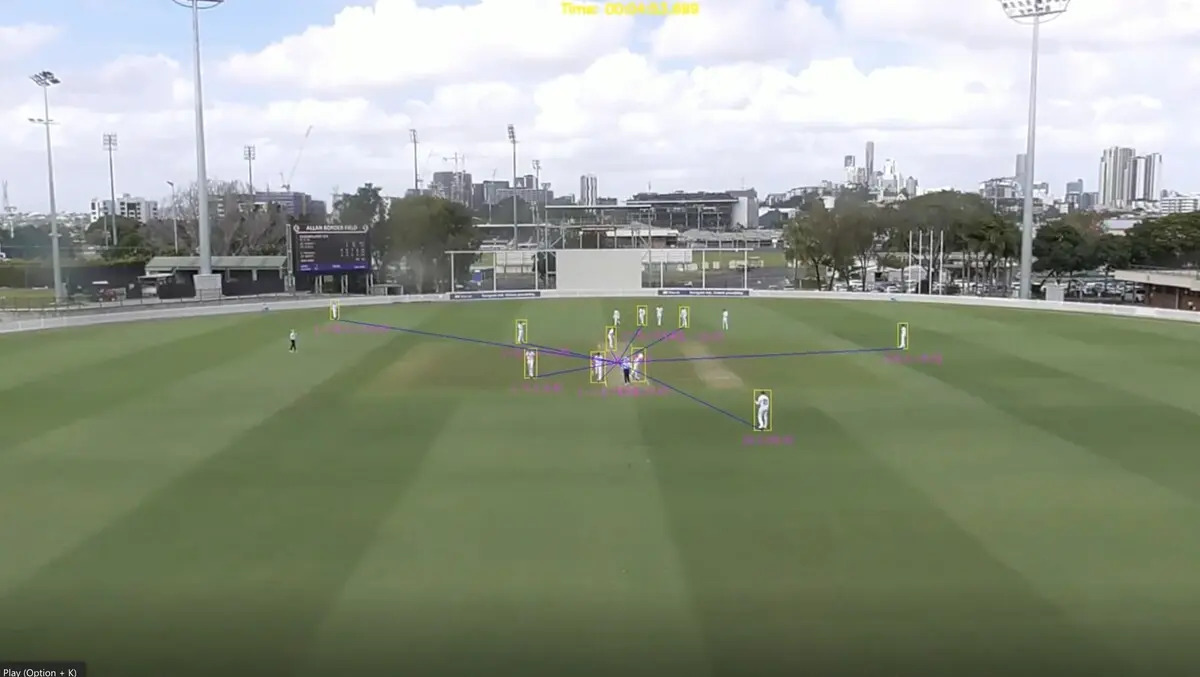
CQUniversity has started a six-month project with Cricket Australia that uses artificial intelligence and computer vision to track fielding positions in real time.
The work focuses on capturing where fielders stand during play and recording that information consistently. Cricket Australia currently records many positions manually. The partners said the process can take time and does not always produce the same results across matches and analysts.
CQUniversity said its approach combines sport science and AI. The project aims to quantify common and uncommon field settings, which range from standard positions such as slips and gully to more bespoke placements based on batters, bowlers and match situations.
Innovation Challenge
The collaboration emerged from Cricket Australia’s Innovation Day with the Global Sports Innovation Centre powered by Microsoft in 2025. The event asked participants to propose a video and AI-based approach for monitoring fielding positions in real time.
CQUniversity’s team, led by Professor Fabio Serpiello, reached the finalist stage of the international challenge. The group will now design and deliver a solution for Cricket Australia.
“Our research-informed development will use computer vision technology and AI to solve the current challenges around strategically assigning fielding positions,” said Professor Fabio Serpiello, Director of Sport Strategy, CQUniversity.
Data and Vision
Cricket Australia will provide match vision and analysis as part of the project. It will also give the researchers access to live test events. CQUniversity said this material will feed training for computer vision algorithms.
The organisations said that fielding position data has value beyond a single match. Coaches and analysts use field settings when reviewing tactics, comparing opponents, and planning for future series. Analysts also consider how field placement shifts across overs and formats.
Cricket’s field can accommodate many arrangements within the laws and playing conditions. Teams can place fielders in well-known positions and in hybrid locations between traditional labels. The partners said that variability makes field placement difficult to capture systematically without a consistent method.
Research Team
Serpiello leads the project alongside Associate Professor Santoso Wibowo, described as an intelligent information systems expert, and Dr Anwaar Ul-Haq, an AI specialist. Dr Zhenglin Wang contributes automation and machine learning expertise.
Dr Nathan Elsworthy and Associate Professor Aaron Scanlan also join the group. CQUniversity said they bring experience in movement tracking and decision-making in team sport.
Manual to Real-Time
Cricket Australia said it wants to improve how it collects and uses fielding data during matches. The organisation framed the work as a shift away from manual processes and towards automated capture from video feeds.
“Historically, capturing fielder positions has been a manual, labour-intensive task, prone to error.
“We are on a mission to change that with a cutting-edge solution that efficiently collects this data and enables real-time monitoring, ultimately providing novel and critical information for coaches, analysts, and athletes across Australian cricket.
“CQU technical proficiency, paired with Cricket Australia’s domain expertise and contextual experience, ensures solutions are not only technologically sound but also highly practical,” said Johnpaul Caia, Senior Manager of Performance Data & Technology, Cricket Australia.
The project sits within a wider push by sports bodies to standardise match data capture and improve speed of analysis. Cricket has seen growth in ball-tracking, wearables, and video-based review workflows. Fielding position data remains less standardised across competitions, particularly when it relies on manual labelling.
CQUniversity said it launched its SPORT Strategy 2025-2028 in 2025. The programme sets a framework for collaboration with grassroots groups, government and industry partners. The university said it will use the strategy to guide its work across sport and exercise, physical activity, and occupational and rehabilitation therapies.
The CQUniversity and Cricket Australia team will design and deliver the fielding position monitoring solution during the six-month project. “CQU technical proficiency, paired with Cricket Australia’s domain expertise and contextual experience, ensures solutions are not only technologically sound but also highly practical,” said Caia.