
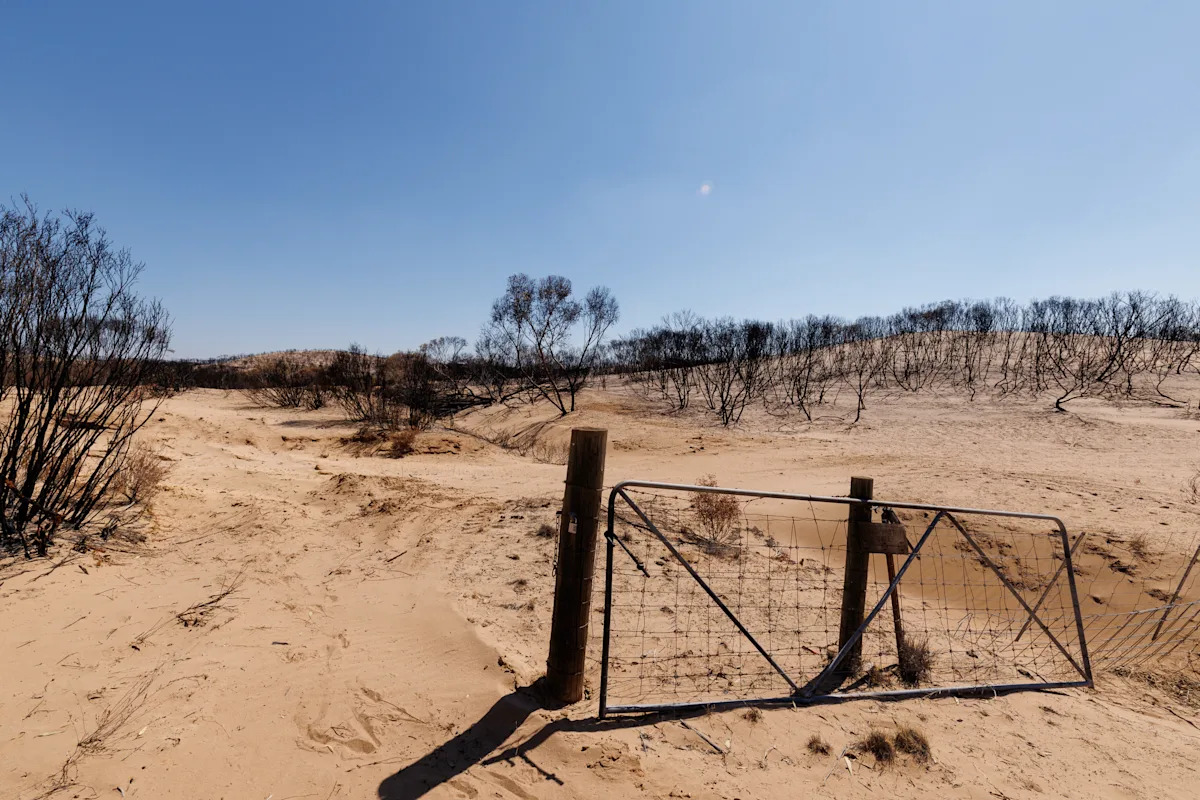
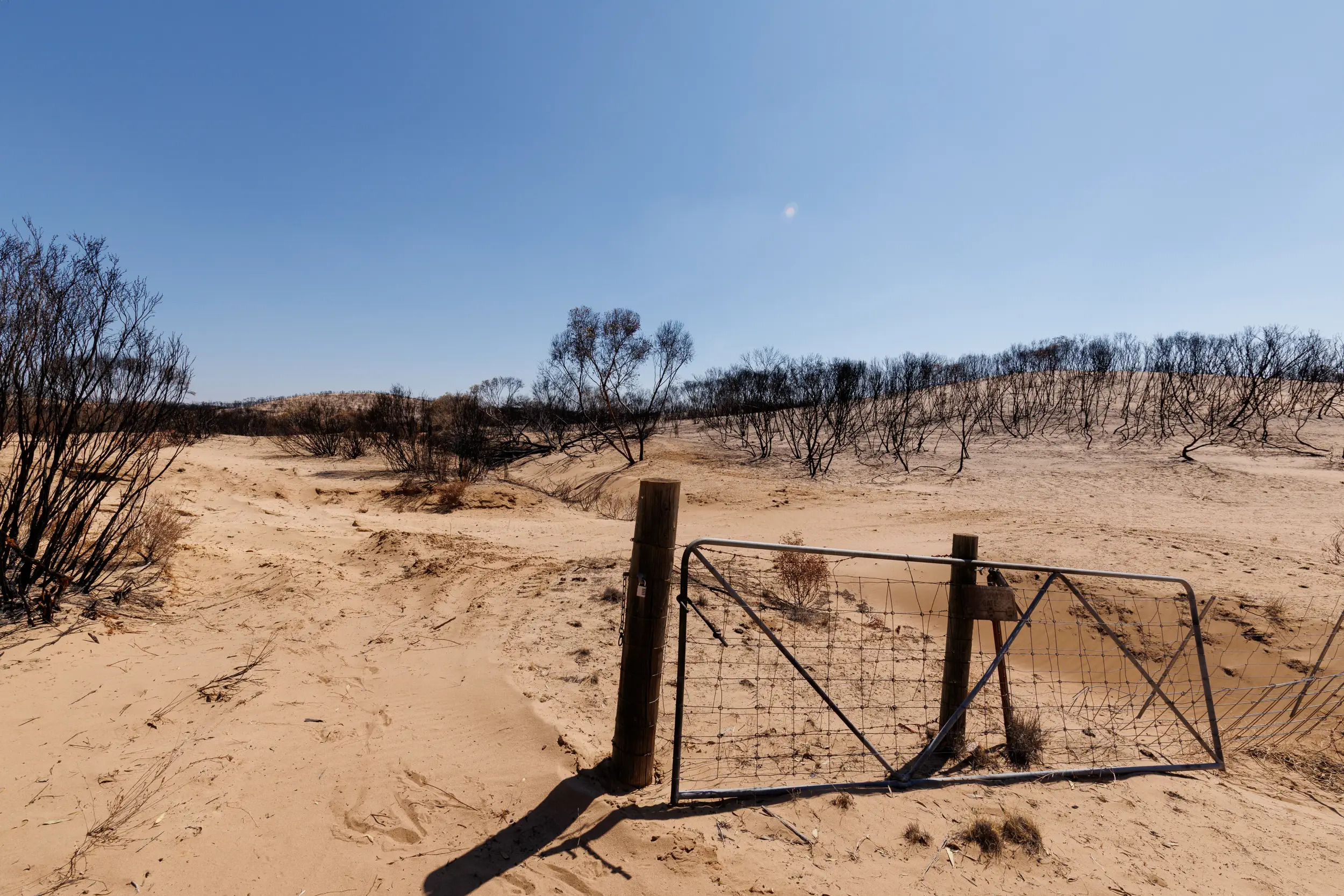
Beyond this fence lies the expansive Wyperfeld conservation area, which has been devastated by bushfires. Source: Michael Gooch – Explore the Mallee
Beyond this blackened fenceline lies a vast wilderness that has been deemed too dangerous to enter. Last week, 60,000 hectares of ecologically important Mallee country was scorched by the Wyperfeld fires as Victoria experienced a heatwave.
A decade earlier, cameras had been set up to monitor the rare and endangered animals that live across the vast semi-arid Big Desert-Wyperfield conservation area. Scorched trees, hot ash, and underground fires still pose a danger inside the park, and until it’s safe to enter, no one knows what the cameras captured.
But they likely show the response of the region’s Wilkerr population, a type of genetically distinct dingo that was shot, trapped and poisoned to near extinction, and fewer than 80 are believed to remain.
Pictures shared with Yahoo News by Professor Euan Ritchie, his Deakin University research team, and their collaborator Big Desert Dingo Research show some of the contents of SD cards, collected in previous years.
Many have jet-black colouring, a vastly different appearance to how most Australians picture dingoes. But just like wolves in Europe, it’s common for the species to vary between regions.
Related: Uproar as zoo forced to install controversial warning sign about iconic Aussie animal
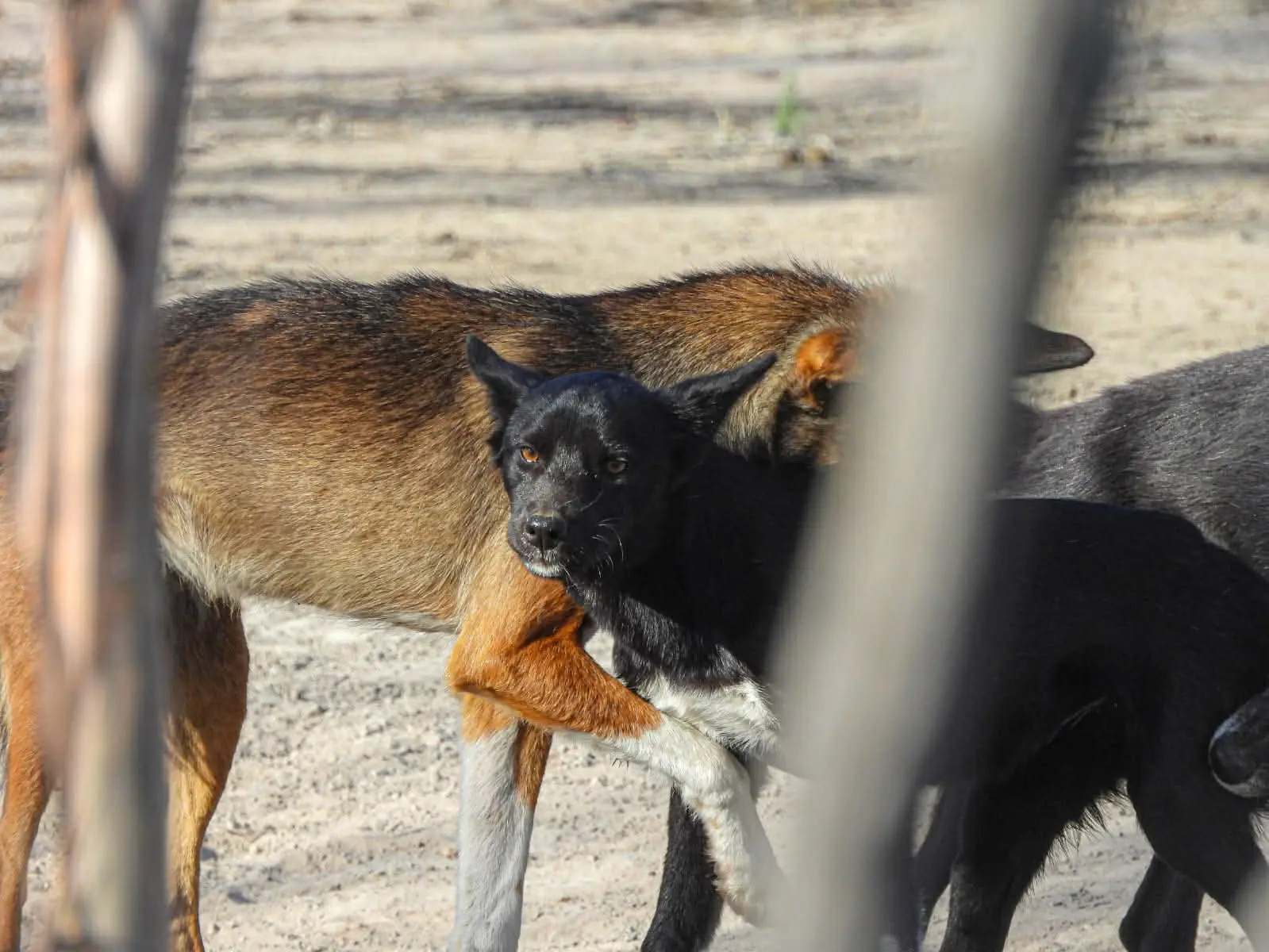
Rare Wilkerr photographed in the Big Desert-Wyperfield conservation area in December 2024. Source: Big Desert Dingo Research
Ritchie hopes that even if the cameras were destroyed, the SD cards will be salvageable, as they contain important information about the Wilkerr, possibly even how they reacted as the blaze approached.
“As horrible as these fire events are, they are also an opportunity to learn about how wildlife responds to fire,” he told Yahoo News.
“We know that dingoes are capable and cunning in terms of surviving fire, but we just don’t really know much at a larger scale about how they respond.”
Urgent concern threatening future of rare Wilkerr
Wilkerr was the name given to dingoes by the Wotjobaluk Nations People, and it is one of their most important totems.
They have thrived in the landscape for thousands of years, but now face a new threat to their survival.
For decades, the Victorian Government had allowed farmers to kill them because the native predators had been known to hunt the sheep introduced to the region.
They were only protected in 2024, and by that time, there were concerns that the population was so low they could face a genetic bottleneck and inbreeding.
Many farmers are furious at their protection, and some have publicly warned on social media that any dingo wandering onto their properties would be shot.
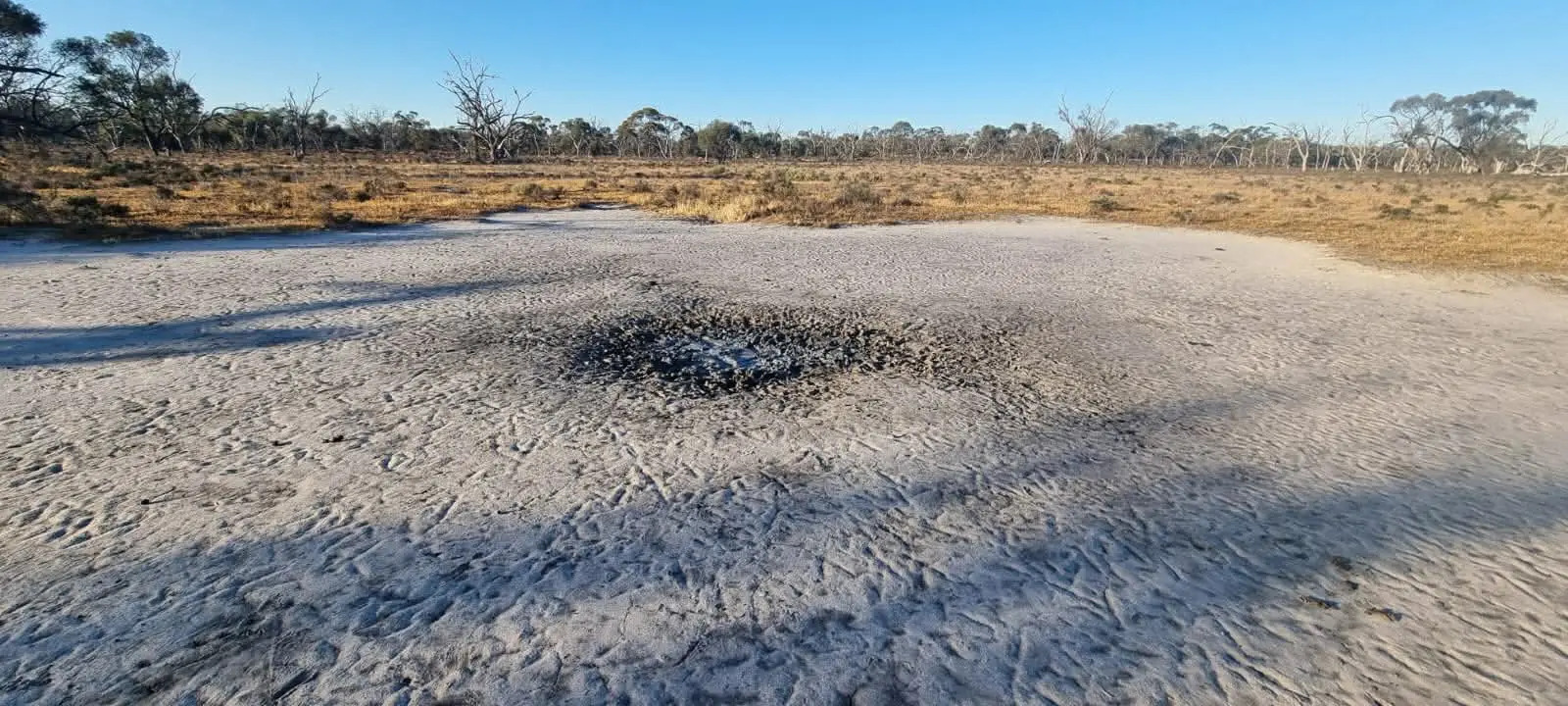
Water has rapidly been drying up around the Big Desert region as this photo from November highlights. Source: Big Desert Dingo Research
Both Ritchie and Ellisha Martin from Big Desert Dingo Research are concerned that the Wilkerr could be forced to leave the wilderness area out of necessity following the blaze.
They have called on the Victorian Government to urgently distribute water where it’s safe to do so, to encourage them not to leave, and to protect the farmers from having their sheep scavenged.
“We’re not asking for the water to be permanent,” Martin told Yahoo.
“Dingoes can go a week or so without water, but in these really dry spells, and after fires, when they’ve got nothing, it could potentially cause predation issues with farmers .”
Before the fires hit, the dingoes were relying on the odd muddy puddle to survive, but now they’re almost certainly dried up, and the kangaroos they once hunted have likely fled or been killed.
On Wednesday, Victoria’s environment department (DEECA) said it was “aware of the potential impact on dingoes”.
It said it would “consider options as part of stabilisation and recovery”, and would not be drawn specifically on the urgent request for water inside Big Desert-Wyperfield conservation area.
Fears for critically endangered pink cockatoo
More broadly across the state, DEECA is in charge of the response to help wildlife displaced following the bushfires and associated heatwave event.
Thousands of animals are understood to have been impacted, including thousands of grey-headed flying foxes which are threatened with extinction.
DEECA warned that due to safety concerns, members of the public and wildlife carers and rescuers are prohibited from entering the fire grounds.
“DEECA Wildlife Field Assessment Teams have been deployed and are currently operating on firegrounds across the state, where it is safe to do so,” it said.
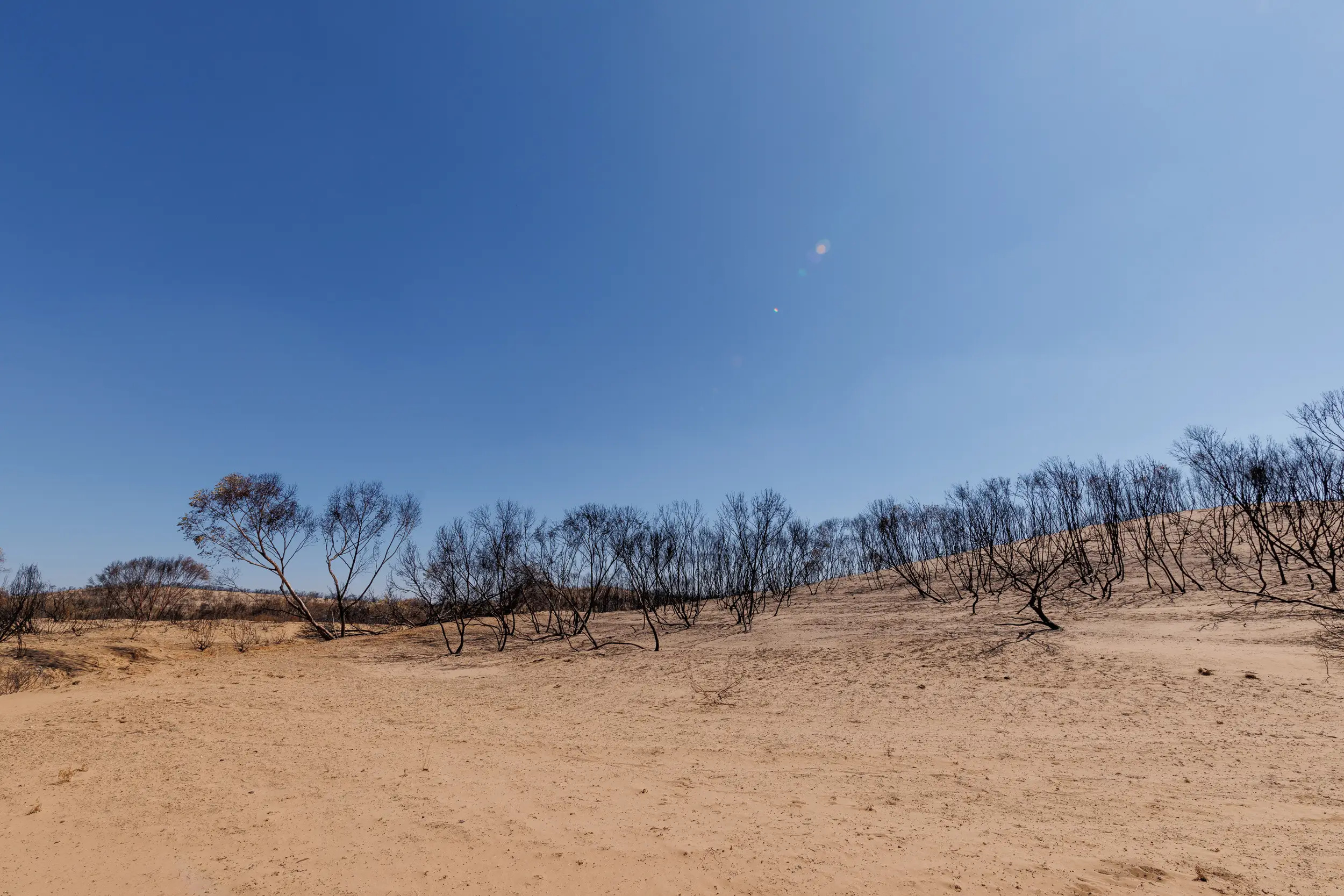
The national parks have been severely burned and there are concerns for the wildlife that called them home. Source: Michael Gooch – Explore the Mallee
Local tourism operator Michael Gooch shared photos of the edge of his property with Yahoo, which hint at the destruction that occurred inside the Big Desert-Wyperfield conservation area.
Because it’s been so dry, the region has been impacted by multiple fires since December. Then Friday during the heatwave, one bushfire became so big that it created its own weather system, including lightning strikes that worsened the situation.
“It’s not been the best few weeks,” he said.
Gooch studies the wildlife that lives in the park, including the pink cockatoo, which is critically endangered and has likely lost three-quarters of the hollow-bearing trees in the region.
“Wyperfeld has always been carrying the brunt of the Victorian population of pink cockatoos,” he said.
But it’s not the only species he’s concerned about. Endangered Malleefowl are known to have lost multiple mounds, likely setting back breeding and putting a dent in the species recovery.
“It’s heartbreaking, it’s absolutely gutting,” he said.
Anyone who finds an injured animal impacted by a bushfire, is urged to report it to DEECA by calling 136 186 or via the Wildlife Emergency App.
If you wish to support the efforts to retrieve the SD cards, and continue to study the Wilkerr can do so here.
Love Australia’s weird and wonderful environment? 🐊🦘😳 Get our new newsletter showcasing the week’s best stories.
