

“With the screen and the bowler running in, the best thing about it is just as a batter, you’ve been able to get into a rhythm with the bowler, and you’re actually reacting to the bowler’s cues.”
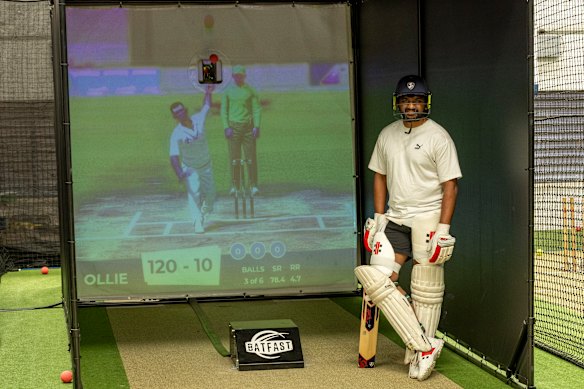
Krish Selvanathan tries out Hitz technology in Melbourne.Credit: Jason South
Rogers believes the technology could have helped him in his playing career, especially when it came to revered England seam bowler James Anderson.
“I think back to facing Jimmy. I remember playing against him and just thinking, how the hell am I going to be able to pick up those little intricate details of whether he bowls an in-swinger or an out-swinger?
“I got better at it as I did it. But if I’d had some earlier learning from what that looked like with cues, that could have been a big help with my own confidence.”
The technology was launched in England last year following 10 years of research and development by the team at Batfast, led by Jignesh Patel and Runish Gudhka. Ten sites are already operational.
Former Cricket Australia chief executive Nick Hockley is chairman of Hitz Australia. In the same way wave machines are helping to develop a new generation of surfers, and golf simulators have allowed people to play that game differently, Hockley wants to introduce a new way of enjoying cricket.
“There’s been plenty of new technology in cricket, but no one has integrated it in a way that it really replicates real-life play,” Hockley said.
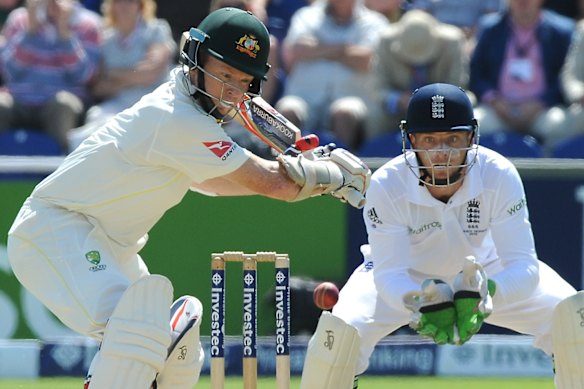
Chris Rogers batting in the 2015 Ashes in CardiffCredit: AP
“One major thing that validated the technology for me was I live opposite a park in Sydney and there’s three beautiful new AstroTurf pitch nets that have been put in. I see parents bowling to their kids, over and over again, and you think, imagine being able to go and actually train on your own, in your own time, and getting your performance analysed.
“When I was playing club cricket, I was never the best cricketer, or the best batter. You might have got 10 minutes in the nets on a Tuesday night, and by that stage, the bowlers are all tired, and the quality of the deliveries varied.
“So what this technology does is just allows players of all abilities to be able to face 150 balls an hour, of completely different variations with the same quality.”
Hockley believes the technology can also work as a key talent identifier throughout the country for boys and girls starting out in the game.
“The talent identification potential is immense, and hopefully, as the network rolls out [across Australia], there’ll be the ability for national coaches to ask players to go in, set a session and then submit their data,” Hockley said.
“Primarily, we hope that it helps players improve, and if this can be a way to be able to spot the next Australian legend, that would be a fantastic outcome.”
Hitz co-founder Dominic Reed spent years coaching some of England’s best young school players, but always wanted something to mentally challenge players when they stood at the crease and faced bowling. Like many coaches, he had used the throwing device widely known in Australia as a “wanger”, but wanted something more intuitive.
Coaches can now program the technology with unique deliveries and field settings for each ball, forcing batters to react. For instance, if a player struggles with a certain delivery or field setting, that can all be pre-programmed into the machine.
“With a normal bowling machine, within six balls, you know exactly what’s coming,” Reed said. “You just stand there and repeat the same shot, but once you’re in this net, you might pre-program 120 balls, but the batsman has no idea where the ball is going to land.
“When you go in as a player, say in the Sheffield Shield, and you’re about to face this next upcoming leggy from NSW, you can go in there and say, I want to face an eight-over spell of leg-spin. I want it to be between 52 and 55 miles an hour. I want 80 per cent of the balls to be drifting into the pads and turning away, but I want the other 20 per cent to be going straight on.
Loading
“You can put all of that in at the start, press go, and then that’s your eight overs there and then.”
Hitz’s ambition in Australia within the next year is to be in every major metro centre, alongside providing an opportunity for the country’s best players to develop. Reed wants everyone to experience the closest thing to facing some of the world’s most iconic deliveries, be it Warne’s ball of the century, or Jofra Archer’s super over in the 2019 World Cup final.
“It’ll be quite unique to Australia,” Reed said. “We want to be able to go and serve those cricket communities that love their cricket out in smaller areas.
“Smaller areas in Australia where they love their cricket, but don’t have the access to the same facilities … we don’t just want this technology confined to, you know, the rich parts of Sydney or London. This is about making sure that everyone who loves their cricket gets a chance to enjoy it.”