
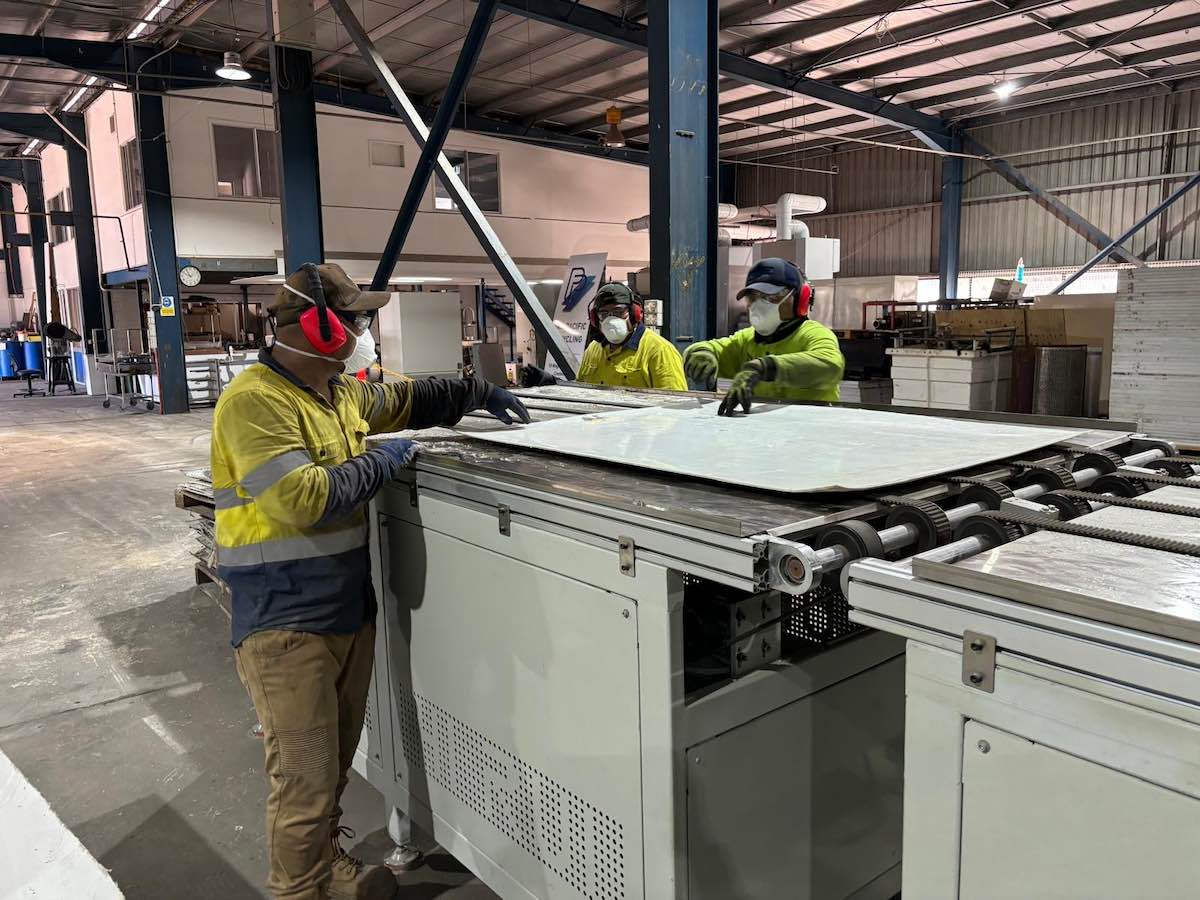
The federal government has announced a $25 million pilot program to establish up to 100 collection sites across the country to deal with the growing challenge of dealing with discarded rooftop solar panels, and ultimately household batteries.
The program was announced on Friday after the release of a Productivity Commission report – actually completed last August – that recommended such a program to deal with the soaring number of rooftop PV panels and the upcoming challenge of dealing with end-of-life household batteries.
The initial program will focus on rooftop solar panels, with the issue now at a critical point given that in some states more than one third of new installations are now replacing pre-existing solar systems.
The government argues that the solar panels contain valuable material and strategic minerals – such as copper, aluminium and silicon – that can support the renewable transition, but also toxic elements that can’t be allowed to be dumped on the side of the road and in bushland, as identified in the Productivity Commission report.
“Only a small percentage of end-of-life solar panels are currently recovered for recycling with most panels are either stockpiled, dumped in landfill or exported for re-use,” environment minister Murray Watt said in a statement.
“But we think solar panels are made up of materials that are too valuable to throw out. These materials can be repurposed to support the clean energy transition and help reduce what we send to landfill, improving out natural environment.”
Currently, only 17 per cent of rooftop solar panels are recycled, and the PC report identifies up to $7.3 billion in benefits through reduced waste and reuse of materials.
The announcement was welcomed by the Smart Energy Council, which warns that four million panels are being decommissioned each year, with only a small number of those actually recycled.
“We know the government wants to see that change and we support it – the industry stands ready to fix the problem,” SEC chief executive John Grimes said in a statement.
However, attempts to establish an industry have proved difficult, despite the creation of new companies and new rules to prevent random dumping of used panels.
Last year, the SEC led a delegation of renewable energy industry leaders warning that solar recycling companies were “on the brink” and calling for a mandatory national PV reuse and recycling scheme.
It was not enough to save Sircel, Australia’s largest established e-waste recycler, which had launched a world-class PV panel processing facility in Parkes in NSW, but which was forced into voluntary administration last October.
It followed the collapse of Reclaim PV, an Adelaide company that went bankrupt in 2023. According to the SEC, the failure of Sircel left just 7 companies specialising in solar PV recycling, with many of them struggling financially.
One of the key barriers, the SEC says, is the cost of getting the rooftop panels from the roof to the recyclers, and it hopes that the creation of collection point can offer a convenient and cost effective way for installers to dispose of the product, and reduce one of the main barriers for the recycling industry.
Darren Johannesen, the head of sustainability at the SEC, says recycling, or “urban mining”, can help address forecasts of supply shortfalls in key materials such as copper.
“Implementing a national stewardship scheme, which we hope and expect will follow the pilot, will trigger an urban-mining boom, and a new wave of smart energy investment in jobs and growth,” Johannesen said in a statement.
The Productivity Commission has recommended a stewardship scheme be introduced, which will help with design improvements of the solar panels themselves, and make it financially interesting for the industry to recycle the panels – and in future, EV batteries.
“Currently, neither solar PV systems nor EV batteries are managed in a consistent or comprehensive way once they are considered to have reached their end of life,” the PC report says.
“In Australia, the majority of end-of-life PV systems are sent to landfill or discarded in shredder floc, with some illegally dumped on roadsides or in bushland.
“Though some private recycling services exist in Australia (for example, Sircel, PV Industries, Ecoactiv), only 17% of solar panel components are recycled (specifically the aluminium frame and junction box), with the remaining 83% of (valuable) materials treated as waste.
“This is largely due to the cost barrier of recycling solar panels, which is approximately six times the cost of sending them to landfill.” But it says a stewardships scheme will deliver an estimated net economic benefit in present value terms of $7.3 billion.
If you would like to join more than 29,000 others and get the latest clean energy news delivered straight to your inbox, for free, please click here to subscribe to our free daily newsletter.

Giles Parkinson is founder and editor-in-chief of Renew Economy, and founder and editor of its EV-focused sister site The Driven. He is the co-host of the weekly Energy Insiders Podcast. Giles has been a journalist for more than 40 years and is a former deputy editor of the Australian Financial Review. You can find him on LinkedIn and on Twitter.