
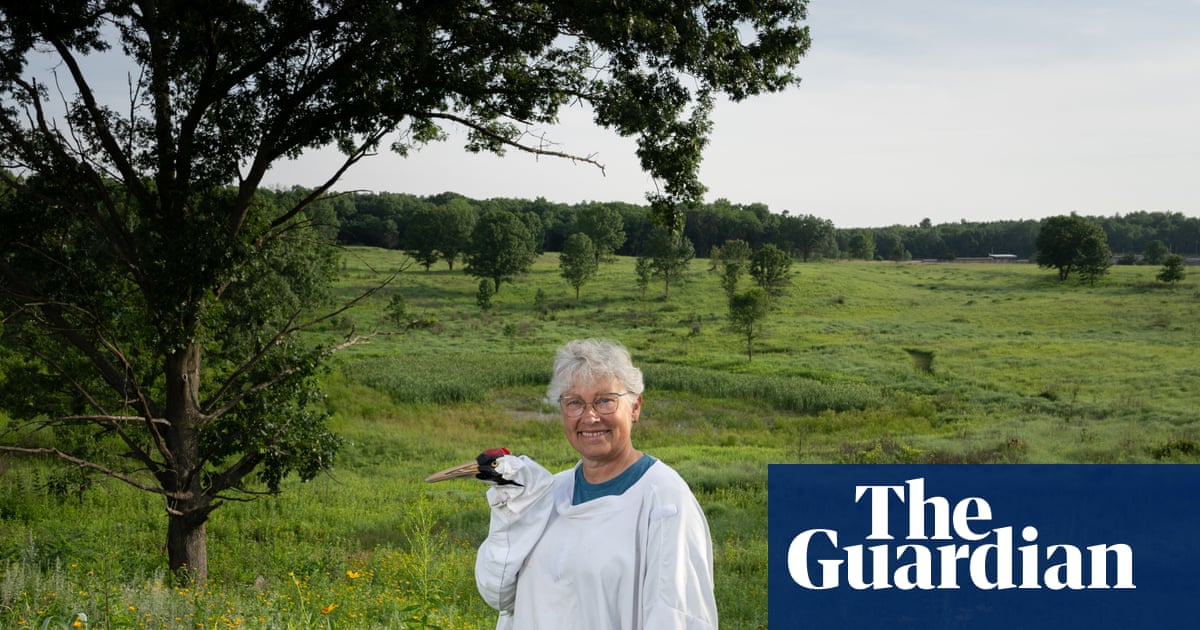
The International Crane Foundation was set up in 1973, with the aim of safeguarding the world’s 15 crane species – most are endangered or vulnerable due to habitat loss, climate change and hunting. As senior aviculturist at the headquarters in Baraboo, Wisconsin, I’m involved in everything from daily feeding to overseeing chick-rearing.
Whenever possible, chicks are raised by their biological parents or adopted by other adult cranes, but when that isn’t possible, we have to raise them, and teach them how to behave like cranes. Some chicks will later be released into the wild, so it’s important that they learn to stay away from people and other predators.
Young birds identify the first large moving object they see as their parent – a process called “imprinting” – so it’s important they don’t see us as humans while we’re raising them. At one time, feeding was done from behind a barrier to reduce interaction, but this wasn’t really practical.
One day, a colleague threw a sheet over himself. A lot of the staff thought he was crazy, but he started developing a more elaborate costume, adding feathers and even wearing pants that matched the colour of cranes’ legs.
Amazingly, the chicks responded well, and followed him as they would an adult crane. The outfits we use now have detailed puppet crane heads on one arm. The other arm is our “wing”. We did away with the feathers to make laundering the costumes easier. Now, any time we spend among the chicks is done in costume.
Whenever I see a video of us running and flapping, it does look kind of ridiculous, but the chicks still get the idea
The chicks can be quite aggressive towards one another, depending on personalities and sexes, and who’s “hangry”. We spend a lot of time making sure everybody’s eating, drinking and getting along OK, and teaching foraging behaviour by searching for crickets and grasshoppers with them. Occasionally I’ll struggle to get an insect into the puppet’s bill and use my hand instead when the chicks aren’t looking.
It can be tiring work – my arms get sore. Usually we rotate who’s in the costumes every hour or two. Wearing them provides anonymity, so it’s easy to ham it up.
When I started here in 1986, I learned a small amount of crane vocabulary and could mimic the scolding sound made by adult cranes if chicks were fighting or putting themselves at risk. Now we hide an MP3 player under the costume and play recordings of real adult cranes. The coloration of the puppet heads also matches that of real birds – for example, whooping cranes have a patch of red skin, which they tilt towards other birds to warn if they’re too close. I’ll sometimes do that to get a chick to back off.
When new people first wear the costumes, it can be hard to suppress the impulse to react to things as a human, rather than a crane. If a plane flies over, they’ll look at it with their real eyes, rather than just reacting with the puppet head. It usually takes about a month to acclimatise.
Before they leave us, it’s important that the cranes are good flyers and able to get away from predators. Coaching them can be a challenge but we have a prairie where we encourage them by running and flapping, right up to the point where a real crane would leave the ground. We mimic adults’ “pre-flight” call and stretch out the puppet head. Whenever I see a video of us running and flapping, it does look kind of ridiculous, but the chicks get the idea. It makes me feel like a proud parent to see them take flight.
I do dream about work – sometimes, in my dreams, I would finally be able to fly. In others, my volunteers would take to the sky while I couldn’t, or I’d be the chick at the back of the flock, unable to keep up with the rest, and I would feel very sad.
Currently, 10 of the 15 crane species are still threatened with extinction, though the number of whooping cranes in the world has grown over the past 80 years from the low 20s to over 800. Ultimately, our aim is to help create a self-sustaining population where all the youngsters will be reared by real cranes, so we can get rid of the costumes. Although I would miss my interaction with the chicks, what an amazing outcome that would be.
As told to Chris Broughton
Do you have an experience to share? Email experience@theguardian.com