
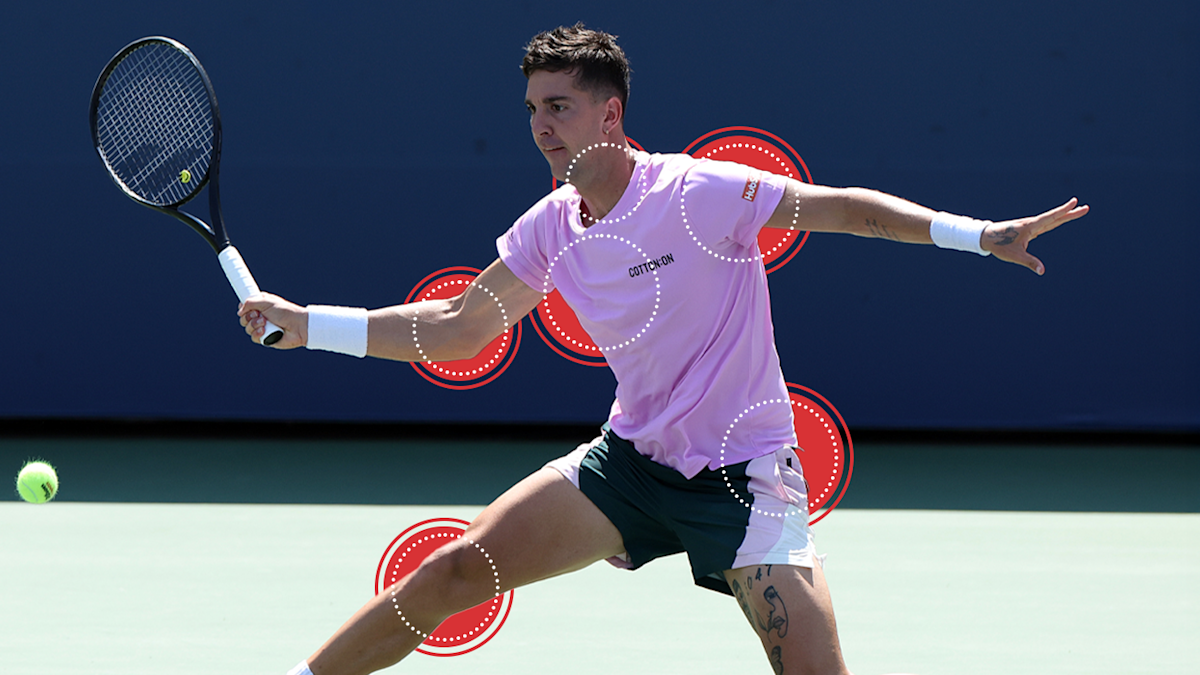
When Thanasi Kokkinakis grabbed at his shoulder during his clash with Sebastian Korda at the Adelaide International, the reaction from the crowd was telling.
There was disappointment, sure, but there wasn’t shock or surprise. The murmurs carried a reluctant acceptance a fresh injury setback was an inevitability.
Kokkinakis told media after that win if it wasn’t Adelaide, his home tournament, not only would he not have continued the match, he probably wouldn’t have played in the tournament at all.
READ MORE: ‘Cowardly act’: Tszyu brothers furious as Zerafa bout ends in farce
READ MORE: Brutal KO, deadly gesture define NAS’ boxing debut
READ MORE: Sinner opens up on ‘difficult’ doping cloud during triumph
In a career as plagued by injuries as his, he’s undoubtedly become used to stepping on court knowing he’s not 100 per cent. But to admit it was bad enough he might have withdrawn from any other tournament altogether was startling.
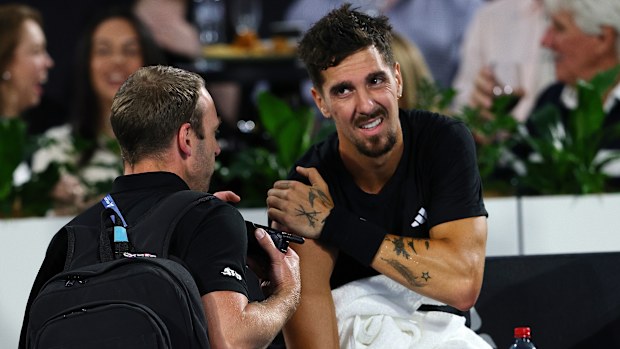
Thanasi Kokkinakis is treated by the physio. Getty
Like Nick Kyrgios and Bernard Tomic, Kokkinakis’ has been a career which promised so much.
After Kyrgios and Kokkinakis did battle in the 2013 Australian Open boys final – the former prevailed in straight sets 7-6(4), 6-3 – those who saw it were sure they had seen the future of Australian men’s tennis.
“Most of us said, ‘Nick’s got a bit more flair, but Thanasi’s got the right attitude – he will make it,” Aussie Wimbledon champion Pat Cash told Wide World of Sports.
“Almost exclusively, we all said the same thing. ‘He’s got the right attitude’.”
Watch the Australian Open live & free on the 9Network & 9Now. Stan Sport is the only place to watch every match ad-free, live & on demand with centre court in 4K.
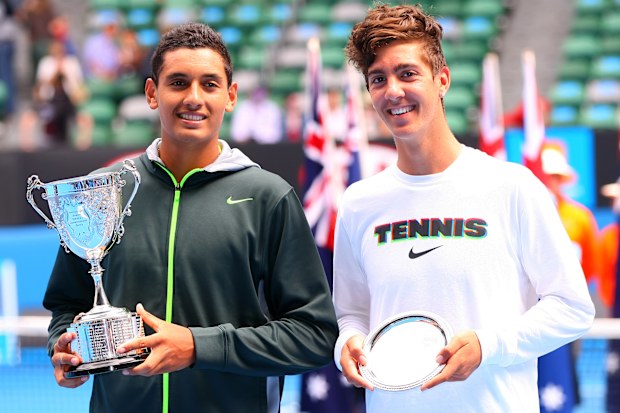
Nick Kyrgios and Thanasi Kokkinakis after the junior boys’ final at the 2013 Australian Open. Corbis via Getty Images
But eventually, as injury after injury after injury crippled his body, the 29-year-old would join Kyrgios and Tomic on the ever-growing list of players that ‘could have been’. His career-high ranking is 65.
“Kyrgios was a grand slam finalist. Who could say that Thanasi would not have been a grand slam finalist? I think he certainly would have been top-10,” Cash said.
INJURY | December 2015: Kokkinakis announced he would miss the Australian summer with a left shoulder injury. He would undergo surgery and miss the 2016 French Open and Wimbledon. He returned at the Rio Olympics, but was knocked out in the first round.
Thanasi Kokkinakis has battled a slew of injuries throughout his career. Nine
‘You eventually run out of steam’
Cash knows better than just about everyone the struggles of playing on tour while injured. Now 60, he’s had north of a dozen surgeries on injuries picked up through his career, with more to come.
“Seven on the right knee, five on the left, Achilles, two back surgeries, two wrists … and I’ve got another four to go,” he recalled.
It’s one thing to rehab an injury when you’re a retired pundit, but to go through it when you’re still playing?
INJURY | August 2016: Having recovered from his shoulder injury, he missed the US Open with a pectoral injury. It was the first of many. It kept him out of the Australian summer, and he wouldn’t return until the following May.
“It’s absolutely exhausting. It’s the mental fatigue. You’re literally starting at the bottom,” he said.
“It depends what the injury is too. If it’s a lower body injury, you can’t run. Or your back, you can’t do anything. You can’t serve. You can’t go to the gym. You’ve just got to rest.”
And don’t for a second believe the player’s return to the court marks the end of their recovery.
“My rule of thumb is the amount of time you are out with an injury is how long it takes to get back to the same form as you were before you got injured,” he explained.
NO INJURY | 2018: Kokkinakis was mostly fit, and reminded the world of his capabilities with a famous win over Roger Federer at the Miami Open. It would be his last ATP Tour win for over a year, however he did pick up a Challenger title.
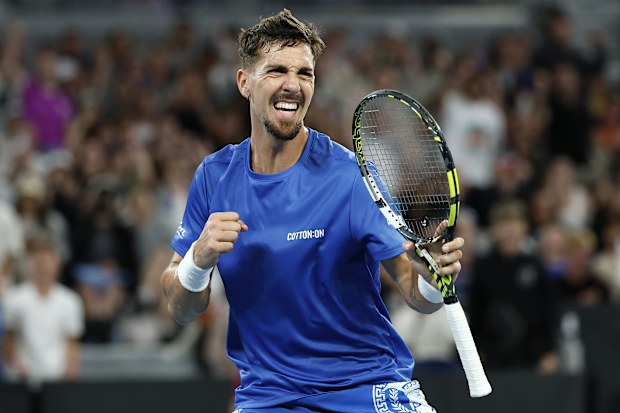
Kokkinakis celebrating a point against Jack Draper in the 2025 Australian Open. Getty
“So if you’re out six months with an injury, it’s going to take you six months of constant playing before you get back to form.
“I had a broken Achilles, that was 10 months. My knee was 14 months. You just eventually run out of steam.”
Cash recalled a conversation he’d had with Matteo Berrettini this week ahead of the Australian Open. The Italian is also coming back from injury, and will take on Alex de Minaur in the first round at Melbourne Park.
“You just run out of energy. Berrettini said the same thing: ‘I’m kind of coming back and I’m exhausted before I even start playing’.”
INJURY | January 2019: Having qualified for the Australian Open, Kokkinakis suffered a partial pectoral tear in his first round match against Taro Daniel. He was out for much of the year, but returned for the US Open, but was forced to withdraw ahead of his second round clash with Rafael Nadal with a shoulder injury.
‘I call it the whack-a-mole theory’
On unseen side of professional sport, particularly individual sports like tennis and golf, is a brutal reality hidden well away from view of fans.
While the idea of being a professional athlete is no doubt glamorous, the reality is a succession of airports, motorways, hotels, courts, hotels, courts, airports, motorways, hotels. Repeat ad nauseum.
And if you get injured, you don’t play. If you don’t play, you don’t earn any money. Without any money, you can’t pay coaches, physios, or even pay to travel to each tournament.
While those at the very top might have the rankings points and financial security to take time off to let their bodies recover, it’s simply not an option for everyone else.
ILLNESS | January 2020: Missed the Australian Open with illness, which he later revealed was glandular fever. The battle included a hospital stint, and he lost 10kg. The pandemic and subsequent disruption to the tour gave him time to let his body heal, but he would later reveal he was also battling depression and anxiety as he battled the possibility he would never play on tour again.
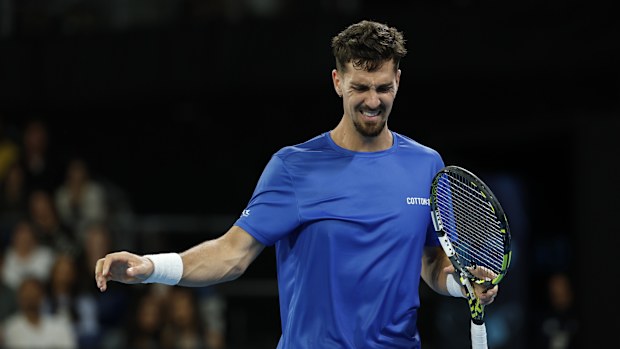
Kokkinakis stretching his shoulder. Getty
And playing through the pain only leads to fresh injuries elsewhere.
“I call it the whack-a-mole theory … you whack one injury down and another one pops up because of that injury,” Cash said.
While data and sports physiotherapy is significantly better than it was in Cash’s playing days, the mental fight the player must face is the same. Tennis is an explosive sport. The forces that go through the body are immense.
When you load up your legs to send a serve down the T, will your hip hold up? What about your shoulder, elbow or wrist? When you change direction suddenly, will your ankle hold up?
NO INJURY | 2021: Was mostly injury-free, and went deep at several Challenger events. He even won a Challenger title at Biella.
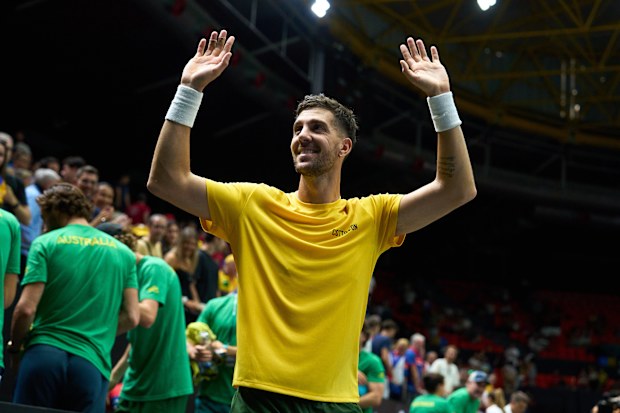
Kokkinakis celebrates victory against Czech Jakub Mensik during the 2024 Davis Cup. Getty Images for ITF
“That data really helps you feel confident, but in yourself you’ve just got to believe it’s not going to happen again,” he said.
“The brain has a map of every injury you’ve ever had, and you have to erase the negative part of that and let the brain know it’s safe. But when these injuries keep occurring, these brain maps keep getting stronger and stronger and stronger.
“(Kokkinakis’) tough old body is carrying mental scar tissue from this, and it’s very, very hard to get over.”
NO INJURY | 2022: Kokkinakis was back. He won the Adelaide International, but was knocked out of the first round at the Australian Open by qualifier Yannick Hanfmann. But teaming up with Nick Kyrgios in the men’s doubles, the ‘Special K’s’ famously went on to win the title. Behind the scenes, he battled a knee niggle for much of the year but still managed a full calendar of tournaments.
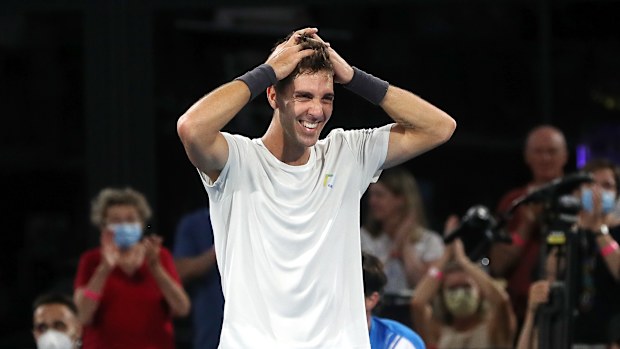
Kokkinakis defeated Arthur Rinderknech to win the 2022 Adelaide International. Getty
And when the injury does re-occur?
“It’s absolutely horrendous. It literally is soul-destroying,” Cash said.
He then recalled a moment in one of his many rehabilitation stints. One of the exercises was stairs. Just walking up and down. Up and down. But the pain didn’t seem to be easing.
“I just sat there. I wanted to pull my hair out. I was crying, screaming, upset. I was at the stage I thought it was a joke,” Cash said.
“The mental part of recovery is almost worse than the physical part.”
NO INJURY | 2023: Again managed to stay mostly fit, but made a habit of playing marathon matches which took a toll on his body. In the second round of the Australian Open, he famously lost to former world No.1 Andy Murray in a five-set thriller that lasted five hours and 45 minutes, and ended after 4am. It was the longest match of either player’s career.
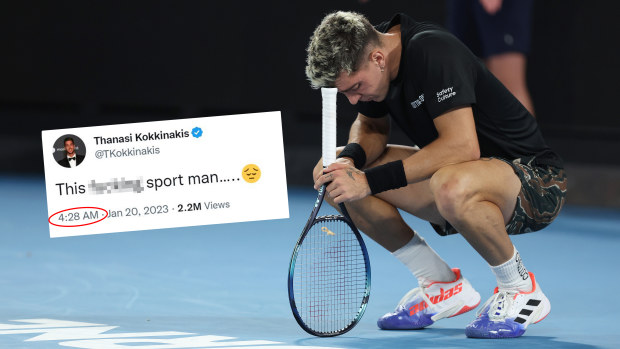
A tweet Kokkinakis posted after his five-set epic against Andy Murray. Getty
‘You’re actually not fine, but OK’
While it might be true the mental part of recovery is difficult, most elite athletes would go above and beyond to ensure they give themselves the best chance of recovery.
But there’s a view in the tennis world Kokkinakis has contributed to his own downfall. One ex-player who shared a locker room with him declined an interview with Wide World of Sports because he didn’t want to be seen to be kicking the 29-year-old while he was down.
It was clear he felt the Aussie had made some poor decisions along the journey.
INJURY | June 2024: Withdrew from Queens Club because of a knee injury. At Wimbledon, having again played out a five-setter in the first round against Felix Auger-Aliassime, Kokkinakis was forced to retire from his second round clash against Lucas Pouille after injuring his left knee in a fall.
As recently as this time last year, Kokkinakis was in the headlines for playing an exhibition tournament in Russia in late 2024, only to succumb to a shoulder injury in the Australian summer. Todd Woodbridge linked that controversial call with Kokkinakis’ body again breaking down in Adelaide then Melbourne, where he still pushed a seed to a five-set epic in the second round, effectively with one arm.
Clearly there is a sense that if Kokkinakis had given himself the best possible chance of success, his fate may have been very different.
While Cash conceded there was merit in an injury-prone player accepting the guaranteed payday that comes with playing in an exhibition, Kokkinakis has always done things differently. There’s a belief in the tennis world that his stubbornness has cost him.
“I don’t know the ins and outs of his rehab stuff … (but) you’ve got to make a living. You’ve got to eat your food, you’ve got to be able to pay for your coach, pay for your airfares, and if the guy feels like he should go and play the exhibition match…
“One of the issues is that Thanasi is quite independent … and he’s not willing to take outside advice from expert coaches.
“That’s not necessarily a bad thing, but sometimes it’s nice to get different feedback from different coaches.
INJURY | Dec 2024: Withdrew from the singles draw of the Brisbane International with a “small hip issue”. Then at the Australian Open, he aggravated that old pectoral injury in a five-set loss to Jack Draper. In the February, he underwent surgery during which a donor Achilles tendon was used to attach his right pectoral muscle to his shoulder to fix chronic scar tissue. It was described as “radical” and “unprecedented” for a tennis player. He missed the rest of the year.
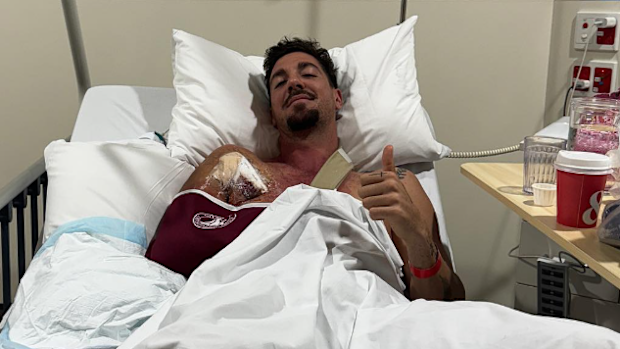
Thanasi Kokkinakis after his pectoral surgery. Instagram
“I reached out to him – I’ve known him for a long time, my son used to play with him – and I said ‘mate, give me two months and I’ll fix a technique issue with you, and I’ll do it for free’. He said no thanks.
“He’s obviously very confident with his team, but I kept watching certain shots and going, ‘Oh my god, somebody’s got to tell this guy, it’s really clear how to fix this’.
“I reached out again, and I said, ‘Thanasi, listen, I’ve got the solution to your problem’. I know his coach. I said, ‘we’ll work together for a couple of months, I’ll do it for free’.
“He just said, ‘No thanks. I’m fine’. I was like, ‘well, you’re actually not fine, but OK, no problems’.
Cash went on to have conversations with other coaches, who all shared similar views on Kokkinakis’ technique, and his lack of interest in hearing from other voices.
INJURY | Jan 2026: On his singles return at the Adelaide International, a shoulder injury flared up in his first round clash with Sebastian Korda. He later said he wouldn’t have played in the tournament, let alone continued the match if it wasn’t his home tournament. He later pulled out of singles for the Australian Open.
“He just wants to do it himself, his own way. I can respect that, but one thing the greats all have in common is they have an open mind and listen to people,” Cash explained.
“Sometimes its confusing and sometimes it’s conflicting, but you have to have an open mind. Roger, Rafa, Novak, they bring in people, they listen to experts.
“Being stubborn and determined is only good to a certain extent.
“If Todd Woodbridge is questioning your decision-making, it might be valid to have a think about it and go ‘he might have a point there – Todd knows his stuff.”
INJURY | At the same time as everything else, he has battled elbow, knee, hip and groin niggles, likely due to compensations his body has made due to the other injuries.
It’s time to act fast
The bottom line is simple. Kokkinakis is only 29. In theory, there’s still plenty of rubber to hit the road.
But if he’s going to maximise his talent before his career is brought to a premature end he’s well and truly hit crunch time.
“It’s incredibly tough mentally and physically,” Cash said.
“Of course you can go ‘just go to the gym and make your arm strong’. But you know it’s got nothing to do with that – it’s the body saying ‘I’m going to protect that. No, you can’t do that’, and every time he gets injured, it’s going to take longer (to recover). So I’m not surprised he’s hurt himself again – it’s just going to be something he has to manage throughout the rest of his career.
“But if he keeps going like this, then he probably won’t have much of a career, which will be disappointing because he’s such a talented player.
“Sport is cruel.”