
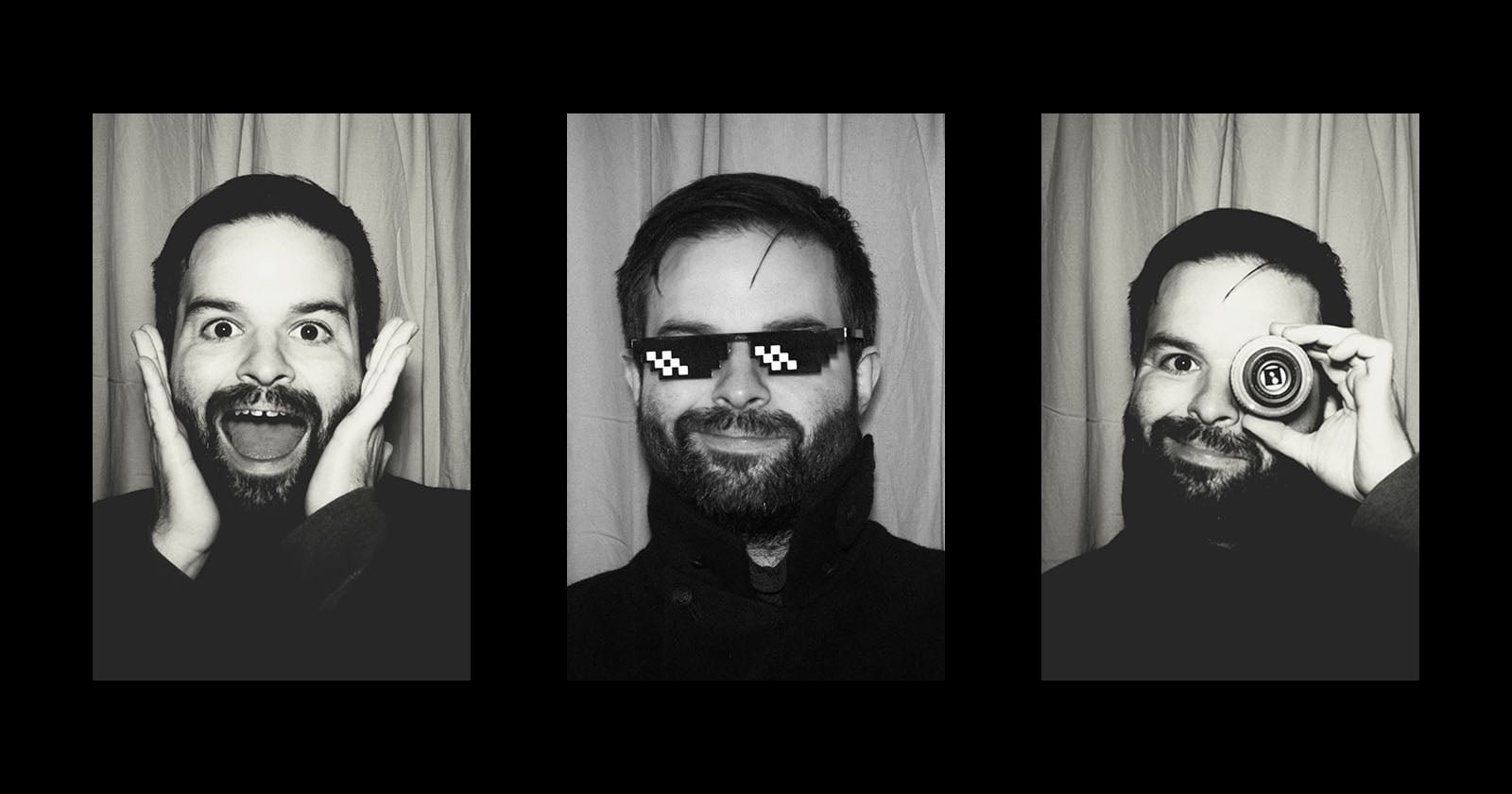
Photographer and YouTube creator Mathieu Stern loves vintage lenses. He also loves vintage analog photo booths. So Stern set out to find out exactly which lenses are used in old-school film photo booths so he could recreate the exact look at home. It was much harder than one might think.
“This project forced me to look for answers in the most unusual places,” Stern says.
Stern and his wife visited a museum in the French city of Nantes and, before leaving, stopped in the museum’s cafe for a drink. In the corner of the cafe is an analog photo booth, which, of course, Stern could not resist.
“As I sat there, one question kept circling my mind. What kind of lens is actually inside that thing?”
Finding the answer to this question in the photo booth itself proved impossible. The lens is only exposed when actively shooting, and there is no way to see inside well enough to identify it. The internet was not much more helpful, either, as Stern says he spent months researching different photo booths with little success.
What he ultimately discovered was “even weirder” than he expected, and for someone like Stern, who is obsessed with the weirdest aspects of photography and especially lenses, that’s a high bar to clear.
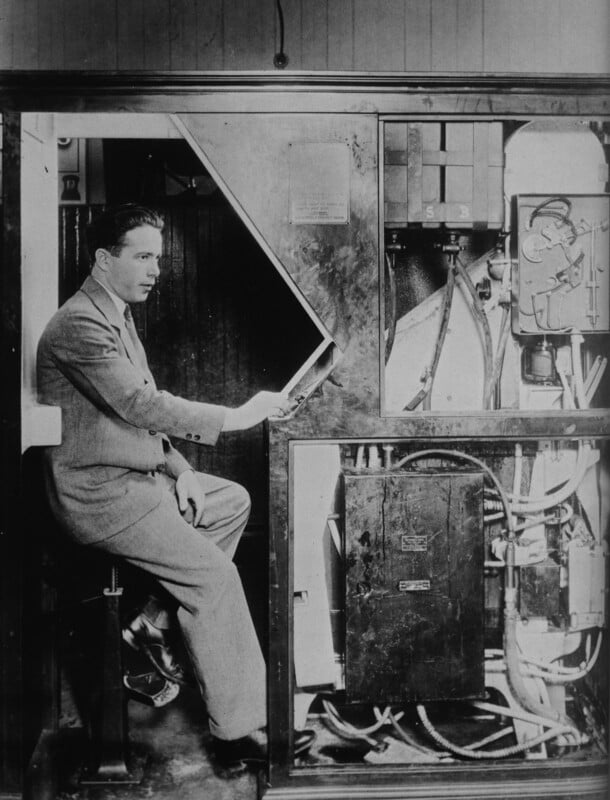 Anatol Josepho inside his photo booth in 1927 | CC BY-SA 4.0
Way back in 1925, Anatol Josepho invented one of the first fully automated photo booths, the Photomaton. People put 25 cents into the machine and got eight printed photos in return. The first booth was stationed near Times Square in New York City. Capturing, developing, and printing the eight photos took about 10 minutes, which is actually extremely impressive considering it was a century ago. At the time, it was challenging and often prohibitively expensive for regular, everyday people to get portraits of themselves. The photo booth changed that in a massive way.
 Josepho and his wife in a Photomaton (1927) | Public domain
In the decades that followed, photo booths became a mainstay at many locations, including train stations, fairs, shopping centers, and more. Photo booths were everywhere.
However, as instant film cameras became more popular and affordable, and then digital photography arrived, analog photo booths vanished one by one. Stern says that today, there are fewer than 200 working chemical analog photo booths left in the world.
People still love them, though. Every analog photo booth Stern visited to make his latest video had a long line of people waiting to get their portraits taken. It remains a very special thing to have a physical, one-of-a-kind picture like this.
Stern eventually uncovered a 1940s-era patent that described the lens, an f/2, 3-inch Wollensak portrait lens. As the patent explained, the “deep focus compensates the depth of field,” and the lens required no focusing to get sharp shots.
Wollensak later made a lens specifically for photo booths, a 75mm f/4.5 “Photomat” prime lens.
“I thought the mystery was solved,” Stern says. However, he found another source with different information.
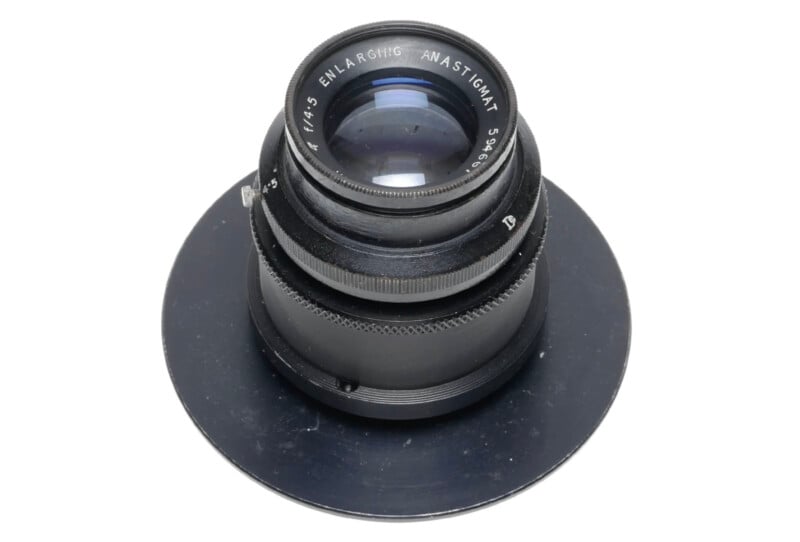
A video showing an old analog photo booth in London being restored showed “a few frames” of the lens, and that lens was a Dallmayer 75mm f/4.5 enlarging lens.
After even more research, including going inside photo booths with a Sony Alpha camera to capture video, Stern found a Nikkor 35mm f/2.8 lens inside two different photo booths in France.
Armed with new information and plenty of test shots captured in real-world photo booths, it was time for Stern to try to recreate the beloved classic look at home. Further, he explained how other photographers could set up the same thing, including with modern digital cameras. As it turns out, the look is absolutely possible to recreate. The feeling, though? Not so much.
“When I first stepped inside that photo booth in the museum cafe, I thought this vintage machines must have some sort of incredible secret optical technology that makes you look call no matter what. A lens that would be impossible for me to find,” Stern says.
However, what ultimately makes these photo booths so special is a nostalgic feeling, he says, and being part of an artistic photographic approach that time has mostly forgotten. Photo booth visitors get a distinct experience and unique photos, and that’s what makes analog photo booths so special. It’s not the glass at all, it’s the experience.
Image credits: Mathieu Stern