
When scientists finally measured the most powerful bite ever recorded, the winner wasn’t T. rex. It was something far older, yet far more familiar.
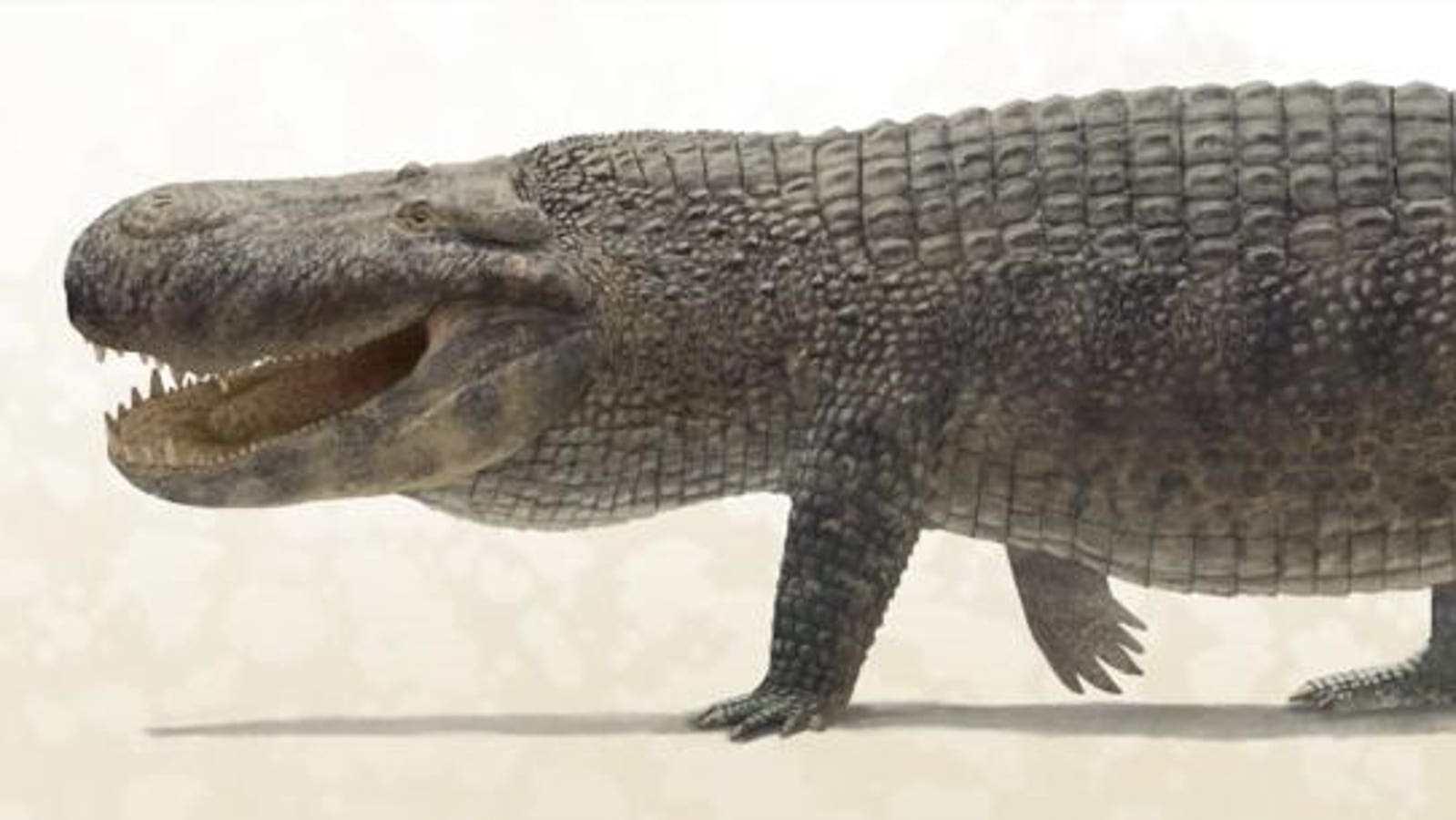
LiterallyMiguel, CC BY 4.0 , via Wikimedia Commons
Most people envision a dinosaur when they try to imagine the most powerful bite in Earth’s history. Tyrannosaurus rex tends to dominate the conversation, given how well-represented its bone-crushing jaws are in the media.
However, once biologists and paleontologists began quantifying bite force using modern biomechanics, they quickly realized that the T. rex had an unexpected contender. Eventually, they realized that the strongest bite ever measured didn’t actually belong to a dinosaur at all; it belonged to a giant prehistoric crocodilian called Purussaurus.
This colossal reptile lived millions of years after the dinosaurs went extinct, yet it may have possessed a bite force that surpassed anything known from the Mesozoic Era. Here’s how it evolved such an extreme weapon, according to paleobiological research.
Measuring Purussaurus’ Bite Force
As a 2015 study published in PLOS One describes, Purussaurus brasiliensis was a genus of giant caiman that lived during the Miocene epoch, around 13 to 5 million years ago. Paleontologists have discovered its fossil remains across South America — particularly in what is now Venezuela, Brazil, Peru and Colombia.
During Purussaurus’ prime, the majority of the Amazon basin was a vast system of wetlands, rivers and shallow lakes. This environment was home to various giant rodents, massive turtles, large fish, early primates and other crocodilians. However, Purussaurus sat at the top of this ecosystem; it had an estimated average length of a whopping 12.5 meters (41 feet) and weight of 8.4 tons (9.1 short tons).
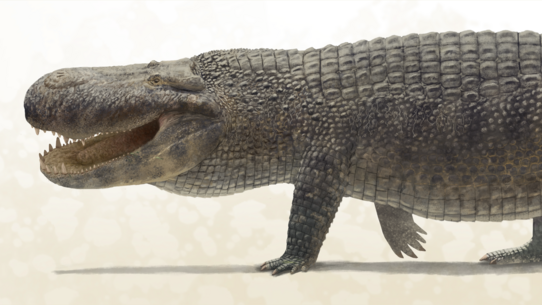
Life reconstruction of the giant miocene caiman genus: Purussaurus.
https://upload.wikimedia.org/wikipedia/commons/8/8d/Purussaurus_life_reconstruction.png
Fortuitously, unlike many prehistoric predators that we know only from fragmentary remains, Purussaurus is represented by exceptionally large and well-preserved skulls. These skulls are ultimately what have allowed scientists to estimate its bite force with unusual confidence.
Typically, measuring bite force requires living animals and force sensors. But for extinct species, researchers can only rely on biomechanical modeling. This involves:
Reconstructing skull geometryEstimating muscle size and attachment pointsApplying principles of physics and comparative anatomy
In the abovementioned 2015 PLOS One study, paleontological researchers applied this approach to Purussaurus brasiliensis. Almost unbelievably, Purussaurus’ bite force exceeded 69,000 newtons.
For comparison, as research from the Proceedings of the Royal Society B notes, the largest measured bite force of species alive today belongs to the saltwater crocodile (Crocodylus porosus) — which produces around 16,000 newtons. By contrast, estimates for T. rex generally fall between 35,000 and 57,000 newtons, depending on methodology.
Even by conservative estimates, this means that Purussaurus likely had the strongest bite produced by a terrestrial vertebrate in the history of life on Earth.
Why Crocodilians Excel At Bite Force
It isn’t too surprising that a crocodilian holds this impressive record, as crocodilians are well-known specialists in force production. Their skulls are built like living clamps: they have thick bones, reinforced sutures and short, broad snouts that maximize mechanical advantage. Modern crocodiles can hold their mouths shut with terrifying force, despite the fact that the muscles they use to open their jaws are relatively weak.
Purussaurus was likely the first creature to optimize this design. Its skull was unbelievably sized by today’s standards, and also incredibly deep. This provided it with an enormous surface area for muscle attachment. Judging by the proportions of its snout, its jaw was most likely optimized for crushing rather than slicing, which is an ideal strategy for overpowering large prey.
A bite as powerful as this isn’t just for show; it reflects just how immense the ecological demands were at the time. The Miocene wetlands of South America supported an abundance of large, heavily armored animals. Purussaurus shared the water with giant turtles with thick shells. There were also massive rodents weighing hundreds of kilograms, as well as other crocodilians and large mammals that came to drink at the water’s edge.
As the 2015 PLOS One study’s biomechanical models indicate, Purussaurus could have easily crushed these competitors’ bones and shells. Its bite force would have allowed it to kill prey outright, rather than relying on prolonged struggle or drowning alone. This differentiates Purussaurus from modern crocodiles.
Why Purussaurus’ Bite Matters
From a biomechanical perspective, Purussaurus is fascinating due to how strongly it pushes against theoretical limits. Muscle tissue can only generate so much force per unit area; bone can only withstand so much stress before failing. The fact that it operated safely at bite forces far beyond any living animal implies that its skull was exquisitely adapted to distribute stress.
Purussaurus also shows us what animals start to look like when natural selection repeatedly favors bigger size, stronger jaws and dominance at the top of the food web, without any of the constraints that limit this kind of growth in modern lineages.
Given its power, it may seem surprising to some that Purussaurus vanished. However, its extinction likely had little to do with competition and everything to do with environmental change.
During the late Miocene and Pliocene, South America’s wetlands were starting to shrink as river systems reorganized and climates shifted. The rise of the modern Amazon River drained many of the shallow habitats that supported giant aquatic predators like Purussaurus. These large, slow-reproducing animals are especially vulnerable to habitat loss. As soon as Purussaurus’ ecosystem started to change, the ecological niche that sustained it vanished.
For biologists, Purussaurus provides invaluable, real-world data points for the upper limits of bite force in evolution. Despite what most people might think, these fossils prove that the strongest bite did not evolve in dinosaurs, mammals or sharks; it came from a lineage that has been surprisingly underreported in popular science.
It also reminds us that evolutionary success is context-dependent. The traits that made Purussaurus so formidable were perfectly suited to its time and place. However, they also didn’t offer the species any protection from large-scale environmental change.
Does the idea of a crushing bite trigger fear or fascination? Take this science-backed test to find out what really drives your response: Fear of Animals Scale
Is your inner guardian defined by a warning snap, a crushing bite or quiet restraint? Find out with this science-inspired test: Guardian Animal Test