
Friday morning found Diego Velázquez striking the familiar pose he has held for the past 370 years, staring out, brush in one hand, palette in the other, from the huge canvas of Las Meninas.
The 14 people who stood before the painting to meet the Spanish artist’s haughty gaze – not to mention the heavy eyes of the dozy mastiff in the picture’s foreground – were among the first visitors of the day to Madrid’s Prado Museum.
Given recent comments by the Prado’s director, they may have felt it was worth braving the January cold and drizzle to get through the door as early as possible.
People look at Las Meninas by Diego Velázquez in the Prado. Photograph: Alex Segre/Alamy
On Wednesday, Miguel Falomir told a press conference that the museum, which welcomed a record 3.5 million visitors last year, felt a threshold had been reached.
“The Prado doesn’t need a single visitor more,” he said. “We feel comfortable with 3.5 million. A museum’s success can collapse it, like the Louvre, with some rooms becoming oversaturated. The important thing is not to collapse.”
With that in mind, Falomir added, the Prado was exploring how best to preserve – and preferably enhance – the visitor experience. Among the ideas for guaranteeing quality over quantity are optimising entrances to the museum, rethinking the size of visiting groups, and making sure people know they are not allowed to take photos in the galleries.
The queues of mid-January can hardly be compared with those of the summer months, when they stretch on and on beneath the merciless Madrid sun, but getting into the museum this week proved painless. After buying a ticket online on Thursday, the Guardian pitched up at the museum at 10.30am on Friday, queued at the entrance for 90 seconds and was through security in less than a minute.
But the real test lay inside – especially as Falomir had insisted that visiting the Prado “can’t be like catching the Metro at rush-hour”. He may well have been haunted by the words of his counterpart at the Louvre, who admitted last year that visiting the Paris museum was “a physical ordeal”.
Although the initial pace through the galleries was slow, it soon picked up and the crowds were more fidgety shoals than heaving masses.
Central panel from The Garden of Earthly Delights by Hieronymus Bosch. Photograph: Album/Alamy
Hieronymus Bosch’s The Garden of Earthly Delights proved predictably popular, with 50 people standing in front of it and obscuring the lower half of its enchantments. But then a tour group moved on and a space opened up at the rope in front of the triptych.
The Goya rooms were a better bet. A suspiciously well-behaved school group hovered beneath Fight to the Death with Cudgels and the unbearably poignant The Drowning Dog.
In a nearby room, Alexander Jute from Stockholm was sitting on a bench with his four children and drinking in the horrors of Goya’s The 3rd of May 1808 in Madrid and The Fight Against the Mamelukes.
How was their visit going? How were the crowds?
“I think it’s perfect,” said Jute. “Perhaps it could even be a little more crowded. I’ve been here a couple of times before – including in the summer, and that was much busier.”
Down a corridor that led off a granite staircase echoing with the shouts and laughter of another school party, Laura Moya and her partner, Enrique Ayala, were also pleasantly surprised by the lack of crowds.
“We’re not seeing too many people here today,” said Moya. “The only problem is knowing where to start but the audioguide is very good.”
The couple, who were visiting Madrid from the south-eastern region of Murcia, said they had been relieved to be able to stash their coats and bags as they had heard the cloakrooms sometimes filled up quickly.
One of the galleries at the Prado. Photograph: Alex Segre/Alamy
“We came early to beat the queues,” added Moya. “It’s a great experience; wherever you look you find something.”
Visitors hoping for a more solitary trot around the Prado can find respite in some of the museum’s less trodden areas. The Alonso Cano gallery was deserted, leaving no one to appreciate the 17th-century Spanish master’s Dead Christ Supported by an Angel, his Penitent Magdalene, or his Saint Bernard and the Virgin.
Even the room holding such treasures as Velázquez’s portraits of court entertainers, including The Buffoon Calabacillas, was almost empty save for Enrique, a Madrid local who is also a member of the museum.
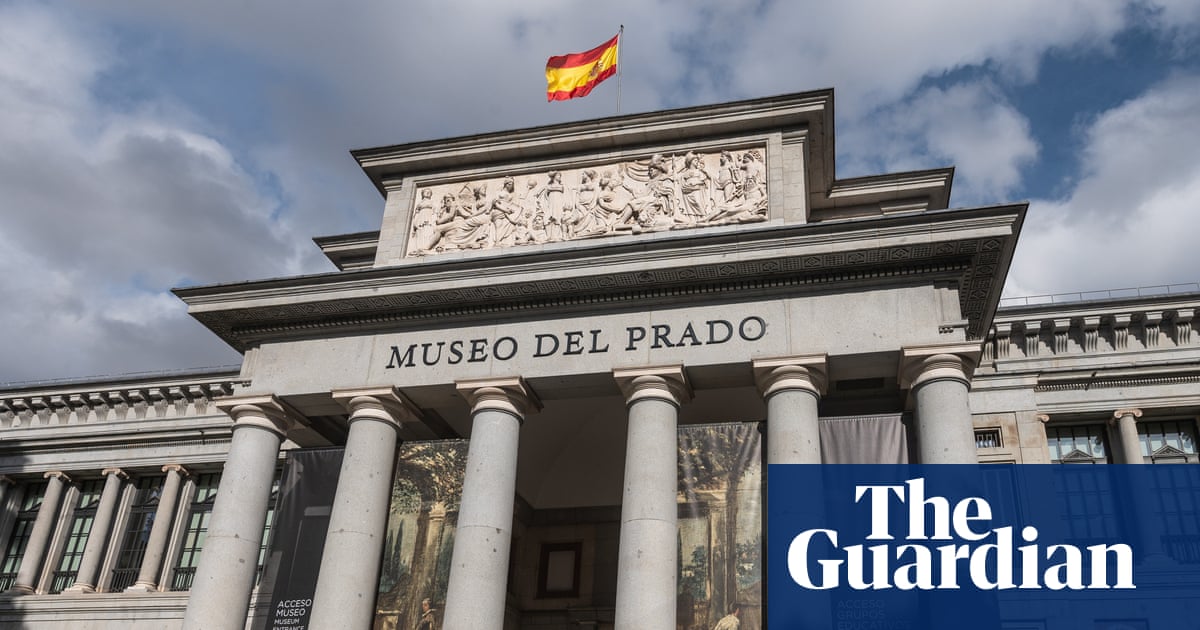
Queues at another of the Prado’s entrances. Photograph: Bob Korn/Alamy
He said his frequent visits to the Prado had never been marred by impossible crowds. “Visitor numbers keep going up and up and I’m glad that they do,” said Enrique. “It’s really good that people want to come and see culture.”
Some cultural draws, however, are more potent than others. By 11.10 on Friday morning, room 12, which houses Las Meninas, was filling up and growing noisy.
Visitors attempting to take photos of the picture were politely pounced on by sharp-eyed attendants: “No photos, por favor. No photos.”
Velázquez appeared to glower briefly from the canvas. And the dog dozed on.