
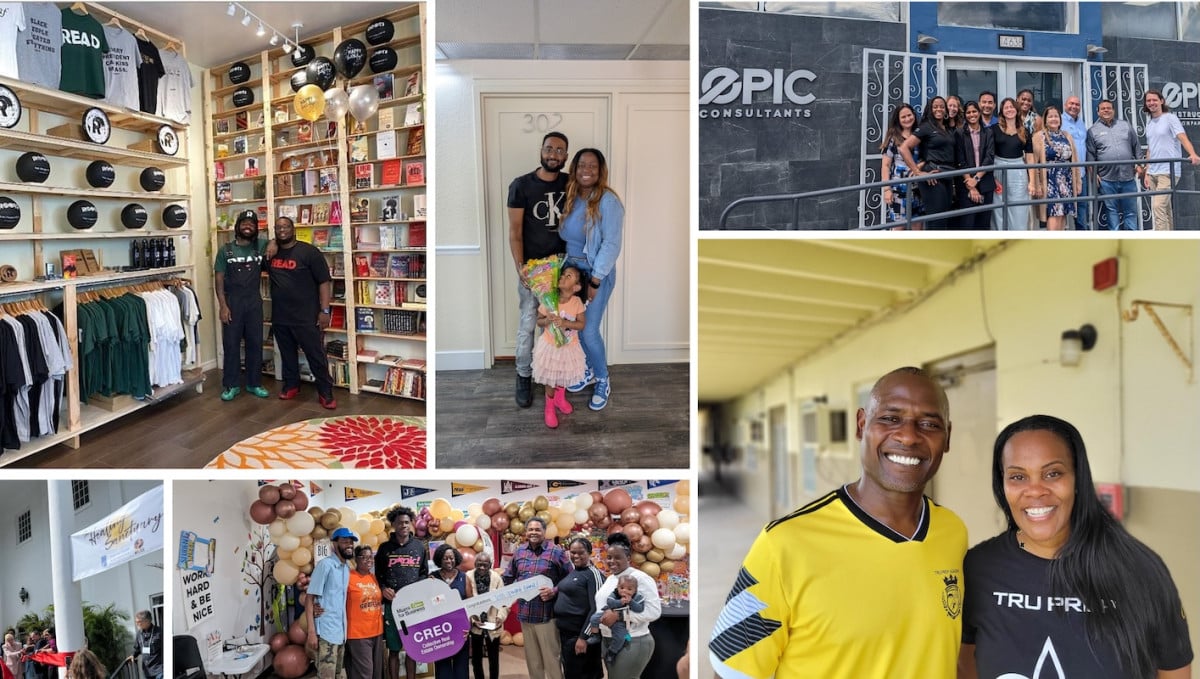
The Miami Foundation’s Collective Real Estate Ownership program has helped 30 small businesses owners go from renting their storefront properties to owning their own buildings.
This Q&A is part of Lessons from the Field, Next City’s series of interviews with anti-displacement practitioners across the country.
During the thick of the Covid-19 pandemic, as countless small businesses faced an existential crisis, The Miami Foundation received a $20 million grant from Wells Fargo with one goal: to support these vulnerable business owners.
Brittany Morgan, the foundation’s senior director of economic resilience, got creative with the money. The foundation launched the Collective Real Estate Ownership program, a five-year, fully-forgivable $500,000 commercial down payment program to help Miami-Dade County’s small business owners of color — often considered high-risk borrowers — partner with similar organizations to buy their buildings instead of continuing to rent.
It’s removed the burden of rent volatility for these small business owners while creating avenues for the business owners and the communities they serve to build wealth, she tells Next City.
“Joint ventures in real estate is not a brand new concept,” Morgan says. “People in the development world have been building joint ventures to own real estate for a very long time. It’s a matter of using this existing tool to structure a financial transaction and building ownership in a way that makes it accessible for BIPOC small business owners, who may have been historically cut out of property ownership.”
Although the CREO program has sunsetted, it’s helped spark a “laundry list” of local governments creating similar financial tools to help combat small business displacement, Morgan notes.
“This movement has really proliferated,” she says. “The City of Minneapolis has down payment assistance. The city of Denver networked with me at the outset of their program to understand how our RFP was structured. I actually had a call with The City of Boston two weeks ago about a commercial down payment assistance program that they’re rolling out. We’re now creating a national cohort of cities, municipalities and funders who are looking to do this work.”
This interview has been edited for length and clarity.
What issue was CREO trying to address, and how did it get started?
CREO is our main anti-displacement strategy. We had other capital products available to small businesses, but they weren’t as devoted to keeping folks rooted in place as CREO, our commercial down payment support program. The goal was twofold. It was to root longstanding small businesses and nonprofits that had experienced lease volatility in the years following the pandemic, but it was also an effort to try to build generational wealth for property owners through what we know of the accumulations and appreciation of real estate.
Home ownership is one of the major drivers of wealth, and what we were trying to do is create a net worth for small businesses via commercial property ownership.
There was a study called The Color of Wealth that found that white or non-Hispanic households [in Miami] had approximately four times the amount of wealth as Latino and Black households. (Note: As of 2024, this research now shows that households with a white, non-Hispanic householder were 10 times wealthier than those with a Black householder in 2021.)
What makes it particularly severe in the domain of commercial real estate is how few minority families are owners of commercial real estate. A lot of folks look to entrepreneurship as a wealth-building driver, because we know owning a business helps create wealth. But it’s different than when you also own the storefront in which you operate.
Read more: Building a National Movement To Protect Small Businesses From Displacement
If you get the boot or you get an unexpected lease increase, that can destabilize the business entirely. When you own both your business and the place in which you operate it, you have a lot more solidity and you won’t be pushed out.
It’s a pathway to not only help create earnings and income and sales, but also to create worth, net worth and assets into the future. Buildings appreciate over time. As that time goes on, you own more equity in that building, and that equity can either be drawn down on for other investments or sold out.
How is wealth-building for this community different from wealth-building for somebody who has, say, 10 flourishing businesses already and is trying to gain more?
There are a lot of individuals that look at multifamily or commercial real estate for an investment opportunity. They aspire to become a landlord and rent those facilities out. There’s not necessarily anything wrong with that on its own, but what we want to see more of is Small Business Owner-Occupied Real Estate. That means that they have a vested interest in how the property is cared for. They have a vested interest in how it appreciates and the types of leaseholder improvement that are performed on that property.
Unfortunately, when I started CREO, I learned that negligent landlords happen to be a lot more prevalent in the commercial space. They know that people are not occupying the unit 24/7, so they can get by with a little bit more deferred maintenance. When you’re helping people become property owners who then inherit or occupy the space themselves, there’s a lot more pride in ownership, and that actually pays dividends for the community. You have better-looking facades, you have better cared for facilities. Overall, it’s kind of like a double bottom line.
We, specifically in this initiative, did not want to necessarily seed more landlords. We wanted to seed more community business owners who were also the owners of their storefront in which they operate.
Tell us more about CREO’s model for combating displacement.
We were the beneficiaries of a $20 million grant from Wells Fargo, alongside four other U.S. cities. All of the funding needed to support the acquisition of assets — hard assets, fixed assets — but real estate was one of the allowable use cases within that definition. So we conducted a landscape scan, engaged stakeholders, interviewed 50 to 70 business owners and ecosystem advocates in Miami.
There was a consensus that real estate property ownership needed to happen because of the rent volatility, but also felt impossible without some sort of creative financial tool. So that’s when we decided to apportion money from our $20 million grant towards a collective real estate ownership forgivable loan product. We ended up coming up with a dollar amount of half a million per property that was to be administered in a fully forgivable format.
So it’s half a million dollars that begins as a loan. But provided that they hold on to the property and they don’t flip or sell it, provided that they don’t exit the collective ownership agreement, we will forgive one-fifth of that loan amount each year, until the full principal is forgiven at the culmination of year five.
That means that year one that you hold it in your possession and you maintain the collective ownership arrangement will wipe $100,000 of that debt. This is a subordinate product, which means that we’re in second position. We’re behind any other senior lender; the borrowers that applied for this program and were awarded a CREO loan still needed to find the financing to purchase the remainder of that property.
Half a million dollars won’t get you so far in Miami-Dade County. We find our properties ranging in price anywhere from $500,000 for a very small property or a medical office suite condo all the way to $5 million for a 20,000-square-foot facility on three acres. So we come in as a subordinate lender, and then we make sure that they have financing in the first position to secure the remainder of that property.
Why was it so important to require collective ownership and other conditions?
We’re a community foundation. We want to really encourage better social and economic conditions in our community. That’s why we felt it was really intent to have these forgiveness conditions and that five year monitoring period in place. We didn’t want to necessarily seed more landlords or help people purchase this facility that they would vacate and maximize for-profit returns. We really wanted to keep it small business owner-occupied.
We’re unique in requiring a collective ownership arrangement; [this was] very novel, not only for our community, but also all of the others open for business grantees that did commercial down payment support. It’s intended to keep the property in the hands of the community members who benefited from that investment. We don’t want them in year two or three to take advantage of the appreciation and exit. We really want them to stay in the community and continue to contribute. We also see the collective ownership requirement as remaining in place so that multiple owners can benefit from the gains and appreciation and equity in that property.
We offered $500,000 per transaction. That’s not necessarily going to buy the biggest property, but when you band multiple small business owners together, they’re able to unlock much larger properties. They’re able to service the monthly debt service on that mortgage more effectively. And that’s how we’re able to create pathways for ownership for more than one family.
That was something that we felt really resolute about. For example, in one of our collaboratives, we have three gentlemen who are the owners of an IT services firm, an architecture firm and a general contractor. Rather than one business owner buying a million dollar property and having all the equity to call their own, we now have three separate families that will get some portion of that $1 million property as it accrues value into the future, which goes back to our thesis around building generational wealth.
Tell us about the collective aspect of this.
A lot of folks think it’s “Commercial Real Estate Ownership,” but the C stands for collective.
Community ownership is definitely in vogue right now across the United States. More people are learning that structures such as [community] land trusts or cooperative membership of real estate assets provide a dividend to more than one individual.
If we want to protect the future of our communities and have a say in local government, it’s important that people who are from the community own those facilities. If only one person owns the building, it tends to be a little bit more individualistic and how that property will be managed and developed into the future. So we definitely wanted to use this opportunity to foster not just more property ownership, but more shared equity property ownership, so that there was more power being built in the community.
Then the dividends of that property were divided amongst multiple families to maximize every dollar that we received from Wells Fargo. For example, we could have five deals, each half a million dollars, benefiting just five business owners — or we could have five deals that helped house 15 small businesses permanently. It’s really a multiplier effect that we believe in.
I won’t lie, executing shared ownership is incredibly challenging. There’s logistics around setting up your joint venture, building confidence with your peer business owners about their own financial health and the ability to manage a property into the future.
There’s definitely a lot of things that could corrupt the efficacy of that model. That’s why it was very important to wrap our business owners with support on how to do that. For example, bringing in attorneys that would help them structure their joint venture operating agreement, bringing in examples from other municipalities in the U.S. where shared ownership has been done successfully, and making sure that we work with them lockstep every year.
You’re presenting a new right financial opportunity, but it sounds like it requires a lot of trust. What was it like to convince small business owners who have been historically kept out of property ownership to agree to this collective ownership model?
In the application process, we didn’t necessarily encourage small business owners to partner up with desconocidos (strangers). I thought that we could maybe help convert some of these shopping plazas where you see, like, four renters who are all small businesses band together to buy out their landlord — but that’s not what transpired.
What we actually found is that the people who partnered together already had long standing relationships. For example, Kristi House and MUJER, both nonprofit organizations. Kristi specializes in serving children who have survived sexual abuse or other traumatic events, while MUJER specializes in serving women survivors of domestic violence. The two of them realized they could accomplish so much more together. They purchased a facility in South Miami-Dade County, where there is a predominantly immigrant, Spanish-speaking population. Shortly after, Dade Legal Aid became co-located on site with them.
There are some people who found out about the program and didn’t see how they could potentially partner with anybody else. But the ones who rose to the occasion found a purpose-built-partnership that they were already in the process of building or having, and now it just meant coming together for the purposes of being a property owner.
They were able to tap into bigger philanthropic resources because they were partnering together. The senior loan for that facility for MUJER and Kristi House came from a local foundation that believed in their mission of serving children and families. Would they have been able to unlock $5 million investment from a foundation, had they not proposed coming together to service children, families, immigrant mothers, all under one roof?
There’s a lot of power in partnership and collaboration. We just need to prepare people with the tools so that they don’t fear it. Other groups have been doing joint venture partnerships for centuries. We’re missing out on a lot of opportunities while we wait on the sidelines being fearful of collaboration.
What has been CREO’s greatest success?
We’ve deployed a little bit over $4 million in commercial acquisition assistance, and that has leveraged $22 million worth of property and real estate. The amount of leverage that our subordinate loan has unlocked in property value is amazing. Those projects include nine acres of land, multiple facilities and almost 100,000 square feet of space. There were only 11 transactions, but we actually have 25 to 30 business owners and nonprofit leaders within those transactions. So that’s been a tangible quantitative success.
The other aspect of it is really the community that we’ve built. We just had our holiday party. People are trading tips on general contractors, renovation assistance, and they started a WhatsApp group. That wasn’t something that we thought we would create at the outset.
We’re now actively raising additional funds to think about what commercial acquisition 2.0 could look like. And we now have a proof point. It’s not risky to lend to these types of entrepreneurs. They are not ill prepared to be property owners. That proof point is really what’s exciting me about the next adventure.
What makes these small business owners risky to traditional lenders?
While going through this process with our awardees, I’ve learned that commercial transactions are underwritten differently. Lenders expect to see a larger down payment from the owner itself. Our $500,000 didn’t always count as owner equity. We also found that there is a tendency in the commercial lending sector to prioritize some of those landlord investment properties that we spoke about earlier, as opposed to Small Business Owner-Occupied Real Estate.
Read more: Creating More Racially Equitable Underwriting
The irony is that they found investing in the small business owners to be a little bit more risky. These assumptions don’t favor smaller actors. It tends to be development companies or big box retailers that have a larger footprint and better credit facilities. What we’re trying to do is turn that notion around on its head, prove that investing in owner entrepreneurs who occupy their own building is actually not a risky investment.
One of our nonprofit leaders, she’s an elder in the community. She’s been operating her nonprofit for youth for over 20 years and hasn’t missed a single rent payment. However, the financial ability of her nonprofit was not seen as strong enough to garner her getting a mortgage.
The irony is that [a lot of these business owners] have been in their community for years. They’ve been renting successfully for decades, and all of them have proven that they can own property and pay their mortgage on time, whether that’s a conventional mortgage or that’s a seller financing arrangement. Our small business owners want their business and their customers to stay around and to frequent those businesses. You won’t find that same type of customer loyalty to, say, a big box retailer.
What were some of the biggest challenges you all faced while implementing CREO?
Getting that senior mortgage in place. If the property is $1.5 million and we’re providing up to half a million dollars, they still need to find a million dollars in financing. So closing the capital stack has been one of the most challenging elements.
The other major challenge was converting a lot of folks to first-time commercial buyers. We networked with our local CDFIs and tried to see if there was an existing first time buyer workshop. There was not. We had to contract with a real estate agent who delivered a two-day workshop. In total, over 50 business owners attended these sessions. We helped educate a lot of people about how to become a commercial buyer, property maintenance, ownership.
What we found is that we’ve had to continue to work with our awardees in addition to providing this type of loan. The technical assistance and the knowledge aspect of the work has been really critical. We can’t simply rely on administering capital and thinking that that’ll solve the equation.
Why is it important to address commercial real estate to effectively combat displacement?
It’s very hard to be booted out once you own the spot. Any business owner who has lease volatility knows that completely eats away at their profit margin, and then they have to move somewhere else. You could always default on your mortgage, but what we find is that once you are the owner and you have a very fixed monthly repayment, the risk of getting booted out or the risk of not being able to afford your monthly housing costs lessons drastically.
Rent is unpredictable. Rent prices can go up overnight, whereas your mortgage is fixed over a much longer term. So inherently, you have some staying power financially. There’s also this abstract element of becoming an owner, where now you’re paying property taxes, you are a member of that community, you own a parcel on the corridor. What that does for staying power, visibility of the brand, increasing consumers and just political power is really unparalleled.
Read more: Cities, Here’s Your Small Business Survival Playbook
That’s the soft power of ownership that we don’t talk about as much. Once these folks close on their property, the district commissioner knows that they’re there to stay. They’re now contributing property taxes. There is the financial aspect of “I have a predictable mortgage and I won’t be given an increase that I can’t weather with my existing profit margin.” At the same time, “I’m also becoming an important political actor by virtue of owning land in the system that we call property rights in the United States.”
What guidance would you give to other funders that are looking to fight displacement for small businesses?
Try to be incredibly flexible and creative. The creativity that went into this product was pretty much unparalleled. We had never done real estate transactions. We had never asked people to form collective ownership models. The one thing that we knew we had were the resources. So we got incredibly creative.
We referred back to our data to establish the specific communities experiencing the highest risk of displacement, and then we worked with them, hand in hand, to make sure this was a success. We tried to honor the relationship and the partnership with the borrowers; we now convene them monthly.
A lot of grant makers or lenders tend to treat deals like one-off transactions, whereas we work really hard to cultivate a sense of community. At the end of the day, their success is our success. It’s a mutually reinforcing activity.
If you were starting over, what would you do differently, knowing what you know now?
I would have gotten a lot clearer on the lenders’ underwriting requirements and made sure that our underwriting was aligned.
I would not have just given our borrowers a resource sheet with lenders that I hadn’t briefed. We didn’t fairly set our borrowers up for success by fully understanding what the senior lenders wanted. We had a bulleted list of potential lenders that you could go talk to make sure that the senior financing was in place.
The second learning would be to offer more structured technical assistance around being in a shared ownership model. There’s agreements, there’s resale formulas, there’s splitting the equity and the partnership agreement. That’s something I would definitely beef up in future iterations, if we were to make the collective ownership requirement a permanent feature of the program.
This story was produced through our Equitable Cities Reporting Fellow for Anti-Displacement Strategies, which is made possible with funding from the Robert Wood Johnson Foundation.
_200_200_80_c1.jpeg)
Eliana Perozo is Next City’s Equitable Cities Reporting Fellow for Anti-Displacement Strategies. An engagement reporter and political educator based in New York City, she has covered social services, education, New York’s migrant crisis, criminal justice, public health and more. Before transitioning into engagement journalism, Eliana spent nearly 10 years working in movement spaces as an organizer and policy expert. She is an Ida B. Wells Scholar from the Craig Newmark Graduate School of Journalism and holds an M.A. in engagement journalism. Her work has been featured on This American Life.
Follow Eliana .(JavaScript must be enabled to view this email address)