
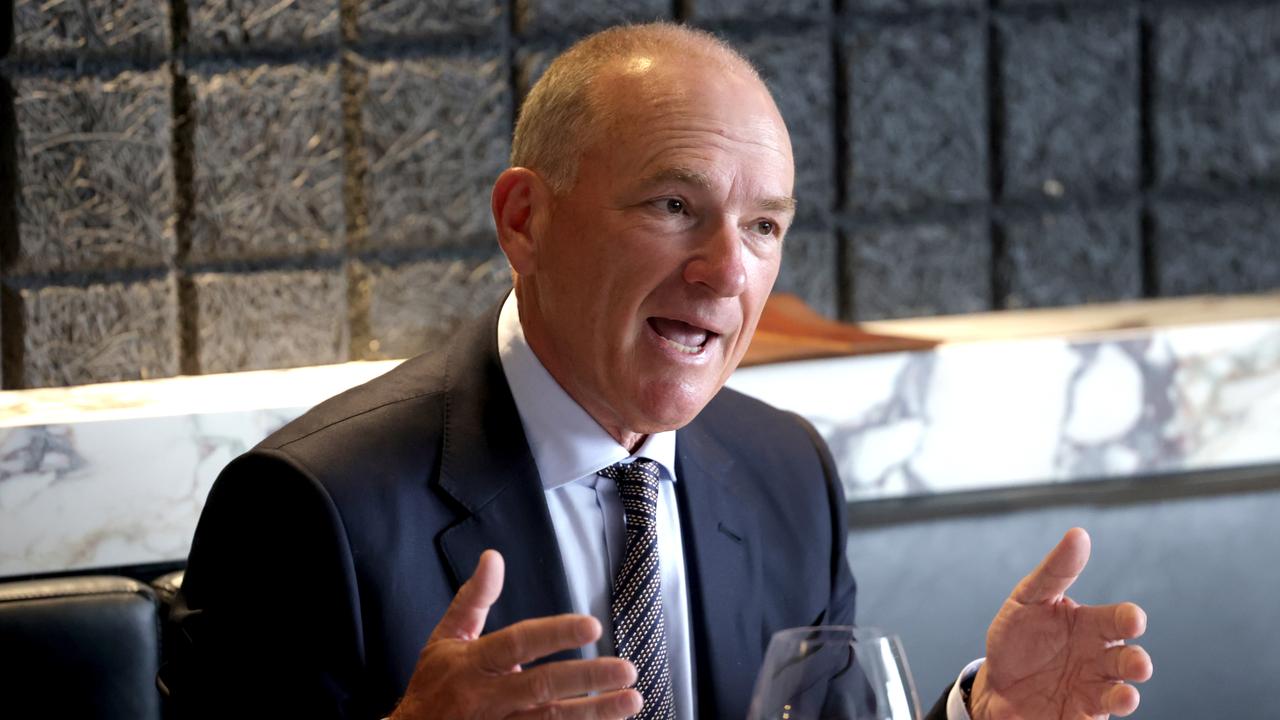
When one of Australia’s top investment fund managers – responsible for a portfolio of $15 billion – says supermarket prices will drop, you have to hope he’s right.
What does Paul Taylor know that we don’t?
For starters, as head of investments for Fidelity International in Australia, he has boots-on-the-ground intel into how big players like Coles are using AI to streamline their operations.
Taylor toured the supermarket giant’s distribution centres in October and says their automation is “very, very significant”.
“Shopping is heading to e-commerce and home delivery which is getting better and better. There are fewer people involved, so fewer errors.
“In the old days, you ordered something online and a staff member would go into the supermarket and just pick from the shelves, and sometimes the stuff you wanted wasn’t there, so they would substitute it for something else, or they just made a mistake.
“Now, going through a centralised distribution centre and using AI means there’s less likelihood of items being unavailable or wrong.”
Taylor says blue-chip companies like Coles and Woolworths – and banks – are prioritising “self-help”, using AI to reduce theft and fraud and ultimately their own costs of doing business.
But surely, average consumers won’t reap any of these savings?
Taylor disagrees.
“I actually think lower prices will come,” he says.
“What they’re focused on is two prong – where half the cost savings go to consumers, half to shareholders. I always think in that sort of situation you want a balance.”
Taylor, 59, is widely respected for his decades of experience steering other people’s investments through all sorts of ups and downs, including the GFC and Covid-19 pandemic.
“You could be an individual investor, or you could invest through a financial planner, who then puts it with us, and we manage money for the super funds, and sovereign wealth funds around the world,” he says.
A huge part of his success is being hands-on.
“Fidelity is what’s called a bottom-up stock selector. So we invest in companies, but what that means is every quarter, we meet with the management team,” he says.
“It’s a real privilege to talk to chief executives, who are fascinating people, and hear how their businesses work and the challenges they face.”
Taylor and his team also listen to the workers.
“If it’s a mining company, we go out and see the mine.
“If it’s a consumer company, we see the stores or the distribution centres.
“And it’s the same with banks, we want to talk to the people, see how they’re developing, how the customer interface is going.
“We basically just want to kick the tyres, and meet the people on the ground to get a better feeling of what’s actually happening in the business.”
Investment decisions are made accordingly – and currently in the top 10 of Taylor’s stock range are Commonwealth Bank, BHP, Evolution Mining, Macquarie, Goodman (logistics properties and data centres), Suncorp, Seek, Westpac, ANZ and IGO (mining).
As for Coles, he rates it as an overweight stock, meaning its stock price should perform better in the future.
Taylor, who has homes in Clayfield and Teneriffe in Brisbane and Bangaroo on Sydney’s CBD waterfront near his head office, spends most of his life travelling.
“To be honest, I probably live on a plane,” he says, with regular trips to London, China, Japan, Singapore and around Australia.
When he is in Brisbane, he indulges his two major passions, the arts and golf.
In June 2025 Taylor was appointed chair of QAGOMA, having been a long-term supporter of both galleries.
“I started as a foundation member and my family donated a few significant paintings – the most being Arthur Boyd’s Sleeping Bride 1957-58, which I gave (in 2016) in Mum and Dad’s name after they passed,” he says.
“It’s such a beautiful painting and I thought it’s probably that good it shouldn’t really be in a home, it should be on display for everybody.”
Taylor helped bankroll the spectacular lighting installation by American artist James Turrell that has illuminated the facade of the Gallery of Modern Art since 2018.
As chair, he says his challenges “tend to be always financial”.
“Costs are going up all the time, even when we’re borrowing artworks, it’s costing us more and more to bring them in.
“And, you know, obviously, governments are extremely generous but it’s getting harder and harder, they’ve got more challenges in different areas like health and housing.
“But I have to say the current minister, John-Paul Langbroek, has been amazing; he’s highly engaged in the arts.”
Taylor says government funding also comes through Tourism and Events Queensland – “TEQ recognises we are bringing lots of people to Brisbane” – and through philanthropy.
“We are trying to get more private money into the galleries – and that side has grown and grown.
“Obviously the size of the donation is relevant but the person who’s donating a small amount today could be our biggest donor in 20 years’ time. So you need to continually develop that pathway for people and take everybody on the journey.”
For Taylor, art galleries are powerful antidotes to the crazy pace of modern life.
“Given this big disruption happening with AI, art galleries are even more important,” he says.
“To me, an art gallery is the soul of the city. It’s where people come, there’s beautiful art, art that challenges us; it’s contemplative, meditative.
“And I just think, you know, these days it’s hard to get in to see a psychologist, right? So galleries are also about mental health, they bring calm.”
Golf has a similar effect on Taylor.
“It’s a slow game – it’s not a 30-second hit from social media,” he says.
“It’s actually four hours in nature, walking around, talking with people. To me, that’s everything a person needs in this world, which is to slow down, have a chat with friends, meet new people, and get out into the sunshine.”
Taylor – a director of the Australian Golf Foundation – hosts a private suite every year at Royal Queensland for the PGA tournament.
Heads of business, sport, medicine and philanthropy can all be seen enjoying a cold beverage and smorgasbord lunch in air-conditioned comfort on the 17th “party” hole as they watch the greats in action.
Taylor himself – who has a handicap of 10 – has played alongside Adam Scott and Min Woo Lee in the Pro-Ams.
“They are both very engaging people,” he says. “And it was an amazing opportunity to ask lots of questions about their experiences over time, and they give you advice on what you are doing, right or wrong – it’s a once in a lifetime thing.”
Taylor grew up in Brisbane’s northern suburbs with loving parents Eric and Marion Taylor and sister Fiona (former chair of the Brisbane Writers Festival Board).
He attended Anglican Church Grammar School and studied commerce at the University of Queensland before moving to the UK with his wife Sue in 1996 where he gained a Masters in Finance at London Business School.
The next year he joined Fidelity’s head office in London before returning to Australia in 2003. Daughter Kate, now studying criminology at UQ, was born in 2006.
“I was always fascinated by how businesses make money, even from a young age, and I’m very interested in statistics and probability,” he says.
“I think I got that from Dad (Eric, who ran a string of small businesses; Mum Marion owned florists).
“Around the dinner table at night, there was always discussion around what was working or not, and how to collect on bad debts – which disappeared when credit cards came in (in the 1970s).”
With his 60th birthday looming in August, Taylor intends to celebrate in style.
There will be golfing trips to the US, a holiday in Italy – “a year without a trip to Italy feels bad,” he laughs – and plenty of hard work.
“I love what I do, and I hope to still be doing it when I’m 80.”
RATING
Paul Taylor, investment fund manager, chair of QAGOMA
Fatcow on James St, Fortitude Valley
Infinite Rangers Valley 220g rump MB9+ with salad, roasted pumpkin
10/10
Read related topics:High Steaks