
Tehran is the epicentre of the nightly protests shaking Iran’s regime, but the reverberations are being felt loud and clear in Moscow, too.
The Islamic Republic is a vital economic, military and strategic partner to Russia. For Vladimir Putin, the stakes are high.
Russia’s president is yet to address the demonstrations besieging his ally, but experts say he will be watching them closely.
Regime change in Iran would be, at best, unwelcome for Putin. Some experts believe it could lead to the Kremlin’s “biggest fear” in the region being realised.
Loading…
Iran’s leadership is struggling to contain the unrest, despite widespread, deadly crackdowns.
The Human Rights Activists News Agency estimates government forces have so far killed more than 2,500 protesters.
US President Donald Trump has flagged the possibility of his military intervening.
“There have been Iranian protests in the past, and Russia has always looked at them but never reacted, because they probably hoped that the Iranian regime will be able to withstand the pressure,” Mario Bikarski, a senior analyst at risk consultancy firm Verisk Maplecroft, told US network CNBC this week.
“But [this time] the pressure has been building up, and it’s not only domestic, it’s also external.”
So far, the Kremlin’s response has been predictable. Publicly at least, they’ve said and done little.
On Wednesday, Foreign Minister Sergey Lavrov became the first Russian official to address the situation in Iran and focused mainly on criticising the United States.
“I don’t think any third party can change the fundamental nature of the relationship between Moscow and Tehran,” he said.
It’s a position that looks shaky when viewed in the context of what’s happened geopolitically in the past year or so. Russia, preoccupied with its invasion of Ukraine, has watched from the sidelines in the past 13 months as some of its closest allies have been toppled elsewhere.
If Tehran goes next, it would be the biggest domino to fall.
Unwanted geopolitical challenges
To understand why Iran is important to Putin, it helps to look at the other relationships he’s seen up-ended by external forces.
In December 2024, Moscow’s foreign relations got a shake-up when a coalition of rebel groups swept Syrian dictator Bashar al-Assad — a reliable Kremlin partner — out of power.
Russia had provided significant military support to the Assad regime, and the advent of a new administration has forced a reset in relations.
While Russia remains a critical trading partner, and still has air and naval bases in Syria, the fledging government in Damascus has engaged with Putin’s enemies too.
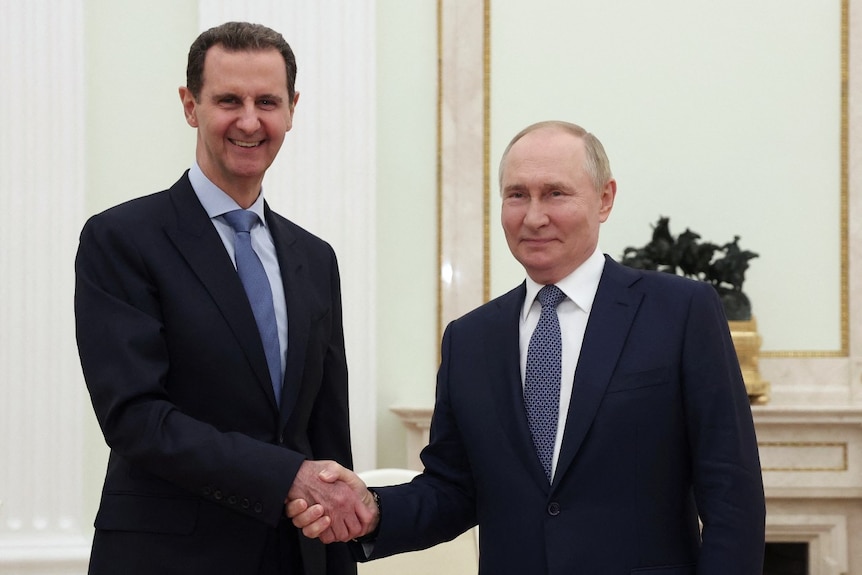
Bashar al-Assad and Vladimir Putin were all smiles during this 2024 meeting. (Pool: Valeriy Sharifulin via Reuters)
Then, earlier this month, US forces captured Venezuela’s leader, Nicolás Maduro, during an audacious military operation. His nation was considered Russia’s most important ally in Latin America.
The political future there is unclear. Trump has said the US will “run” things for the foreseeable future.
Moscow won’t take much of an economic hit from losing its influence in Venezuela, but the situation has been embarrassing for Putin and underscored his nation’s weakness as a military and political actor.
The much-celebrated Russian-built air-defence systems supposed to protect Maduro were useless when the US invaded.
There’s been suggestions that, due to incompetence in both countries, they weren’t even set up.
A brief history of the US’ turbulent relationship with Iran
Syria and Venezuela are unwanted, but not insurmountable geopolitical challenges for the Kremlin.
Iran, however, is different. It’s a vital partner for Moscow.
Economically, it’s not how much they trade that’s important — although they have helped each other avoid Western sanctions — it’s what they’re trading.
Iran is a major supplier of military equipment and expertise to Russia, although the Islamic Republic’s regime denies this.
The Kremlin has used Iranian Shahed drones extensively in Ukraine. Over the course of the war, Iran has helped Russia develop the capability to manufacture them independently.
But for Putin, the value of the relationship goes far beyond any economic and military benefit.
‘Putin’s worst-case scenario’
Iran is a linchpin in the Kremlin’s broader geopolitical agenda.
“Russia wants to fundamentally make a different world — a world with itself at the centre, where great powers act with impunity in their backyard,” says Anna Borshchevskaya, a senior fellow at the Washington Institute for Near East Policy.
“It is a vision that stands in stark opposition to the free liberal world. That’s why we are where we are today, because these visions are incompatible.
“Iran’s current regime is an important part of this puzzle because it, like Putin, shares his vision for this alternative world order and has a lot to offer in the Middle East in terms of how Russia can achieve these bigger aims.”
Loading
Ties between Tehran and Moscow have limits, though. Despite signing a comprehensive strategic partnership last year, which provided a blueprint for the next two decades of relations, the two countries have no formal defence commitments.
Russia, too, does not want Iran to develop nuclear weapons. This was underscored during the so-called “12-day war” Iran fought with Israel and, eventually, the US last year. Russia watched its ally get pummelled from the sidelines.
Analysts debated whether the Kremlin was unwilling, or unable to help. Putin claims Iran never asked for assistance.
If there is regime change in Tehran, there’s no guarantees as to what that would look like, and whether a new government might seek to strengthen, or weaken ties with Russia.
Iran’s protest began amid anger about the collapse of the country’s currency, and have since snowballed to include corruption and opposition to the Islamic Republic’s repressive religious establishment.
They are both grievances that could see a new administration in Iran search for fresh global relationships.
“For Russia, that could mean being pushed out of Iran altogether. That is Putin’s worst-case scenario,” says Ms Borshchevskaya.
“It’s unlikely, Iran is a regional power and a new administration would likely still engage with Russia. But Iran turning pro-Western is the Kremlin’s biggest fear in the region.”