
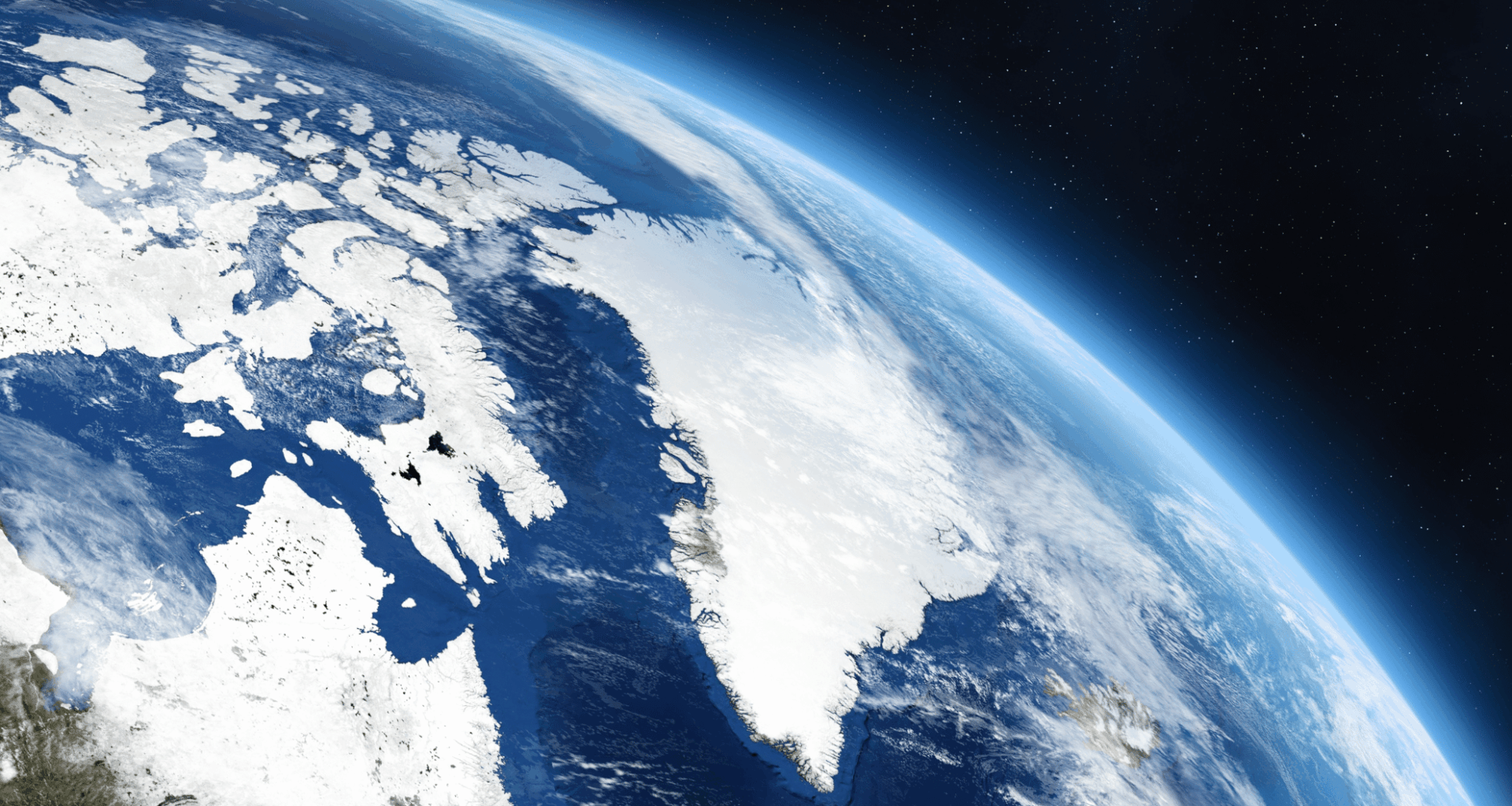
A new study published in Geology has unveiled a hidden factor that could be dramatically accelerating Greenland’s ice loss. Scientists from the University of California, San Diego (UCSD) have mapped an unseen layer beneath the ice sheet that changes how glaciers move and melt. This discovery reshapes how researchers understand Greenland’s contribution to sea-level rise, pointing to processes unfolding deep below the surface that could determine the planet’s future coastlines.
Seismic Signals Reveal A Hidden World Beneath Greenland
Using earthquake-generated seismic waves, UCSD scientists led by Yan Yang analyzed Greenland’s subsurface without drilling through miles of ice. By measuring tiny delays in how these waves traveled through the Earth, the team built a map of the ground beneath the ice sheet. What they found suggests the foundation of Greenland is far more complex, and more dynamic, than previously believed.
Each seismic signal offered a clue to what lies below. Variations in wave speed revealed that different regions of Greenland rest on contrasting materials.
“The safety of coastal communities depends on accurate forecasts, and knowing whether the bed is hard rock or soft sediment is essential for improving future sea-level change predictions,” said Yang.
Published in Geology, the research points to a mosaic of conditions under the ice: some regions are rigid and stable, while others appear more fluid and changeable. These hidden differences can dramatically influence how fast glaciers slide toward the ocean.
What Lies Beneath Shapes How Ice Moves
The study reveals that Greenland’s ice does not simply melt from above, it also moves in response to what lies underneath. Where the base is smoother or less resistant, the massive weight of the ice sheet allows it to flow faster toward coastal areas. This movement feeds outlet glaciers, which carry vast amounts of ice into the sea.
The scientists also observed that temperature and meltwater interact with these subsurface layers. During warmer months, meltwater can penetrate deep through moulins, or vertical shafts, reaching the bottom of the ice sheet. Once there, it changes the pressure balance between ice and ground, influencing how easily the ice can slide. The findings suggest that the relationship between heat, water, and subsurface material plays a bigger role in ice flow than previously recognized.
This means parts of Greenland that look stable from space may, in fact, be primed for rapid change. As the Arctic continues to warm, areas that have held firm for centuries might begin to shift, adding uncertainty to global sea-level forecasts.
Why This Discovery Changes Climate Forecasts
Greenland has already raised global sea levels by about 0.43 inches between 1992 and 2018, but this new insight could alter projections for the decades ahead. If subsurface conditions accelerate glacier movement, future sea-level rise may happen faster than models currently predict.
The researchers emphasize that a denser seismic network is needed to capture Greenland’s complexity more accurately. Localized changes in heat or water pressure can create differences over surprisingly short distances. Seasonal meltwater flow, for instance, may temporarily alter the stability of certain regions, making long-term predictions difficult.
By combining seismic data with satellite velocity maps and topographic models like BedMachine, scientists aim to build a new generation of ice-sheet models that integrate what’s happening both above and below the surface. These models could provide more reliable forecasts for policymakers and coastal planners around the world.
Beneath The Ice Lies The Key To The Future
The implications go far beyond Greenland. Understanding what happens under ice sheets could be the key to predicting the pace of global sea-level rise. The study’s authors argue that future models must incorporate the “invisible” processes occurring beneath the ice to accurately estimate the risks ahead.
As Yang emphasized, “The safety of coastal communities depends on accurate forecasts.” Her team’s findings offer a clearer look at one of the least understood parts of our planet—one that may quietly determine the fate of millions living near the sea.