
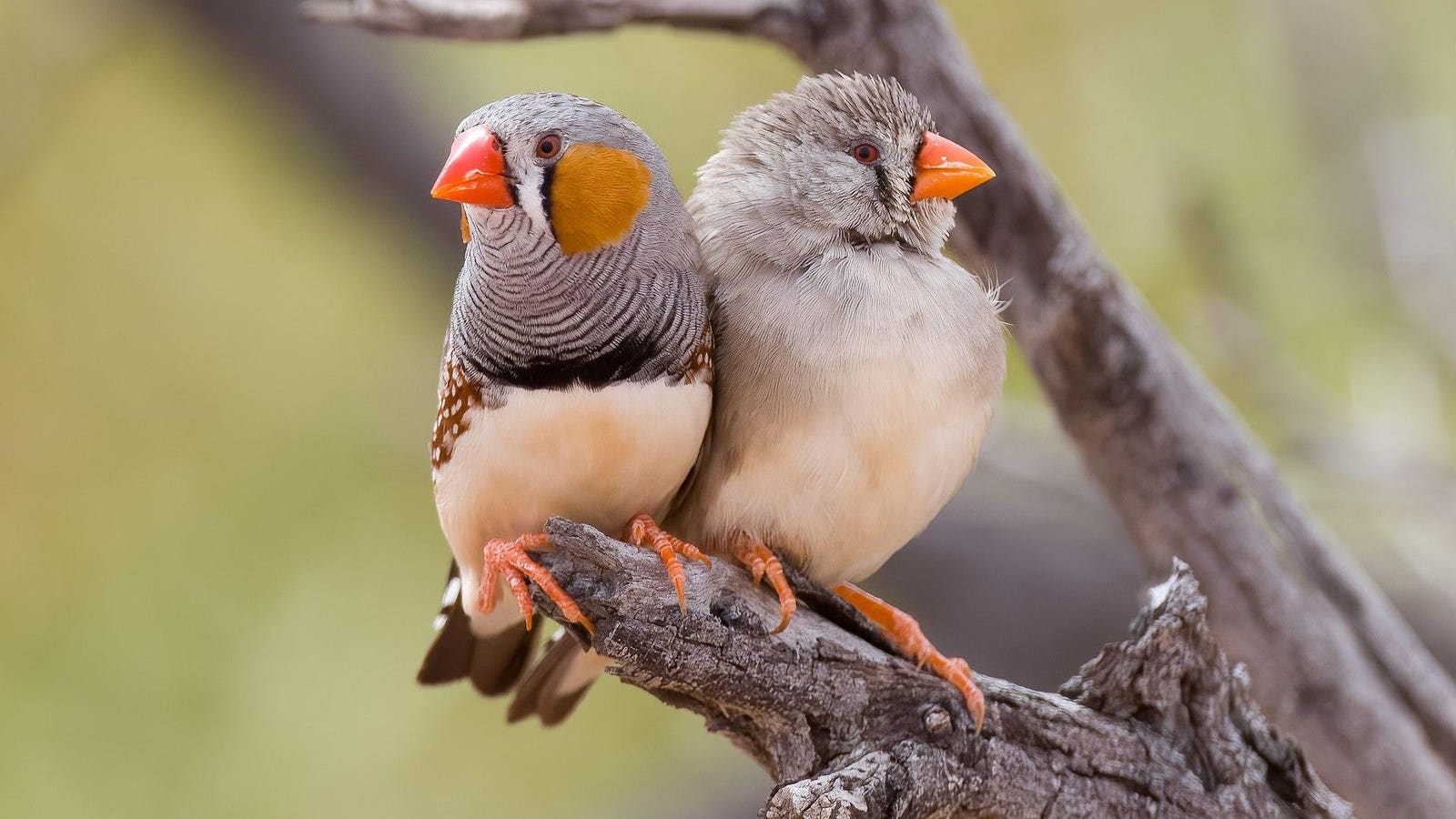
A pigment that colors feathers and hair orange helps prevent cellular damage by removing excess cysteine from cells.
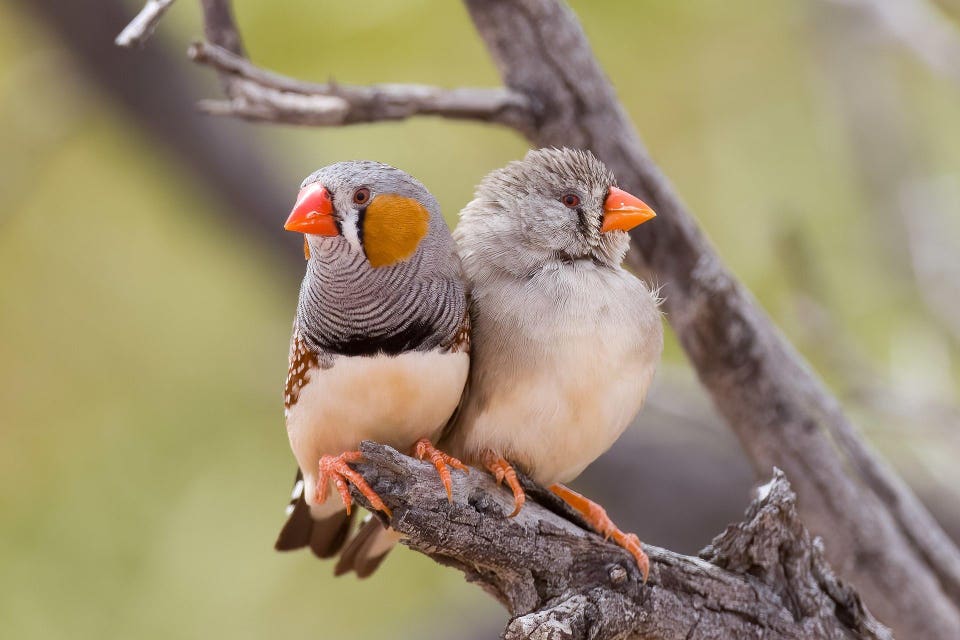
A pair of Australian Zebra Finches (Taeniopygia guttata) at Cameron Corner, Sturt National Park NSW. The male is on the left. (Credit: PotMart186 / CC BY-SA 4.0)
PotMart186 via a Creative Commons license
Orange coloration in animals is created by the pigment, pheomelanin, a yellow to reddish-brown pigment synthesized from the amino acid cysteine. This inert pigment is deposited into feathers and hair, thereby creating orange coloration. Previous research has found that pheomelanin is associated with increased melanoma risk, thereby raising questions about why evolution has maintained genetic variants that promote pheomelanin production.
Male (left) and female (right) wild-type zebra finches (Taeniopygia guttata). The orange feathers displayed by the male are colored by the pigment pheomelanin, which is also present in human skin and red hair. Pheomelanin is associated with an increased risk of melanoma, but also exerts a beneficial physiological function consisting in the avoidance of toxicity that an excess of the amino acid cysteine in the diet may cause. Female zebra finches, which do not produce pheomelanin like males, experience cellular damage when exposed to high dietary levels of cysteine.
Ismael Galván / doi:10.1093/pnasnexus/pgaf391
In zebra finches, Taeniopygia guttata, a small sexually dichromatic bird species, only males produce pheomelanin, which creates their orange cheek patches and the brownish-red plumage patches on their sides. Females lack these patches.
“[M]ales produce the pigment pheomelanin, but females do not,” said the study’s lead author, evolutionary physiologist Ismael Galván, a staff scientist with the National Museum of Natural Sciences. Professor Galván specializes in investigating the pigmentation of animals and how it drives their evolution, relying on birds as his primary study organisms.
“This is why the presence of orange feathers in cheeks and flanks in an adult zebra finch means that the bird is a male, while females are completely grey colored (in the wild variant of the zebra finch),” Professor Galván explained in email.
This lack of orange plumage also implies that females lack the ability to neutralize cell damage due to the excessive accumulation of cysteine.
“Females do not have the protection mechanism related to the pigment,” Professor Galván observed in email. “This way, males can avoid accumulation of cysteine in cells, and in turn, this avoids toxicity and cellular damage.”
Professor Galván and collaborators came to this conclusion by studying 65 adult zebra finches. Male zebra finches in the treatment group were fed dietary cysteine for a month along with the drug, ML349, that blocks pheomelanin synthesis. They found that male zebra finches treated with both cysteine and ML349 showed increased oxidative damage in blood plasma compared to males who were only fed cysteine. In contrast to both the males and to the female controls, female zebra finches in the treatment group showed slightly higher levels of oxidative damage when fed extra dietary cysteine, although the difference was insignificant.
Fig. 1. Change in systemic oxidative damage (malondialdehyde levels in plasma [ΔMDA]) in wild-type zebra finches supplemented with dietary cysteine (alone and combined with ML349) and controls.
doi:10.1093/pnasnexus/pgaf391
Pheomelanin is also produced by mammals, including people – so-called red-heads or “gingers” – where it also helps prevent cellular damage by removing excess cysteine from cells, just as reported in birds.
But don’t gingers have an increased risk of some cancers, even in the absence of sunlight?
“Yes, it is very well established that ginger hair people have an increased risk of melanoma,” Professor Galván remarked in email. “It was believed that the mechanism behind such association was that pheomelanin produces a light color on the skin, thus not protecting skin cells from solar UV radiation. Then it was discovered that pheomelanin itself produces lots of free radicals that damage cells when exposed to UV. But then, the team led by David E. Fisher at Harvard Medical School showed, using mutant mice that mimic the ginger hair pigmentation pattern of humans, that the presence of pheomelanin in these mice increased melanoma risk independently of UV radiation (ref). This is particularly important because it suggested that the mechanism of pheomelanin synthesis in cells itself is what increases the risk of melanoma.”
At the same time that Professor Fisher was studying his mutant ginger mice, Professor Galván and his team found that pheomelanin production in birds may either be costly or beneficial depending upon how much cysteine was available (PDF), and this may explain why pheomelanin-promoting genetic variants persist despite being associated with increased melanoma risk.
“If the genetic basis of a person or an animal predisposes a high production of the pigment, then there will be a limited availability of cysteine to build the antioxidant,” Professor Galván told me in email. “Thus, ginger hair people may be under chronic oxidative stress, which may favor melanoma. In animals, this may translate into a lower ability to cope with environmental stress sources, as we showed in birds that inhabit the Chernobyl area (ref).”
In 2011 (ref), Professor Galván and collaborators at that time, examined 97 bird species living around Chernobyl. They found that species with the molecular basis to produce large amounts of pheomelanin showed a limited ability to cope with oxidative stress when compared to species that produce eumelanin, a darker, sulfur-containing pigment. Interestingly, Professor Galván and collaborators found that the magnitude of population declines revealed that certain groups of birds, especially non-corvid songbirds, are especially sensitive to radioactive contamination. At the same time, pheomelanin synthesis was also strongly linked to increased melanoma risk (ref), by causing DNA damage that drives skin cancer, especially after exposure to sunlight (UV light).
Male (a) and female (b) European nuthatches (Sitta europaea). Females prefer males with paler colored flanks. (Credit: Ismael Galván)
Ismael Galván
This relationship been also reported for Eurasian nuthatches, Sitta europaea, another songbird with orange plumage, according to a 2018 study (ref), but in this species, females show a surprising preference for as little orange plumage coloring as possible when making their mate choices. Why?
“In Eurasian nuthatches, females prefer to mate with males with orange flank feathers of diminished color intensity, according to the fact that, in nestlings, birds with more intense flank feathers are in poorer body condition, probably as a consequence of the detoxifying strategy that lead them to produce more pheomelanin,” Professor Galván told me in email.
The 2018 study (ref) suggested that female nuthatches may actually be choosing their mates based on their body condition as a nestling, not his current body condition. If so, nuthatches are one of the few examples where females prefer “less fancy” mates – those with diminished traits (paler coloration, in this case) – and pheomelanin synthesis provides the only explanation for this curious observation so far.
“These findings represent the first experimental demonstration of a physiological role for pheomelanin, namely avoiding the toxicity of excess cysteine, leading to a better understanding of melanoma risk and the evolution of animal coloration,” Professor Galván and collaborators wrote in their study.
According to Professor Galván and collaborators, it is now possible to develop a comprehensive understanding of melanoma risk at the interface between pigmentation phenotype and environmental conditions that determine susceptibility to cysteine accumulation. Professor Galván suggested that future studies should aim at identifying such environmental factors, which will also help understanding the evolutionary predictors of animal color diversity.
Source:
Ismael Galván, Marina García-Guerra, and Marta Araujo-Roque (2026). MC1R depalmitoylation inhibition reveals a physiological role for pheomelanin, PNAS Nexus, 5(1):pgaf391 | doi:10.1093/pnasnexus/pgaf391
© Copyright by GrrlScientist | hosted by Forbes | LinkTr.ee
Socials: Bluesky | CounterSocial | LinkedIn | Mastodon Science | Spoutible | SubStack | Threads | Tumblr | Twitter