
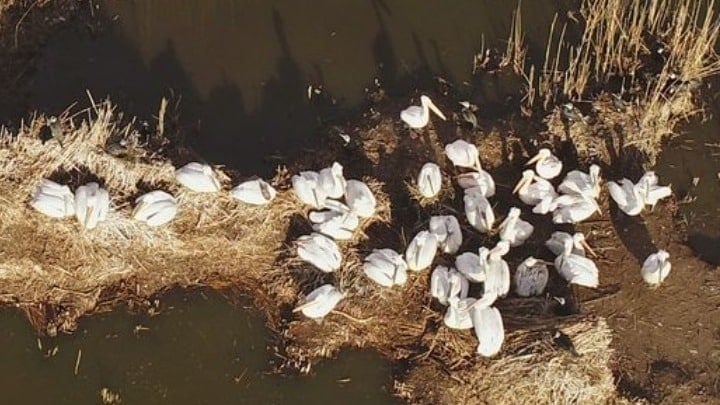
For large-bodied birds with these characteristics, it takes decades to recover from such a significant blow. Credit: AMNA
Three years after the devastating 60% decline of the world’s largest Dalmatian Pelican colony at Lake Mikri Prespa in northern Greece, researchers have reached critical conclusions regarding the loss of over 2,300 birds across Greek wetlands.
The research, a collaboration between the Society for the Protection of Prespa (SPP) and the Spanish research institute IREC/CSIC, revealed that the avian flu virus was likely introduced by migratory waterfowl (ducks and geese) arriving from northern climates.
While ducks and geese carried the virus, they remained asymptomatic. They transmitted the virus to the pelicans via droppings left on the small islands where both groups rest.
Interestingly, Great White Pelicans nesting alongside the infected colonies remained completely unaffected by the virus. Also, colonies in Western Greece (Amvrakikos Gulf and Messolonghi lagoons) escaped the outbreak. Scientists believe higher temperatures and water salinity in these areas may have inhibited the virus compared to the freshwater environments of the north.
Signs of survival and hope
Olga Alexandrou, a forester-ornithologist for the SPP, noted a fascinating physical marker of survival: cloudy corneas. Birds that have survived the initial infection often display a “foggy” eye, a sign that they have successfully battled the disease and are now breeding again. Furthermore, blood samples from 2023 revealed that chicks had avian flu antibodies, suggesting that survivors are passing on immune protection to the next generation.
Despite these signs of resilience, the outlook remains cautious. The 2022 outbreak was the worst ecological disaster for wildlife in Greek history, wiping out 40% of the Southeast European breeding population—roughly 10% of the entire global species.
Recovery will be slow
Slow Reproduction: Pelicans do not reach breeding age until 3–4 years old and typically raise only one chick per year.
Predation and Climate: In 2023, extreme drought allowed jackals to reach previously isolated nesting islands, resulting in the loss of hundreds of chicks.
Viral Mutation: Scientists remain on high alert for new, highly virulent strains currently affecting Western Europe (where over 80,000 cranes have perished recently).
“For large-bodied birds with these characteristics, it takes decades to recover from such a significant blow,” warns Alexandrou. “In this uncertain environment, we don’t know when Prespa will return to its 2022 level of 1,400 breeding pairs.”