
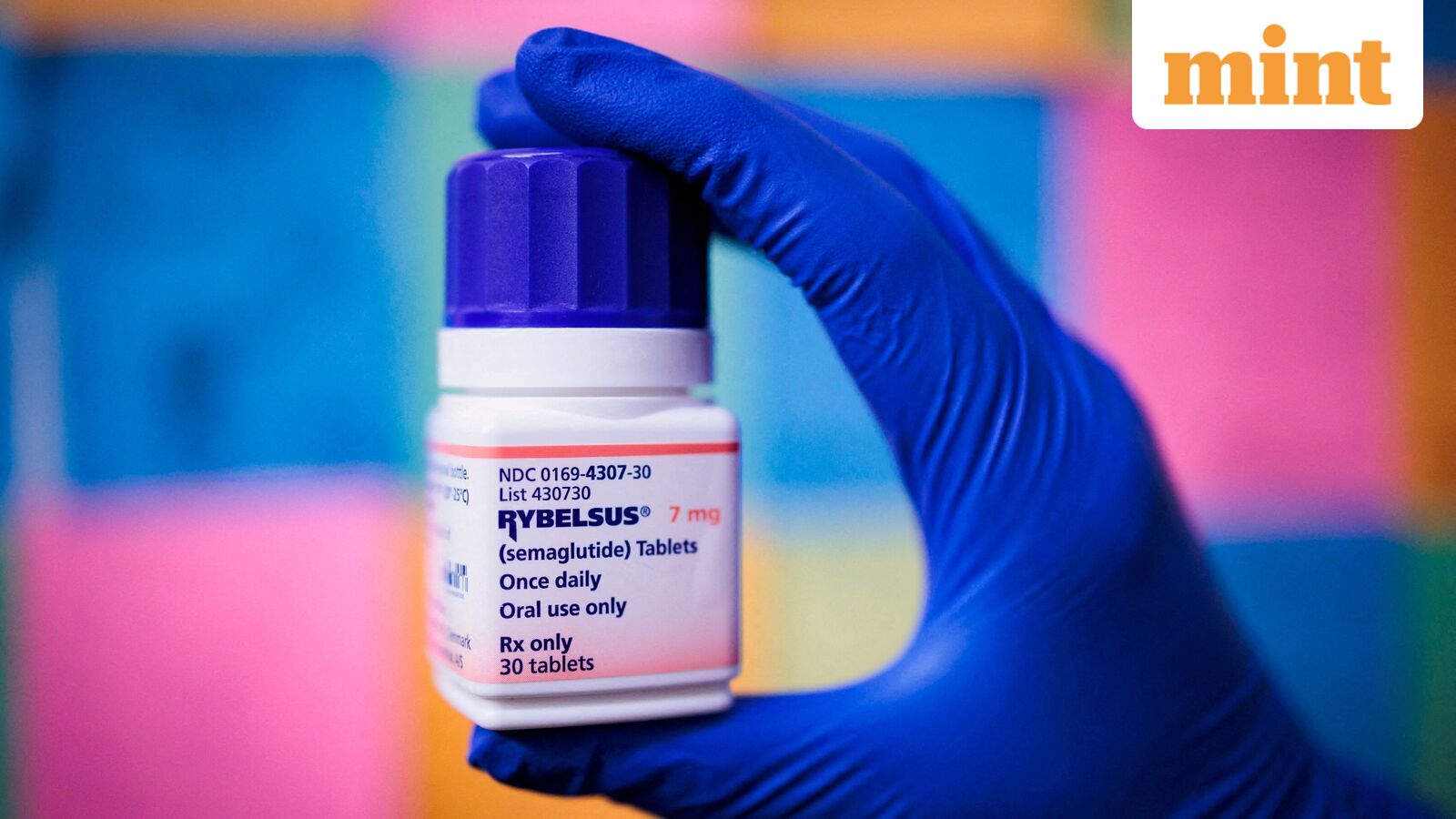
Novo executives project that oral pills could capture more than a third of the total obesity drug market by 2030. Its rival Eli Lilly is expected to receive approval from the US Federal Drug Administration (FDA) for its own oral weight-loss drug, Orforglipron, by March 2026.
These moves reflect intense competition in the weight-loss drugs market. This year, competition is set to intensify in the US and increase radically in other markets around the world.
Balance of power
The US weight-loss drugs market is currently dominated by Novo Nordisk and Eli Lilly, though the balance of power has shifted. Novo Nordisk was the pioneer, launching Ozempic for diabetes in 2018 and Wegovy for obesity in 2021, thereby enjoying a significant first-mover advantage.
These drugs belong to a class called GLP-1 receptor agonists, which mimic a natural hormone that regulates appetite and blood sugar, leading to significant weight loss.
Eli Lilly entered later with Mounjaro for diabetes and Zepbound for obesity, and has rapidly gained ground, capturing about 60-70% of US obesity prescriptions by 2025, compared to Novo’s 30-40%. Head-to-head trials show Eli’s injection delivers roughly 47% more weight loss than Wegovy, and the company has maintained stronger production capacity. Its revenues grew 54% year-on-year in the September quarter of 2025, driven by weight-loss drugs, compared to Novo’s 12% growth.
Investors have responded accordingly. Novo’s market capitalization stands at $261 billion, down from a peak of $570 billion in 2024, while Eli Lilly’s has surpassed $1 trillion, making it the first pharma company to hit this milestone. As its dominance faded, Novo cut 9,000 jobs and replaced its CEO to sharpen its commercial execution.
Supply race
Demand for GLP-1 drugs has been growing ever since they were first introduced. The US market alone is expected surge from $22.8 billion in 2025 to a peak of $68.5 billion by 2033, according to a Goldman Sachs report in May 2025.
Both Novo Nordisk and Eli Lilly have struggled to keep up. Novo Nordisk had to restrict the supply of Wegovy starter doses in the US to ensure existing patients could continue treatment, while compounding pharmacies captured an estimated 30% of the US market by selling unapproved copycat versions.
Both companies are pouring billions into expanding production to close this gap. Novo Nordisk invested more than $28 billion in capital expenditure over the past four years, and its parent company acquired contract manufacturer Catalent for $16.5 billion to secure three additional factories and boost US capacity. Eli Lilly spent $21 billion on capital expenditure over four years, including a $3.7 billion commitment to two new factories in Boone County, Indiana.
The shift to oral pills is expected to intensify this pressure. Novo’s oral Wegovy requires significantly more of the active ingredient (semaglutide) than injections, raising concerns about scaling up production.
Patent cliff
The year marks a turning point for these drugs. Key patents for semaglutide, the active ingredient in Ozempic and Wegovy, are set to expire in major markets as China, India, Brazil, and Canada starting this year. This will allow other manufacturers to legally produce generic or biosimilar versions. Competition from generics is expected to reduce prices, making treatment more accessible.
What is certain is that there will be demand. Obesity has become a health emergency, with over a billion people now living with the condition globally, according to the World Health Organization (WHO). Adult obesity has more than doubled since 1990, particularly in emerging economies.
India has the world’s second-largest number of people with type 2 diabetes and faces rising obesity rates, while China also has strong demand for weight-loss treatment. Last year, WHO included diabetes and weight-loss drugs in its essential medicines list, urging pharmaceutical companies to lower prices and expand production.
In the US, the Trump administration has negotiated deals with Eli Lilly and Novo Nordisk to slash prices for Medicare and Medicaid by up to 71% in exchange for broader coverage and tariff exemptions.
A bigger market
In emerging markets such as India, where patients pay out-of-pocket for healthcare, prices must fall. Generic players operating on a ‘high-volume, low-cost’ model are expected to reduce prices. Analysts estimate competition could push monthly treatment costs to $15-50 in some places, expanding the size of the market.
Pharmaceutical companies in India and China are gearing up to tap the oppotunity. In India, Dr. Reddy’s Laboratories is preparing to launch its version of the drug in 87 countries, while Cipla and Sun Pharma are developing their own versions. Biocon already sells a generic version of an older weight-loss drug (Liraglutide) in the UK and has signed a deal to distribute generic semaglutide in Brazil. Exports account for half of India’s pharmaceutical industry. Meanwhile In China, generics makers such as Huadong Medicine and CSPC Pharmaceutical Group have sought approval for their semaglutide versions.
In response, Novo Nordisk slashed Wegovy’s price in India by up to 37% in November to ₹10,850-16,400 a month and reduced prices in China to make its branded products more competitive against incoming generics. Both companies are also partnering with local firms to to deepen their market penetration. Novo has teamed up with Emcure in India, while Lilly has partnered with Cipla to expand distribution beyond major cities.
Defensive strategy
Both Novo Nordisk and Eli Lilly are also filing hundreds of secondary patents to extend their exclusivity in primary markets. Novo Nordisk has filed more than 320 applications and secured 49 patents covering product modifications, aiming to delay the entry of generics in the US and Europe until 2042. Eli Lilly already holds patent protection for tirzepatide (the active ingredient in Mounjaro and Zepbound’s) extending into the mid-2030s.
They are also contending with startups. The sector is attracting investments, with companies such as Kailera Therapeutics raising $600 million and Verdiva Bio securing $411 million for obesity pipelines. Structure Therapeutics and Viking Therapeutics are developing oral candidates to compete in the pill market.
Both companies are also developing next-generation treatments. Eli Lilly is working on retatrutide, a ‘triple G’ agonist that has delivered up to 24% weight loss in trials, while Novo is advancing CagriSema, a combination therapy offering weight loss beyond Wegovy, and Amycretin, an oral candidate.
This innovation matters because patients who stop using these drugs regain the weight they lost, with most returning to their pre-treatment weight within one-and-a-half years, according to a study in the British Medical Journal.
www.howindialives.com is a database and search engine for public data