In the silent immensity of space, where every extra kilometer makes communication harder, NASA has achieved something historic: a two-way laser link with the Psyche probe, now drifting more than 350 million kilometers from Earth. The feat — even beyond the average distance to Mars — marks a new era in exploration. For the first time, we have a technology that could completely reshape how we communicate with the farthest corners of the solar system, paving the way for future crewed missions to the Red Planet.
When light becomes language
Since the dawn of the space age, spacecraft have spoken to Earth through radio waves — a dependable but limited method. It’s a bit like trying to send an entire book through a keyhole. The faint radio signals from Voyager 1 and 2, launched in the 1970s, still reach us today, but at such low speeds that transmitting a single image can take hours.
Now, a new laser-based approach changes everything. Instead of radio, Psyche and Earth communicate with beams of light, turning data into rapid pulses that travel cleanly through the void. This optical leap multiplies transmission capacity many times over, enabling a level of data exchange once thought impossible.
The system depends on extraordinary precision. From NASA’s Jet Propulsion Laboratory in California, a 3-kilowatt laser beam targets Psyche with pinpoint accuracy. This guiding light helps the spacecraft orient itself relative to Earth — a remarkable feat, given the complex orbital dance of both worlds.
The art of catching lost photons
Catching a laser signal from deep space is a breathtaking technical challenge. Imagine spotting the flicker of a candle hundreds of millions of kilometers away — while that tiny flame races through the void at tens of thousands of kilometers per hour. That’s exactly what California’s Palomar Observatory manages to do, its giant optical dome focused on the cosmos.
By the time those weary photons reach Earth’s detectors, they’re only a faint trace of their original power. Yet NASA’s ultra-sensitive receivers can still decode the information hidden in that fragile light, turning it into clear, usable data.
This technology has already made headlines. In December 2023, NASA stunned the world by beaming back a high-definition video of a cat chasing a laser pointer — from space. Funny as it sounds, that brief clip was a proof of concept for something revolutionary: transmitting full-motion video from 31 million kilometers away.
Space performance at Earth-like speeds
The results have shattered expectations. Engineers report data rates on par with home broadband — a breakthrough that redefines what’s possible for deep-space communication.
Gone are the days when distant probes could send only a few images each day. With laser technology, future missions could stream enormous amounts of scientific data, continuous video in high resolution, even real-time visuals from alien worlds.
The Psyche mission’s record — 350 million kilometers — far exceeds the average distance between Earth and Mars. That milestone proves the system’s readiness for the next great leap: supporting future robotic and human expeditions to Mars.
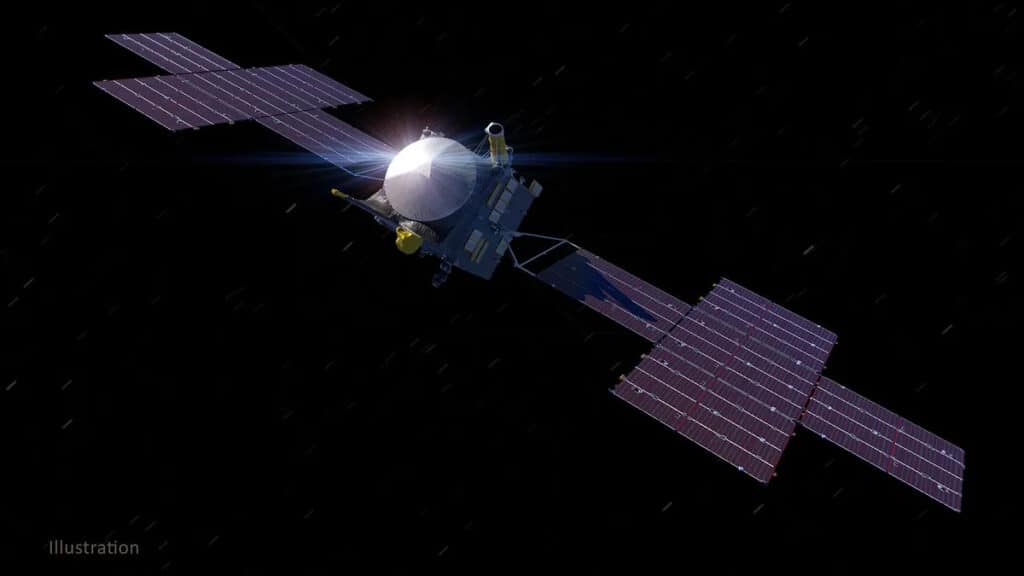
NASA’s Psyche mission will be the first to visit the metallic asteroid also known as Psyche. Credits: NASA/JPL-Caltech/ASU
The dawn of the interplanetary internet
These advances are rewriting the future of exploration. The next Mars missions, now in NASA’s pipeline, will enjoy data links of extraordinary quality. Astronauts could maintain near real-time conversations with Earth, sharing discoveries with a richness never before possible.
And the implications go far beyond technology. One day, people around the world could watch live as humans take their first steps on Mars, explore vast Martian canyons, or examine red rock samples in real time. The experience would bring an emotional closeness that makes space exploration feel almost tangible.
This breakthrough signals the birth of a true interplanetary internet — a network of light connecting worlds. As humanity expands deeper into the solar system, these laser highways will become the vital lifelines of our growing cosmic civilization. For the first time, deep space feels just a little closer to home.