
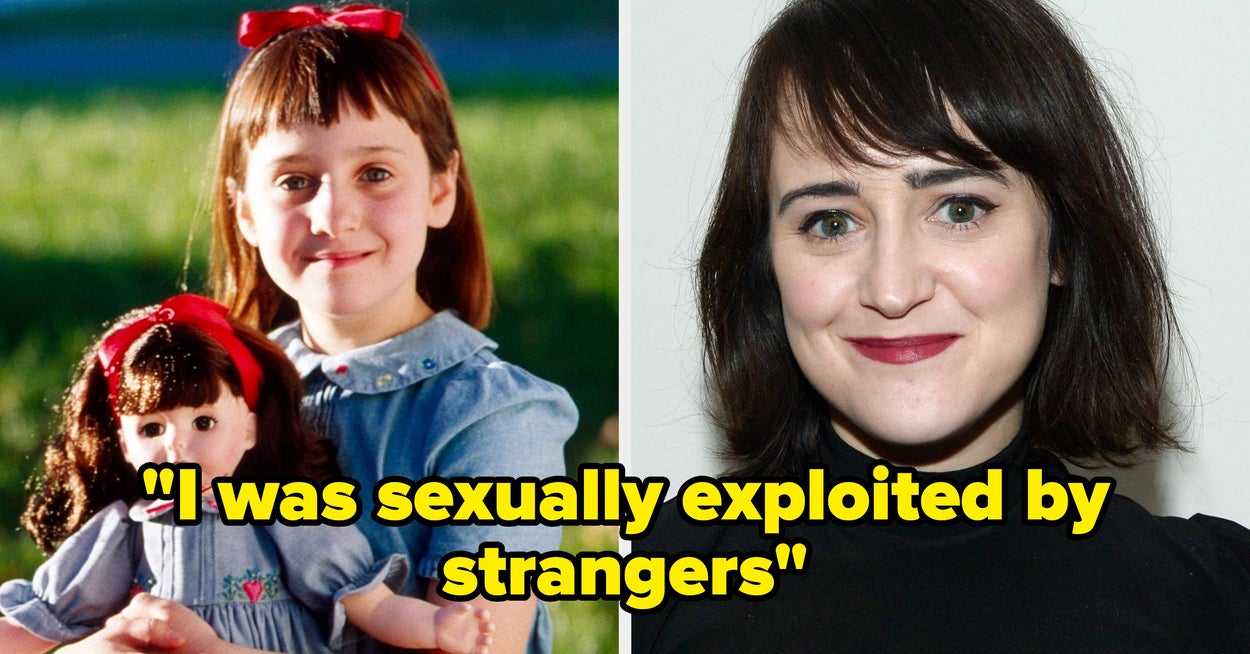
Matilda’s Mara Wilson On Childhood Sexual Exploitation
Mara Wilson was just five years old when she became a globally recognized movie star back in the ‘90s, starring in films like Miracle on 34th Street, Mrs. Doubtfire, and Matilda throughout her childhood.
And in more recent years, the former child star has been incredibly open about the downsides of becoming famous at such a young age, and has shared disturbing insight into her personal experience in a bid to raise awareness and express her support for emerging young celebrities, including Millie Bobby Brown.
For reference, Millie was 11 years old when she made her debut in Stranger Things back in 2016.
Penning an essay for Elle in 2017, Mara wrote: “Even before I was out of middle school, I had been featured on foot fetish websites, photoshopped into child porn, and received all kinds of letters and messages online from grown men.”
So, when Millie hit the big time in Stranger Things, Mara admitted that she found herself taking an interest in how she was being treated. She wrote: “I wasn’t worried about her. Not at first. It’s my nature to worry about child actors. Then Millie Bobby Brown turned 13. Last week, I saw a photo of her on Twitter, dressed up for a premiere. I thought she looked like a teenage girl. The caption, however, read that, at 13, she ‘just grew up in front of our eyes.’ It had been tweeted by a grown man.”
Then, in 2021, Mara penned an emotional op-ed for the New York Times, where she recalled being sexualized at a young age. “People had been asking me, ‘Do you have a boyfriend?’ in interviews since I was 6,” she wrote. “Reporters asked me who I thought the sexiest actor was and about Hugh Grant’s arrest for soliciting a prostitute.”
Two years later, in 2023, Mara had a raw conversation with the Guardian, opening up some more about being “sexualized” by the public — despite always feeling “safe” on movie sets. “I was still sexualized,” she said. “I had people sending me inappropriate letters and posting things about me online.”
“I made the mistake of Googling myself when I was 12 and saw things that I couldn’t unsee,” Mara recalled, with the journalist noting that photos of her face had been edited onto other girls’ bodies on porn sites, replicating child sexual abuse.
And Mara, now 38, has now opened up some more about these manipulated images in a new essay for the Guardian, where she expressed her growing fear surrounding AI, and how it is putting children of today in danger. The essay comes shortly after X faced fierce backlash when its AI tool, Grok, was exposed for creating indecent images of users without their consent.
“I was sexually exploited by strangers,” Mara writes in her latest piece. “From ages five to 13, I was a child actor. And while as of late we’ve heard many horror stories about the abusive things that happened to child actors behind the scenes, I always felt safe while filming… The only way show business did endanger me was by putting me in the public eye. Any cruelty and exploitation I received as a child actor was at the hands of the public.”
“Before I was even in high school, my image had been used for child sexual abuse material (CSAM). I’d been featured on fetish websites and Photoshopped into pornography,” she recalls. “Grown men sent me creepy letters. I wasn’t a beautiful girl – my awkward age lasted from about age 10 to about 25 – and I acted almost exclusively in family-friendly movies. But I was a public figure, so I was accessible. That’s what child sexual predators look for: access. And nothing made me more accessible than the internet.”
“It didn’t matter that those images ‘weren’t me’,” Mara went on. “Or that the fetish sites were ‘technically’ legal. It was a painful, violating experience; a living nightmare I hoped no other child would have to go through.”
In her essay, Mara goes in-depth about how these images are allowed to be created, and what needs to be done in order to make it stop, and for children to be protected. She writes: “We need to be demanding legislation and technological safeguards. We also need to examine our own actions: nobody wants to think that if they share photos of their child, those images could end up in CSAM. But it is a risk, one that parents need to protect their young children from, and warn their older children about.”
“If our obsession with Stranger Danger showed anything, it’s that most of us want to prevent child endangerment and harassment,” she concludes. “It’s time to prove it.”
You can read Mara’s full article here — let me know your thoughts in the comments.
If you or someone you know has experienced sexual assault, you can call the National Sexual Assault Hotline at 1-800-656-HOPE, which routes the caller to their nearest sexual assault service provider. You can also search for your local center here.
If you are concerned that a child is experiencing or may be in danger of abuse, you can call or text the National Child Abuse Hotline at 1-800-422-4453(4.A.CHILD); service can be provided in over 140 languages.