
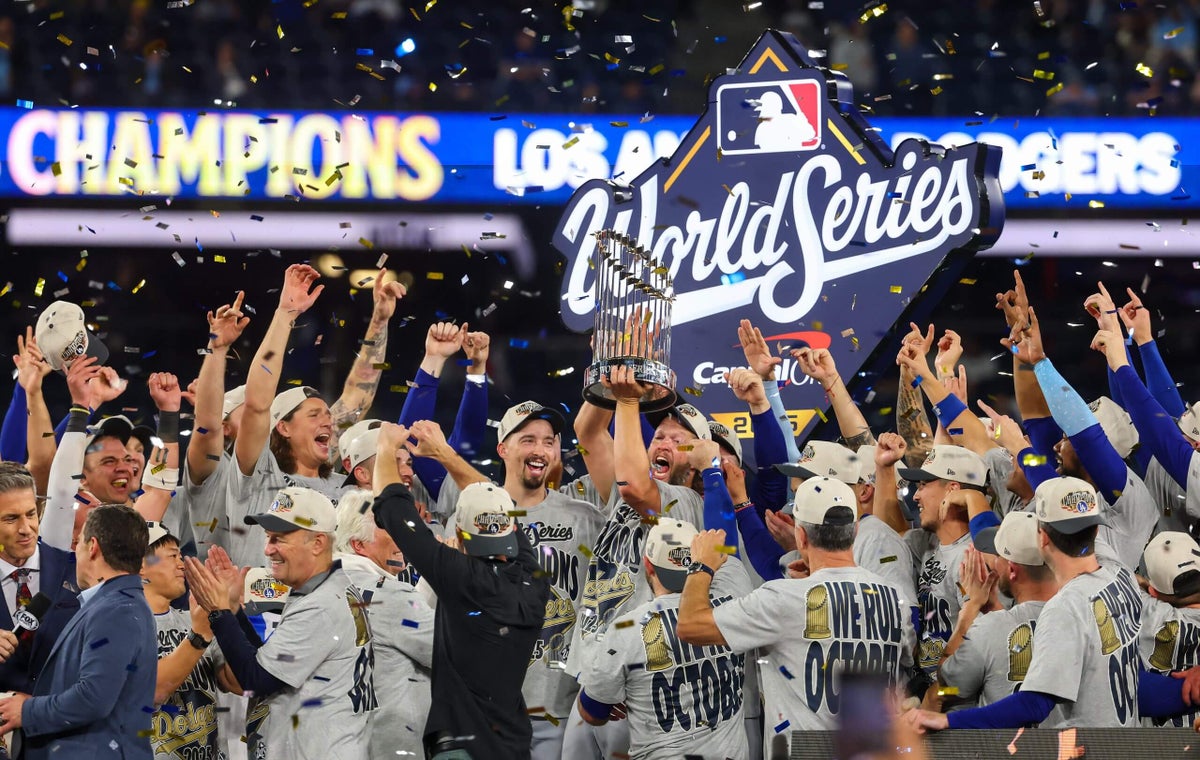
The Los Angeles Dodgers are a model franchise, an empire built on countless smart decisions. They serve their fans by leveraging every built-in advantage, exactly as they should. As the old shampoo commercial says, don’t hate them because they’re beautiful.
The Dodgers want to keep winning championships, and there is nothing wrong with that. Kyle Tucker — an excellent player who has never hit more than 30 home runs or batted .300 in a season – is now wildly overpaid with a $57 million average annual salary (adjusted for deferrals). But he makes the Dodgers better. Ownership can afford him, so good for them.
It is equally foolish, though, to think that any team can operate like the Dodgers. If the Dodgers decide that they want a player and will always outbid everyone else, what can the other teams do? If you’re the New York Mets, you pick the next-best player on the market — Bo Bichette, in this case — and blow him away with three years and $126 million.
That is how free agency is designed to work. Tucker’s precedent helps Bichette make more, and Bichette’s precedent will help the next guy. It is the free market, and it has undoubtedly improved baseball overall.
Fifty years ago, when free agency started, most owners howled in protest. But soon, the benefits fanned out everywhere — to the New York Yankees, at first, but also to the Philadelphia Phillies (Pete Rose), Houston Astros (Nolan Ryan), San Diego Padres (Steve Garvey, Goose Gossage) and so on. All of those teams won as they never had before.
Fans have accepted the concept of free agency, of course, but baseball stands alone among the big four sports leagues — MLB, the NFL, NBA and NHL — as the only one without a salary cap. When the Dodgers do Dodgers things, the cries for a cap grow louder.
In the last collective bargaining agreement, the owners and players agreed on some measures to curb outright tanking and service-time manipulation. And luxury taxes on high payrolls are clearly here to stay. But nothing has changed the reality that some owners are richer and more aggressive than others.
The league needs a system that further incentivizes the low-payroll teams to spend. Give them more money, but force them to spend it on players. That sounds great in theory, but if owners raise the floor, they will want to lower the ceiling. That is a salary cap, and there’s no indication it will ever happen.
The players stood firm against a cap in 1994, striking that August before the owners could unilaterally impose one. The standoff cancelled the World Series and delayed the next season. The lesson: insisting on a salary cap is a warhead so dangerous it should never be deployed again. You can’t win a war by destroying the planet.
In simplest terms, with the CBA expiring this December, the sides need to reach an agreement without a salary cap that protects the 2027 season – while also changing the perception that the sport is fundamentally unfair.
That last part is the hardest because it’s so firmly entrenched. The subtitle of Michael Lewis’ “Moneyball,” remember, was “The Art of Winning an Unfair Game,” and that was two dozen years ago. The once-a-decade low- to mid-payroll champion — the 2003 Florida Marlins, the 2015 Kansas City Royals — has not changed the image.
Payroll disparity is not a new phenomenon. In 1992, according to the Baseball Cube, the Mets had the highest payroll at $44.3 million. The Cleveland Indians had the lowest payroll at $8.2 million, or 18.5 percent of the Mets’ outlay.
Last year, the Dodgers’ opening day payroll (not including tax penalties) was $325.9 million. The MLB-low Miami Marlins’ payroll was $69.1 million, or 21.2 percent of the Dodgers’ figure.
The game has survived these decades of inequity because the product on the field is the great equalizer. Before winning the last two World Series, the Dodgers lost in the division series two years in a row, to San Diego and Arizona. It is easy now to forget how random short series really are.
The Dodgers have adapted by deemphasizing the regular season and building such a deep roster that they basically can’t miss the playoffs. This allows them to rest talented but fragile starting pitchers for half of the schedule, using openers and placeholders instead.
If that means playing a wild-card round instead of earning a bye, so be it. Tyler Glasnow, Blake Snell and Shohei Ohtani were ready when it mattered last fall, starting 70.5 percent of the Dodgers’ postseason games after starting just 26.5 percent of their regular season games.
It is not exactly sportsmanlike. But it’s smart, and shows how Andrew Friedman’s front office can innovate and adapt. Remember when the Dodgers leaned heavily on matchups, platooning half their lineup against the Red Sox in the 2018 World Series? Last year, eight position players started all seven games against the Blue Jays.
The Dodgers built that stable lineup with acquisitions that eluded other teams — playing close to the backboard, as they like to say, in case a loose ball comes their way.
Freddie Freeman wanted to stay in Atlanta, but the Braves let him go in free agency. The Boston Red Sox foolishly refused to pay Mookie Betts market value, trading him to the Dodgers (with David Price) for minimal return. The Los Angeles Angels brought Shohei Ohtani to the majors, paired him for six years with MVP-level Mike Trout and couldn’t even finish .500.
Will Smith, the catcher who smashed the winning home run in Game 7 in Toronto, was the best player taken in the first round of the 2016 draft — with the 32nd pick. He is signed for a very reasonable $14 million per season through 2033.
The Dodgers saw value in Max Muncy when the rest of the industry did not. They stole Tommy Edman in a lopsided trade with the hapless Chicago White Sox and floundering St. Louis Cardinals. And manager Dave Roberts knows how to expertly use veteran role players like Kiké Hernández and Miguel Rojas.
Yes, the Dodgers are wealthy and play in a city where players want to be. But the other team in the L.A. market is terrible. The two Chicago teams have combined for three pennants since 1946. The two New York teams have combined for one championship in the last quarter-century, while the two Missouri teams have three in that span.
Baseball, in fact, has had 16 different champions since 2000, compared to 14 in the NHL, 13 in the NFL and 12 in the NBA. In a more recent timeframe, since January 2012, 18 different MLB teams have played in the World Series, compared to 17 in the Stanley Cup Finals, 13 in the Super Bowl and 13 in the NBA Finals.
The Dodgers take swings nobody else wants to take — like giving Tucker $60 million per year, but also a combined $46 million to Michael Conforto, Tanner Scott and Kirby Yates, who flopped last season. Older, more expensive players often come with their own set of problems, just as younger, cheaper players do.
Obviously, money helps a lot. Like the Dodgers, teams in other markets — Milwaukee, Cleveland, Tampa Bay — make consistently wise decisions. They win through the summer but expire in October. Randomness has not helped them win rings.
The players and owners should find creative ways to dull the Dodgers’ edge, so other teams can come closer to matching it. But you cannot make the Dodgers dumber or less driven to win. And as long as they are smart, motivated and opportunistic, this era will belong to them.