
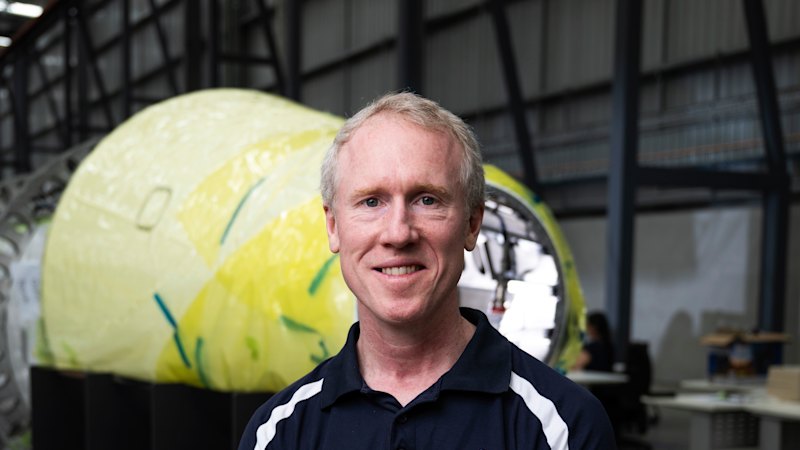
The funding round attracted an unusual coalition of institutional investors including the Future Fund, HESTA, QIC, Funds SA, NGS Super and Brighter Super, along with tech-heavy venture capital funds Blackbird and Main Sequence, a fund founded by CSIRO.
Loading
“I fundamentally believe that superannuation funds should be much more heavily investing in Australian companies,” Gilmour said. “I talked to plenty of them at round tables towards the end of last year. They said they’d like to invest in us but didn’t have a mandate. I think it was pretty weak. If they can get a mandate, that will unlock a ton more capital.”
Gilmour said the company operates on roughly a quarter of the annual budget of its American competitors, giving it a longer runway despite the smaller capital base. The new funding provides what he called “room to grow, room to have a go, room to fail, room to keep going”.
The company already has its sights on public markets, with Gilmour revealing it has held discussions with the ASX, NASDAQ and New York Stock Exchange about a dual listing within two to three years.
“Everyone’s comfortable with that timeline. We want to at least get to orbit, have a decent contract book, get all that technology right,” he said. “We’ve gotten good pitches from the NYSE and also a decent pitch from NASDAQ.”
NRFC chief executive David Gall said Gilmour’s technology has the potential to anchor Australia’s space industry, noting the country’s geographic advantages for orbital launches.
“We don’t have the same back-up of two-plus years just to get in the queue to launch like they would in the US,” Gall said. “Being on different orbits, we can use that freeway with much easier access.”
The investment comes as Gilmour’s financial accounts show mounting losses. The company’s losses rose to $22.4 million in filings with the corporate regulator from November, typical for a pre-revenue rocket company yet to achieve commercial launch.
Gilmour Space, founded in 2013 by brothers Adam and James Gilmour on the Gold Coast, now employs 235 people and plans to add another 50 staff this year. The company operates Australia’s first and only licensed orbital spaceport at Bowen and has demonstrated satellite capability through its ElaraSat platform, which launched on a US rideshare mission in 2024.
Rick Baker, partner at Blackbird Ventures, which led Gilmour’s Series A round, said he gave Adam Gilmour “a few million to get started and build out these hybrid rocket engines” – a modest sum compared to the $217 million now backing the company.
“Blackbird led Gilmour’s Series A when Australia didn’t have a space agency, let alone a pathway to launch,” Baker said.
“That early capital let Adam and the team prove what was possible and created the conditions for today’s institutional investment. This is how deep tech gets built … Venture takes the first risk, founders deliver, and larger pools of capital follow.”
Baker said Gilmour “has this innate ability to get things done – that’s just wonderful to see in an Aussie founder.”
The Business Briefing newsletter delivers major stories, exclusive coverage and expert opinion. Sign up to get it every weekday morning.