
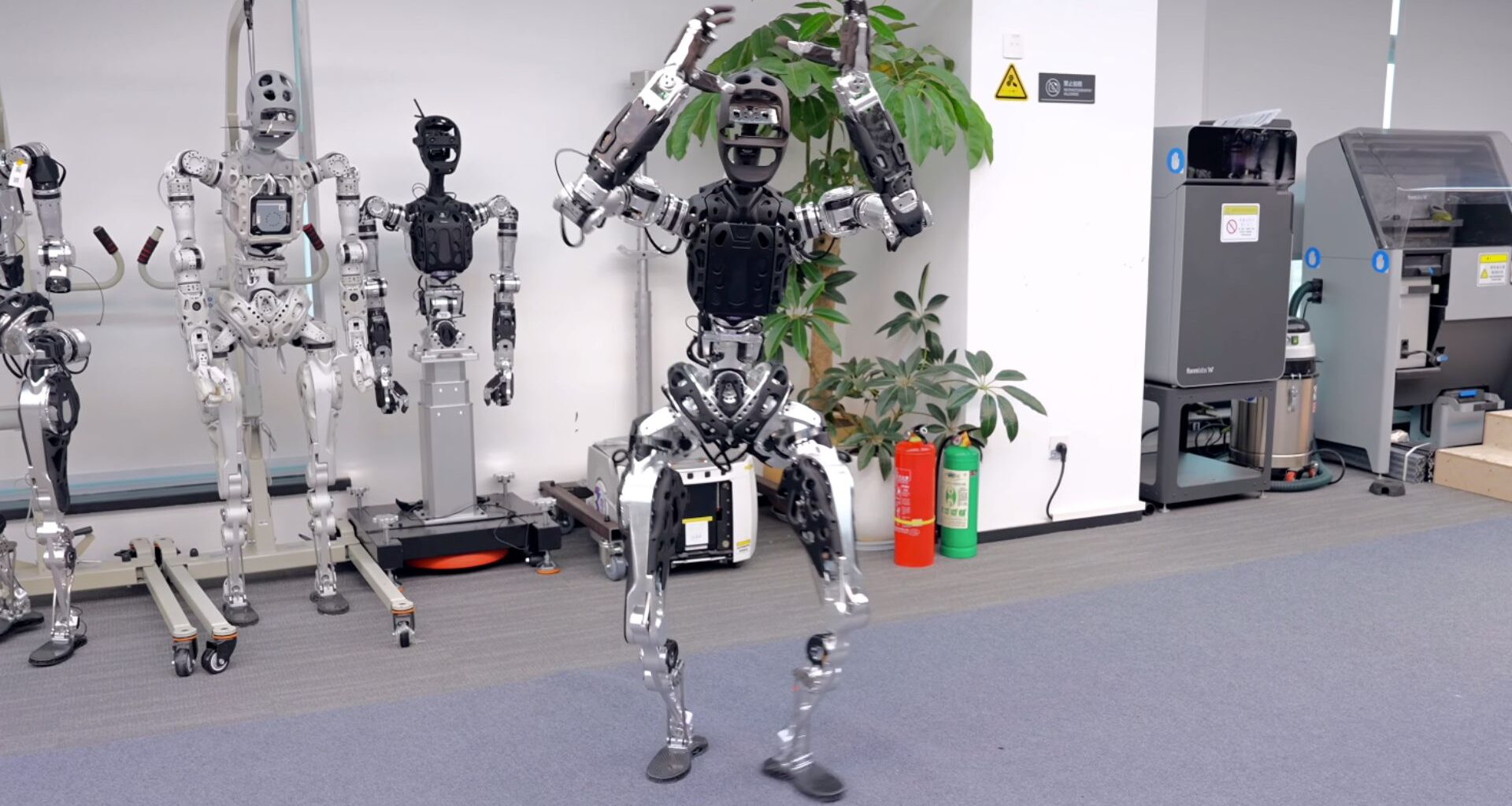
A full-size humanoid robot named Adam is drawing attention by performing the Charleston, a dance known for demanding timing, balance, and coordination.
According to its developers, PNDbotics, the demonstration highlights a shift in humanoid robotics from basic locomotion to expressive, whole-body movement. Adam’s 41 degrees of freedom and high-torque, low-latency control system enable fast, precise, human-like motion.
Engineers frame the dance not as entertainment, but as a rigorous systems-level stress test, signaling progress toward humanoid robots capable of complex real-world tasks alongside humans.
Last week, the Chinese robotics firm introduced Adam-U Ultra, a humanoid robot with a built-in VLA model and 10,000 samples for autonomous manipulation and learning.
Humanoid control leap
In August 2025, the Chinese robotics firm unveiled its full-sized humanoid robot, Adam, alongside its data-collection platform, Adam-U, at the World Artificial Intelligence Conference in Shanghai.
Now, a new YouTube demonstration of its humanoid robot Adam showcases the machine performing the Charleston dance with remarkable speed, balance, and coordination. The high-energy routine highlights advances in full-scale humanoid control, placing Adam among the most dynamically capable robots to date.
Adam is a 1.6-meter-tall, 132-pound (60 kilograms) humanoid robot developed by PNDbotics for high agility and precision. At the core of the performance is Adam’s advanced hardware design.
The robot features 41 degrees of freedom, enabling complex, human-like joint coordination, while custom high-torque actuators deliver hundreds of newton-metres of force for rapid jumps, pivots, and sudden directional changes. These capabilities allow Adam to execute complex movements without sacrificing stability.
According to RoboHub, the fluidity of the routine is driven by optimized trajectory-planning algorithms that smooth transitions between steps, avoiding the rigid motions often seen in humanoid robots.
Additional expressiveness comes from three degrees of freedom in the waist and two in the wrists, adding subtle, human-like flair. A high-speed, low-latency communication network keeps control loops tightly synchronized, ensuring each movement stays precisely on beat.
AI-powered humanoids
Alongside Adam, PNDbotics unveiled Adam-U, a stationary humanoid platform developed in collaboration with Noitom Robotics and Inspire Robots.
Designed for AI research and training, Adam-U integrates Noitom’s motion-capture technology with Inspire’s RH56E2 six-degree-of-freedom dexterous hands. The platform features 31 degrees of freedom, including fully articulated hands, a multi-DOF waist with braking, a movable head, and binocular vision, providing human-like perception and dexterity.
Building on Adam-U, PNDbotics recently introduced the Adam-U Ultra, a humanoid robot designed to advance autonomous manipulation and learning capabilities.
According to PNDbiotics, Adam-U Ultra is a versatile humanoid robot designed for rapid adaptation and real-world deployment. Equipped with precision quasi-direct drive (QDD) joints, it delivers enhanced control, stability, and performance across a wide range of autonomous manipulation tasks.
The system comes preloaded with a vision–language–action (VLA) large model and a comprehensive dataset of over 10,000 real-world samples, enabling the robot to learn and execute new skills within hours, significantly shortening setup and training times. PNDbotics provides these datasets at no additional cost, helping users adapt the robot to new environments and tasks more efficiently.
A company’s YouTube video showcases the full workflow, including data collection, model post-training, and deployment, supported by professional post-training services.
The startup aims to position Adam-U Ultra as a unified, flexible platform suitable for industrial, commercial, and educational applications, bridging research and practical robotics with minimal configuration required.