
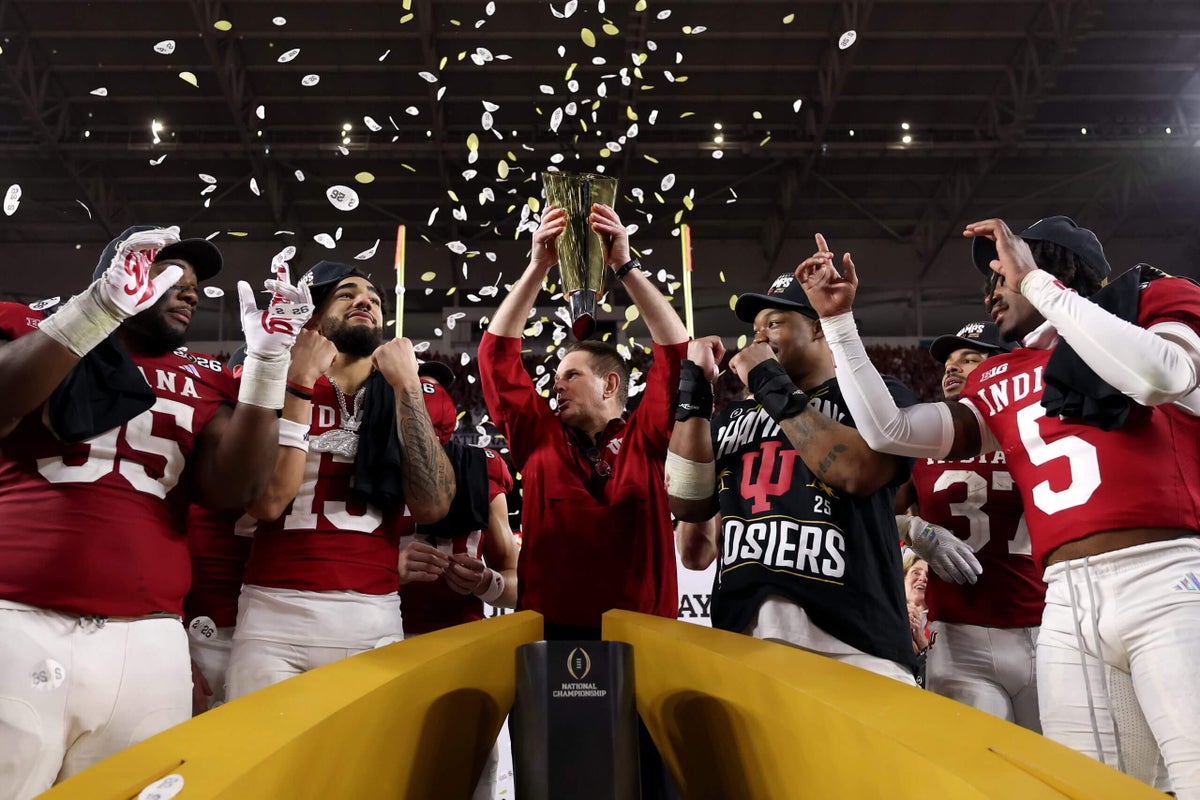
MIAMI GARDENS, Fla. — Red and white confetti fell as Fernando Mendoza tried to comprehend it all. His right arm red and bruised, he squinted to hold back tears of joy, to compose himself for a TV interview. The 1976 Abba hit “Fernando” blared at Hard Rock Stadium as Indiana fans sang along, as astonished about what had just happened as everyone else familiar with the sport.
Indiana’s remarkable run launches college football into a new era, where anything feels possible. Indiana, which had lost the most games in college football history entering this season, is now the champion, after downing Miami 27-21 in a thriller that came down to the final minute.
The Hoosiers, who went 3-9 two years ago, are the first 16-0 team at the highest level of the sport other than Yale in 1894. The Hoosiers are the first, first-time national champ in 30 years. Alabama? Georgia? Ohio State? They didn’t even make the semifinals this year, and Indiana beat two of them along the way.
In this new world, the team with the most elite players won’t necessarily win the championship. Players get paid now and can transfer every year if they want, so talent is more widely spread, and rosters can change quickly. The expanded College Football Playoff also means more chances for upsets, as we saw this year with Miami and Ole Miss making deeper-than-expected runs.
“I think we sent a message to society that if you keep your nose to the grindstone and work hard, you’ve got the right people, anything’s possible,” Indiana head coach Curt Cignetti said. “On our particular situation in the athletic world, college football has changed quite a bit, the balance of power.”
Execution wins championships. Discipline. Coaching. Fundamentals. All the cliches that are thrown out are true, making college football much more like the NFL. A sport that historically has had little parity now has an unprecedented amount. Indiana had zero former five-star recruits on its roster. Alabama had 14, Oregon had six, Miami had five. All fell to the Hoosiers on their Playoff run.
It was Mendoza, the Miami native, once the 182nd-ranked quarterback in his recruiting class, bouncing off Hurricane bodies into the end zone on what would end up as the game-winning touchdown on a fourth-down play that will live forever in Indiana lore. Twice in the final quarter, the Heisman Trophy winner found receiver Charlie Becker, a former three-star recruit who had six career catches entering the month of November, for two monumental grabs.
“I was a two-star recruit coming out of high school, I got declined a walk-on offer to Miami,” Mendoza said. “A full circle moment here.”
This Indiana team simply never made mistakes. The cleanest team in the country in so many statistics was once again on display Monday, and it proved to be the difference. It was Miami that committed an offside penalty leading to an Indiana touchdown. It was Miami that had a punt blocked, resulting in another Indiana touchdown. It was Miami that threw an interception in the final minute, sealing the Hoosiers’ victory.
Execution. Discipline.
“Are there eight first-round draft choices on this team? No, there aren’t,” Cignetti said. “But this team, the whole was greater than the sum of its parts.”
As college football has undergone massive transition over the past five years, both planned and forced upon it, the confluence of three major factors brought both Indiana and Miami to this moment Monday night.
The first was name, image and likeness rules in 2021, allowing college athletes to earn money for the first time. The Hurricanes were among the first teams to embrace NIL, with boosters setting up millions in deals for their players and improving their talent level. Indiana was slower to adopt, but the Hoosiers now have a roster payroll that many believe exceeds $20 million, competing with the big boys, though Cignetti said after the game it’s not as high as people think.
The second change was the transfer portal and court rulings in 2024 that allow unlimited player transfers. Without that, Cignetti wouldn’t have been able to bring star players like cornerback D’Angelo Ponds, receiver Elijah Sarratt and defensive lineman Mikail Kamara with him from James Madison and have them play right away.
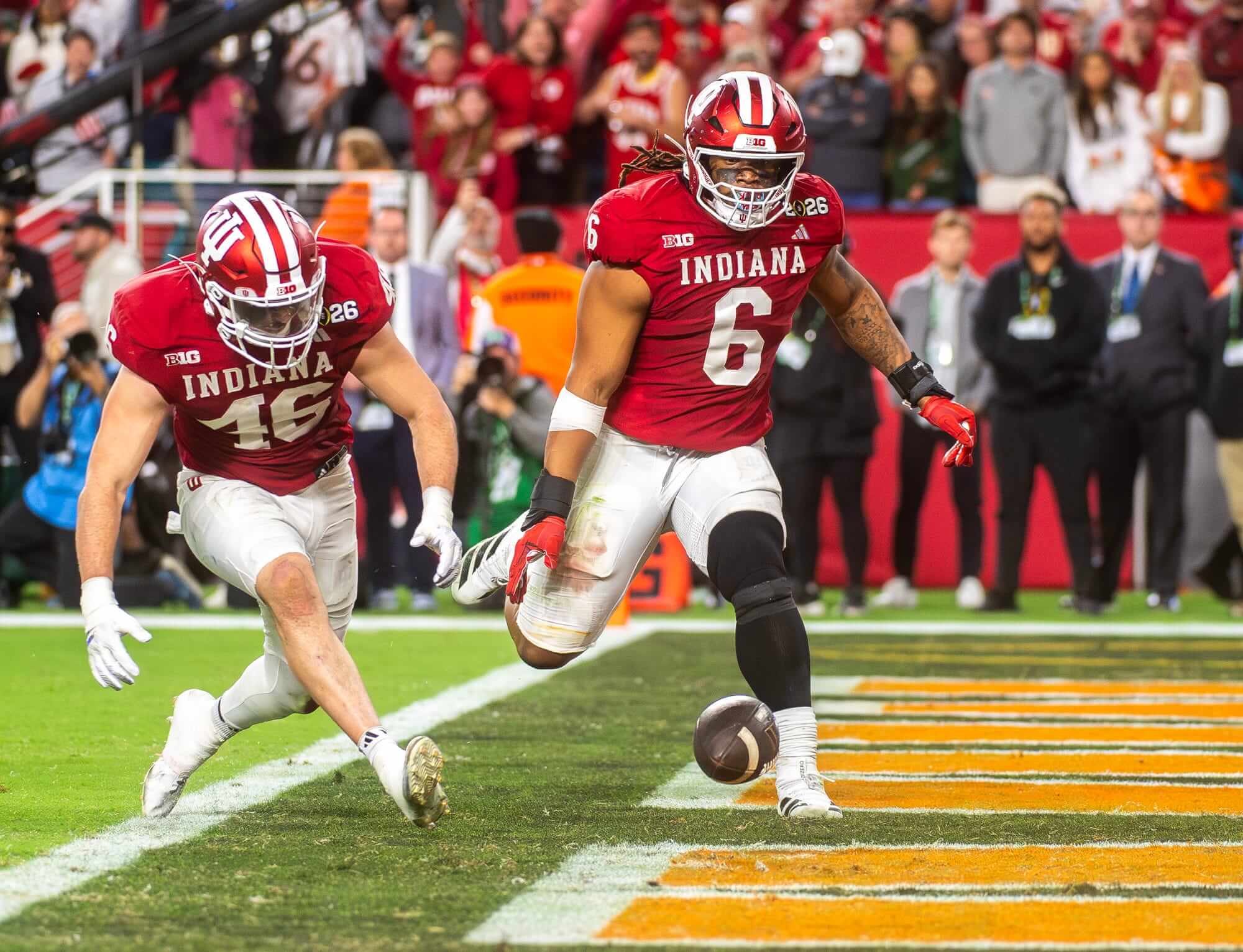
Mikail Kamara’s pivotal blocked punt that turned into a touchdown helped lift the Hoosiers to a win. (Rich Janzaruk / USA Today Network via Imagn Images)
And the last was the expanded College Football Playoff, which moved from four teams to 12 last season. Without that, Miami would’ve been nowhere near this field, let alone the national title game. A team ranked No. 2 at one point this season dropped out of the top 10 after two losses. Only the last-minute decision by the selection committee to flip Miami and Notre Dame put the Canes in the field, thanks to their September win over the Irish. Then Miami got hot and nearly won it all — the kind of thing that happens in pro sports when talent is spread around.
The old rules of building teams no longer apply. Nick Saban, the greatest coach in the history of the sport, had rosters full of five-star recruits who waited their turn on the bench, creating unprecedented depth. That no longer happens, as players can go elsewhere to get more playing time and, often, more money. Saban saw his built-up advantage slipping and moved into retirement. Georgia, which won back-to-back national championships in 2021 and 2022, still wins a lot of games, but the Dawgs have missed the semifinals for three consecutive years.
Ohio State beat Notre Dame in last year’s national championship matchup between two of the most traditional programs in the sport. But even that Buckeyes team, which had 14 players drafted the following spring, lost two games. Ohio State appeared to be college football’s last “superteam” in terms of gathering talent as changes trickled down.
“This idea of somebody is going to go 16-0 in college football, man, put a statue up somewhere of that team,” Texas coach Steve Sarkisian said in the spring. “Because I just don’t know if that’s going to happen again.”
Whoops. Not only did it happen, but it came in the most unlikely of places, which probably means there will, in fact, be statues of Cignetti and Mendoza someday.
This Indiana run wasn’t fluky or an accident — it committed to competing at the sport’s highest level. Over the past four years, Indiana’s football budget more than doubled, from under $24 million in 2021 to over $61 million last year. It went from below the Big Ten median to well above it in 2025.
“I know Indiana’s football history has been pretty poor with some good years sprinkled in there. It was because it wasn’t an emphasis on football, plain and simple,” Cignetti said. “Basketball school. Coach (Bobby) Knight had great teams. The emphasis is on football. It’s on basketball, too. But you’ve got to be good in football nowadays. We’ve got a president that comes from the South that loves football. We’ve got an AD that is a tremendous fundraiser. We’ve got a fan base, the largest alumni base in the country, Indiana University. They’re all in. We’ve got a lot of momentum.”
Indiana’s turnaround is one of the most unlikely stories in American sports history, transforming from a century-long doormat to its first championship. This new world will take getting used to. Traditional powerhouses will need to recalibrate expectations. Coaches will face even more pressure as donors and fans question why a place like Indiana has surpassed them. But new faces will also spring to the top. The sport has always offered renewed hope every autumn, and now there’s never been more to spread around.
“We represent that it’s a new day,” Indiana president Pamela Whitten said. “If you come at it with a new attitude and you’re innovative and ambitious, you can reach the greatest heights. And we plan to stay here.”