
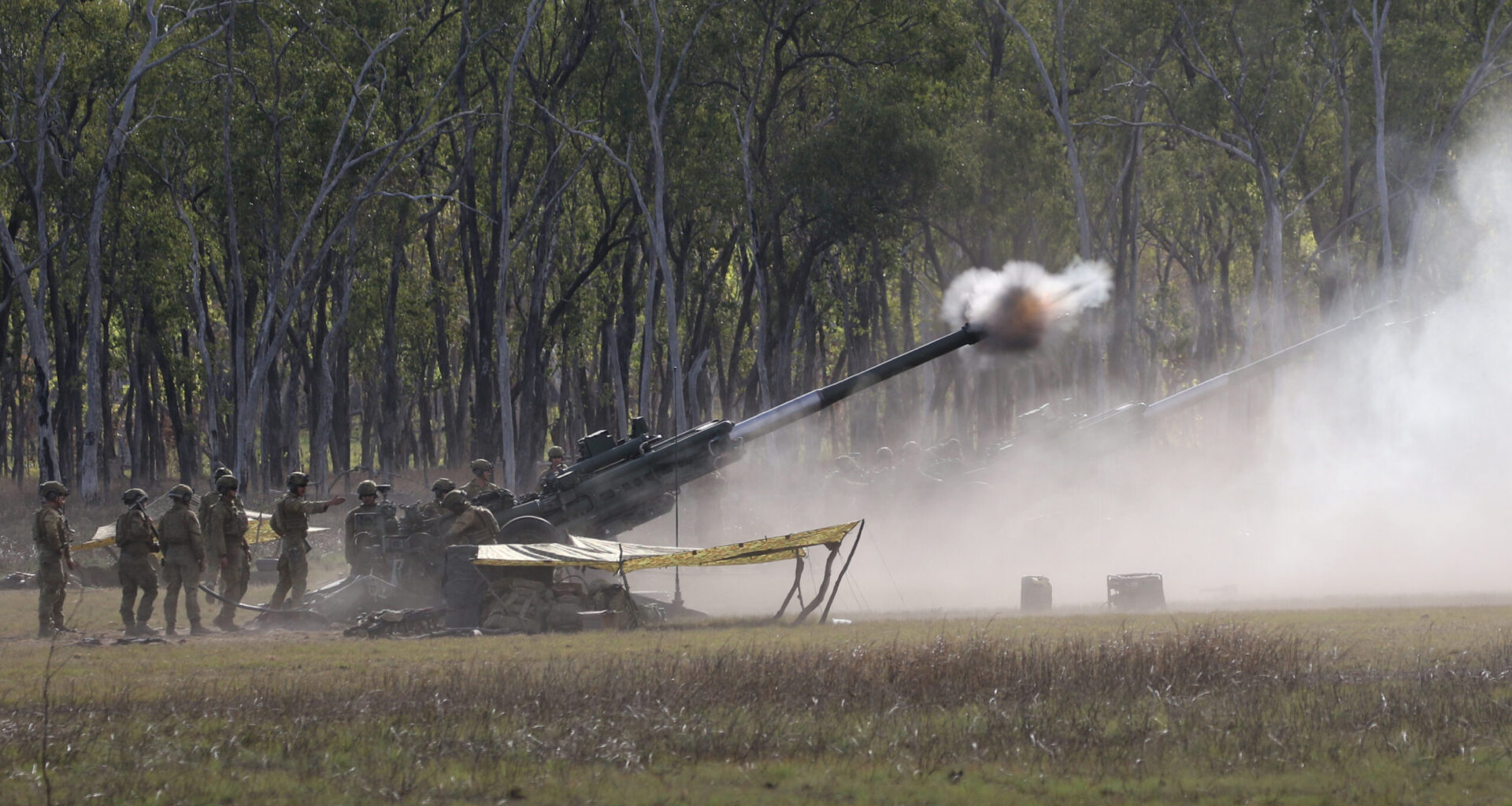
 The Australian Army’s indirect fires rely on M777, AS9 and HIMARS artillery systems, but it is seeking alternative low-cost massed fires. (Gordon Arthur)
The Australian Army is exploring how to provide indirect fire support for amphibious-capable combined arms forces. It wants ground-launched and low-cost systems, according to a request for proposals (RfP) issued on 5 November 2025.
This effort is called Low-Cost Mass Fires (LCMF), and it is designed to supplement M777 lightweight howitzers with a 30km range, and incoming AS9 self-propelled howitzers that possess a 40km range.
The Australian Army has also started inducting HIMARS rocket launchers, whose GMLRS munitions offer an 80km range. The RfP noted, “However, this would require the use of a very limited stock of expensive GMLRS munitions. Therefore, the LCMF solution being sought must be capable of achieving a range of operational effects, at mass, by day or night, and in all weather conditions, out to 80km+.”
The RfP added that LCMF solutions need to “achieve suppression, neutralisation and destruction against unobstructed troops, thin-skin vehicles, lightly armoured vehicles and non-permanent light structures”.
Solutions may be munitions fired from 155mm tube artillery, HIMARS-like rocket pod containers, or potentially one-way effectors, precision loitering munitions or some other contemporary solution that can be deployed from a military vehicle. At this point, the army is not seeking weapons launched from missile pods or air-deployed systems.
The army wants its solution to produce the same explosive effect as a 155mm battery fire mission suppressing an area measuring 200m x 200m. Importantly, the weapons must conform to international agreements and to Australian policies on insensitive munitions.
This Army Minors Capability Acquisition Program initiative is hoping to identify established or innovative technology for development and integration via a future project. Solutions must also be interoperable with current army command-and-control systems, and be able to operate in denied, degraded, intermittent or limited environments.
Live-fire product concept demonstrations are slated for the middle of Q2 this year, and vendors must achieve technology readiness level 9 by Q2 of 2027.
The results of the demonstration and paperwork will be analysed, leading to a down-select for government consideration in FY2026/27.
It is unknown which companies responded to the RfP, but tender responses were due on 12 December. An evaluation process started almost immediately on 15 December, and is due to end on 23 January 2026.
by Gordon Arthur