

It came as a big surprise when Mattia Binotto took over as Audi Formula 1 team boss. The Italian replaced Andreas Seidl, who had headed up the setup of the project at Sauber headquarters in Hinwill, Switzerland.Binotto thus took over the last year of the Sauber team’s existence as an independent constructor, the last of the garagistes as we reported. And now, the man dismissed by Ferrari at the end of 2022, has a second chance to lead a Formula 1 team to glory again.
At the Berlin launch of the new team’s livery, Binotto underlined that Audi’s Formula 1 project is built around a long-term plan, with the manufacturer targeting a championship fight by 2030 rather than expecting immediate success when it enters the grid in 2026.
At Audi’s team presentation in Berlin, the launch marked the point at which the project moved from concept to reality, with the scale of the event itself reflecting the seriousness of Audi’s intent. Binotto said: “Finally, I would say, we turn this into reality. I am fascinated by the venue and by what the team is doing so far. Even being here is a clear statement. Audi is taking this seriously. We are here to compete and we are here to win one day,” with the commitment reinforced by the fact that such an event would not take place without full belief in the Formula 1 programme and its future.For Binotto, the presentation was less about short-term performance targets and more about formally beginning Audi’s journey in the sport: “Today is about turning Audi into an Audi Formula 1 team, the Audi Revolution team. But more than that, for me it is really the start of our journey. Finally, it is the start of our journey towards our objective, which is to become successful one day,” framing the Berlin event as a statement of intent rather than a promise of immediate competitiveness.Progress measured against reality
Building a works team capable of challenging Formula 1’s established front runners remains a significant task, and Binotto acknowledged that comparisons at this stage are premature: “I am happy with the progress. I am happy with the way the team is developing. I know it is still a very long way. We cannot compare ourselves today to the top teams. They are strong organisations with the proper tools and proper infrastructure.”
Confidence comes instead from the culture forming inside the organisation, with the internal mindset described as a critical foundation: “The energy in the team is very strong. The team is really willing to become successful and that is what counts the most, while still staying humble,” alongside a clear acceptance that the first season under the new regulations will present challenges: “We know how bumpy the 2026 season can be. We know that we may fail and we may have problems,” with learning from setbacks and maintaining steady progress seen as central to the early phase of the project.
External perception and internal backing also form part of that foundation: “The perception of people around us that we are here to take this seriously is important,” supported by full commitment from within Audi itself, viewed as essential to sustaining long term momentum.
Early power unit running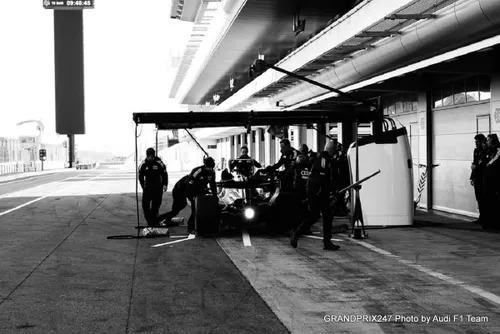
Audi’s power unit programme has already taken its first steps on track, with early running used to validate systems and expose weaknesses: “We have already run on track on the ninth of January with a filming day. It was very important to be on track so early. We were the last to join Formula 1, but the first on track, which is an important sign of how serious this project is for us.”
The current state of the power unit was described candidly, with no attempt to downplay the work still required: “We are not ready. We are still facing problems. We are still not at the level of performance we want. Our powertrain and power unit are not yet as driveable as they should be, but that is normal and not unexpected,” setting realistic expectations for the development phase.
Rather than viewing the early running as a setback, the experience was framed as a necessary learning exercise: “Even if the filming day was not a successful day, it was a positive one. We faced problems, but those problems were useful to help us learn and to prepare ourselves better for the start of the season and for the next test later this month in Barcelona.”
Why 2030 is the benchmark
The decision to publicly target 2030 as the point at which Audi aims to fight for championships was positioned as a tool for managing expectations both inside and outside the organisation: “Setting a target of 2030 was very important for us, to manage external expectations and internal expectations,” particularly given Audi’s history and reputation in other motorsport categories.
Any suggestion of an immediate title challenge was firmly dismissed: “We know that is impossible. We do not yet have the infrastructure, the team, the tools or the organisation ready for that,” reinforcing the need for a measured and structured build up.
With a clear objective defined, the focus shifts to execution and gap analysis: “Once you have a clear objective, you can start measuring the gaps. You can start measuring what is required to get there and then start developing a proper plan to build the team so that one day you can achieve that goal.”
The message from Berlin was consistent and deliberate. Audi’s Formula 1 entry is being shaped by realism and structure, with ambition clearly stated and patience embedded into the timeline.