
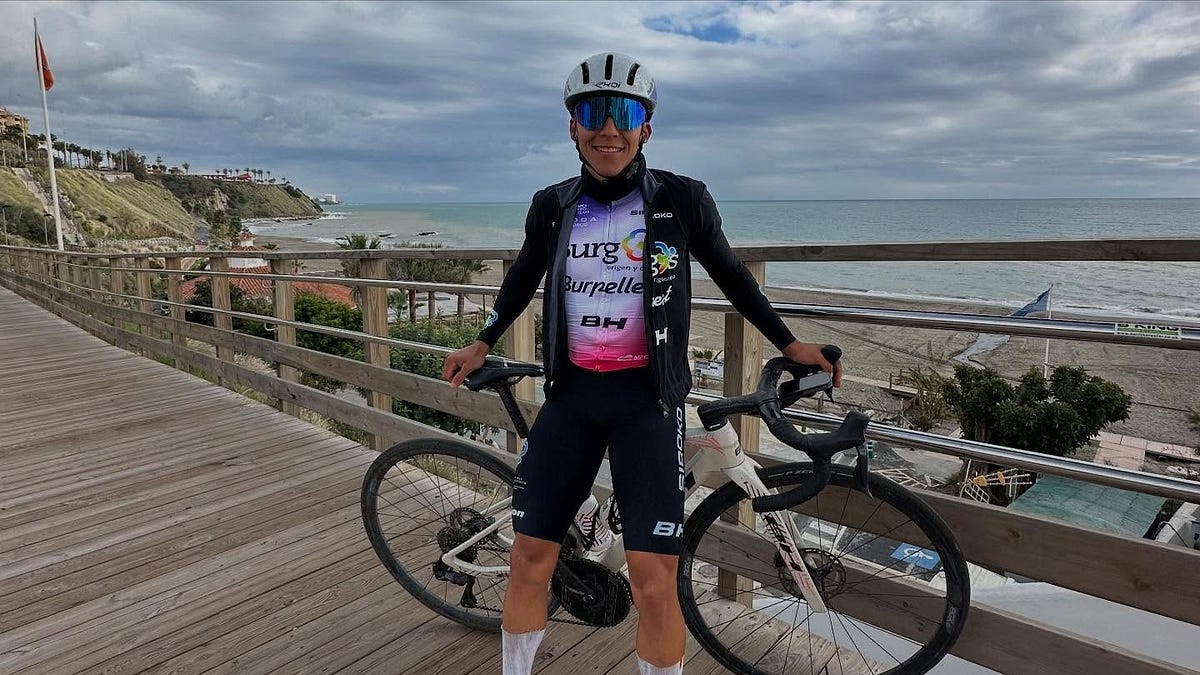
22-year-old César Macias is one of a crop of young Mexican talents on the way up. This season, Macias becomes the country’s second professional rider in the men’s peloton, alongside Isaac del Toro, signing a two-year contract with Spanish ProTeam Burgos-Burpellet-BH.
The team has become well known for its international roster in recent years, and is also the home of African champion Merhawi Kudus, Mongolian puncheur Jambaljamts Sainbayar and Mauritius’ Alexandre Mayer.
Macias is already an accomplished sprinter, taking good placings last year at top level races including the Tour de l’Avenir, Trofeo Palma and O Gran Camiño. Now with a bigger team, and slotting in as one of its fastest riders, Macias will have further opportunities to develop in 2026. His signing was included as one of Global Peloton’s top-10 global cycling transfers for 2026.
Born in Guadalajara on the 17th of September 2003, Macias has been nicknamed ‘L’Expreso de Guadalajara’ (The Guadalajara Express), and he’s well placed to show that characterising speed in some of the world’s biggest races this season.
Global Peloton spoke to Macias during Burgos-Burpellet-BH’s recent training camp in Benalmádena, Málaga, ahead of his season debut at the Clàssica Comunitat Valenciana 1969 this week. After that, Macias heads to Mallorca before returning to the mainland for the Volta Comunitat Valenciana.
Read on to find out how he got into the sport, the development of cycling in Mexico and his hopes for the season ahead.
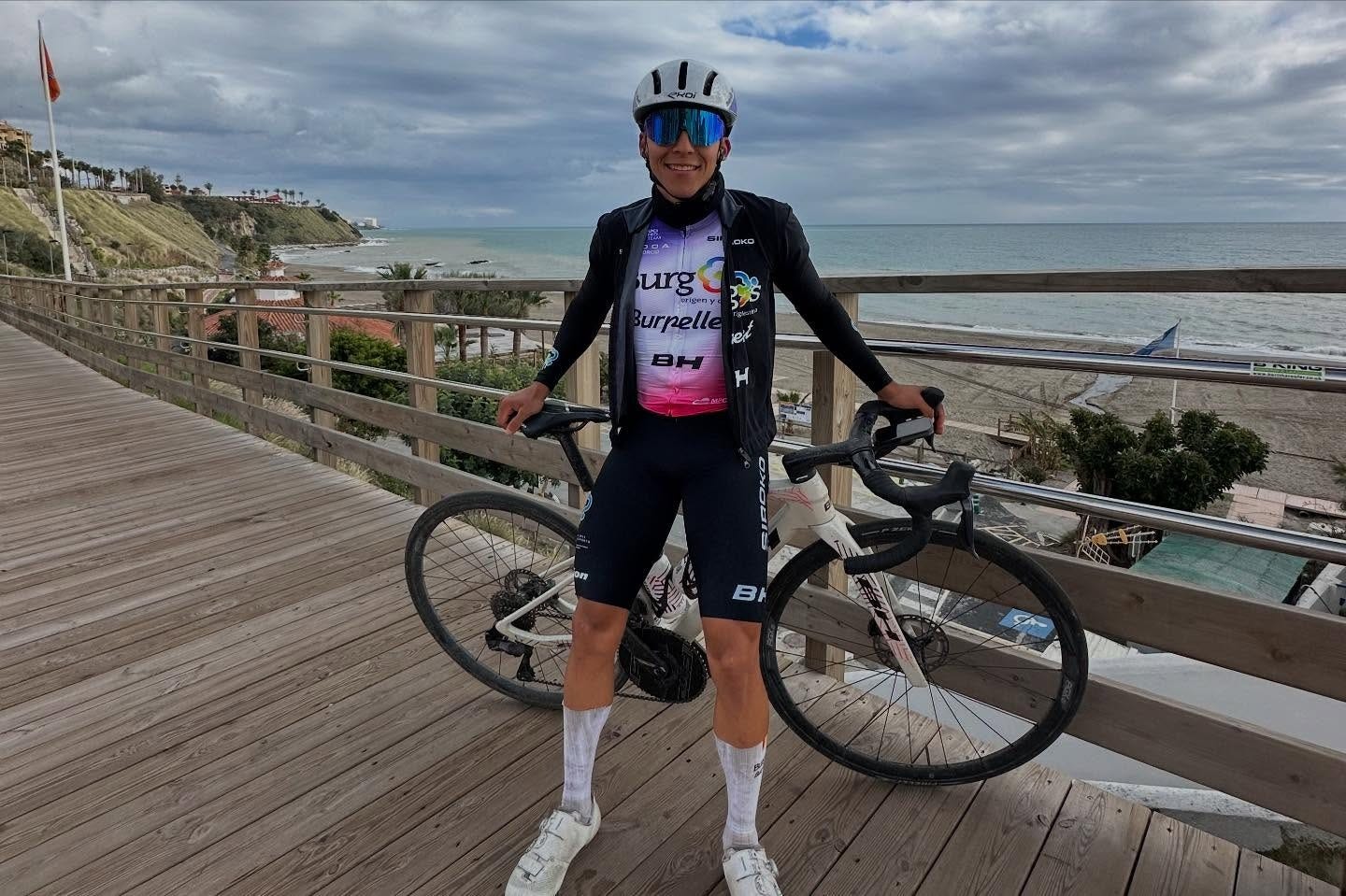 Macias on training camp with Burgos-Burpellet-BH. Image: @cesarmaciase on Instagram
Cesar Macias: In my family, there are no cyclists. I’m the first one. I started at six years old. When I was a child, in the afternoon, after my homework, I was riding my bike all the time.
My parents asked why I don’t do it for sport. We have a forest really close to my home, so my parents took me to the forest with the bikes. I started with a coach, and the coach had a group of ten children, all six, seven or eight years old, and I started there.
And then I was just growing up throughout the years. At the beginning, it was just for fun and then I became more serious after four or five years. So yeah, my start in cycling was from my parents, but there wasn’t another cyclist in my family.
CM: I started mountain bike, then I continued in the track. I grew up really fast in the track, because normally, when I was maybe six, seven years old, my muscles were really big for my age. I remember that all the people say, ‘oh, you have big legs’.
When I started on the track, I was really fast. So I talked with the speed coach, and he told me that maybe I could do speed on the track. I started with team sprint, and then 250 metres, then 500 metres, and then the kilometre. So I was growing up really fast.
In Mexico, there is a competition for all the states in Mexico, a big competition with all the sports. They asked me if I wanted to go on the road and also in track. And I said, yeah, why not? So I started training on the road, and I saw that I was going good. I tried to do both things. After two years, I say, why not do both? I liked the road and I liked the sprint. So I said maybe it would be possible. Then my coach from the track told me I have to choose one of them, because it will be impossible. I
f you are a sprinter on the track, it will be impossible that you can go on the road and finish at the top of the summit, the top of the mountain. So you have to choose one. And I choose the road, because I liked both things, the speed and also the road.
CM: Yeah. If I’m honest, I don’t know why I’m a cyclist, because when I was a child also I liked the motorcycles, the cars, everything with speed. But I choose cycling maybe because it was fun. You were going really fast in the bends. And yeah, it was my kind of sport.
CM: Yeah, that’s a good thing. I think I was lucky because I got a coach with a group of children, because if I’m honest now, there is not many groups of children in Mexico. Maybe there are two groups or three groups in my city, Guadalajara, and there is not more. I think maybe the young people prefer to study or play soccer, but no cycling. I don’t know why. I think it’s not really coming like in Europe.
But now with Del Toro, with me, with other professional cyclists, and maybe PetroliKe, are buidling up the cycling in Mexico. I think it’s really interesting how the people are putting attention on this sport and they are trying to develop more cyclists.
I think cycling in Mexico is growing up really fast.
CM: I think now it’s better because we had a lot of problems the last years without afederation. The last four years, it was a big problem to go to the world championship, to the Pan American championships. There was not a national championship.
And we were riding with other riders with UCI points [Mexican riders were unable to score many UCI points without going to major or national championships – ed] so it was impossible to go for a better team or bigger team because they were looking for UCI points.
And the problem was also for registration to the UCI because there was not federation. So you need to talk with a lot of people to ask how can I get [registered with] the UCI this year? And how are we going to the worlds? And, you know, everything is a process and the process was more difficult because there was not a federation.
So now I think everything got better with the new federation. They are trying to do the things better and we will see how it’s going. But now they are working on the nationals and also now for the Pan American championships in March, I think it will be in Colombia. So I’m looking forward to that and then we will see for the worlds. But now I think everything is going really well.
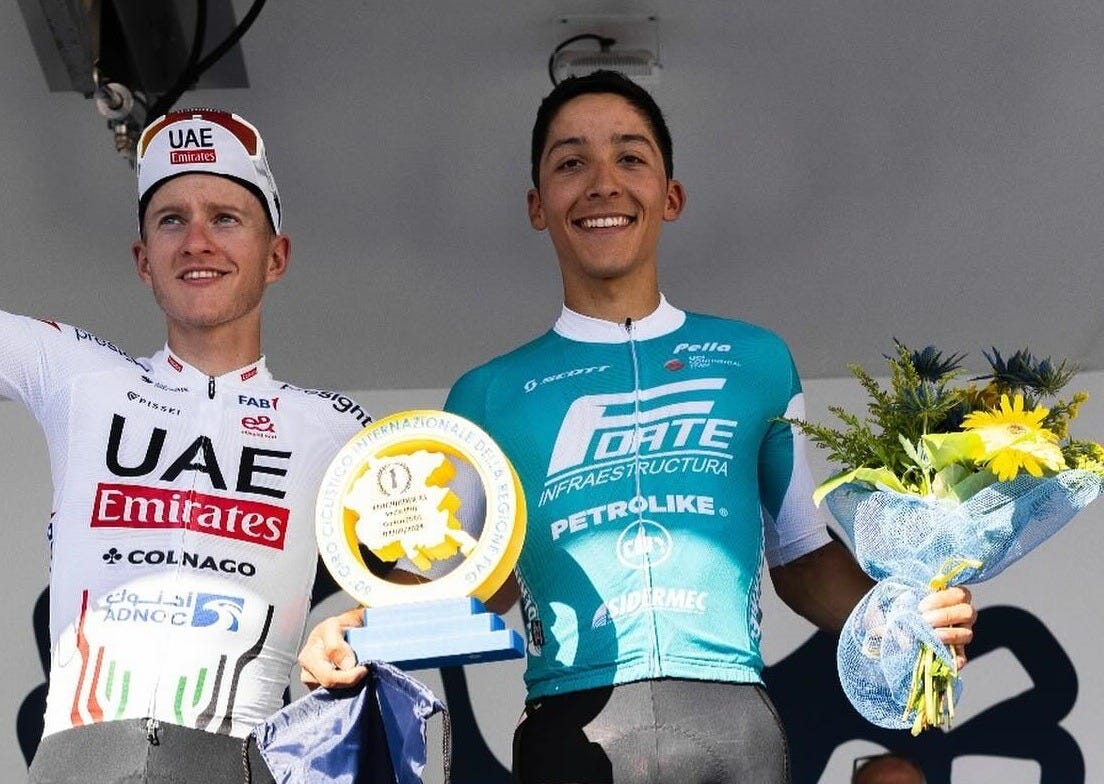 Macias won his first European UCI race in 2024 at the Giro della Regione Friuli. Image: Federación Mexicana de Ciclismo
CM: I think it was one of my best experiences because I came the first time to Europe when I was 17. Obviously I was a little bit nervous because I didn’t know how was the level here in cycling because I was riding all the races in Mexico, but it’s really, really different how they are riding in the races here in Europe.
In Mexico, you attack, you attack, you attack, and then they stop because they are looking for you. If you are behind them they don’t want to go full gas because they are nervous because maybe you can beat them. So here in Europe, I saw another kind of mentality, that if they push, they push full gas. It doesn’t matter if they think they will get dropped or not, they are riding full gas and that’s all.
I went to a team [Start Junior Team] where the manager and the director and all the staff was from Latin America, so they knew about the mentality from Latin America to Europe and they had more years of experience before that I was there. I think it was a big step for me, but I did it really well, if I’m honest, for my first year.
I started finishing all the races and then I was getting better places every race. I think I did my first top 10 UCI race and tried to go better every race. I raced in Belgium, I raced in Netherlands and France, but all the races there are really hard. It’s really hard for the wind, for the rain and obviously the level of the cyclists. I really liked it. Maybe this year I will be back in Belgium or Netherlands – I really want to go.
CM: I really like those kind of races where you start with rain, with cobbles, maybe there are five or six roads with cobblestones and you need to be strong, you need to be at the front, you need to fight. I really like those kind of races.
CM: I think I was nervous, but I wasn’t really, really nervous. I mean, the normal nervous that you feel when you are going to a different place where you want to stay.
Also I got the help to go to Europe from my team before the start, which was Pato Bike-BMC. Now they have a professional women’s team, but in that moment, I was one of three riders that were there in that team. When he was asking me if I want to go to Europe, because he had the contact with Start Cycling, I said, yes, why not? And he told me, ‘okay, you can go. I will support you to go to Europe, but you have to train a lot’. And yeah, I did everything that I could do in that moment.
When I arrived in Belgium, obviously it was hard because I never tried to go for my training in minus-two degrees, with rain or with headwind all day. And obviously I was thinking why I’m here, if I can stay there, but I really wanted to be a cyclist. I just tried to keep going and I stayed for the first time eight months. So it was a long way and maybe in the last two months I was trying to go home, but you have to stay there and it will finish in some moment.
CM: I think last year was the best for me because I saw that I got a big step in my professional career. Three years ago, I said that I was getting better, but not enough. But the last year I saw some things that I can change. For example, the fuel, the weight, the bike, the aerodynamics – everything I was trying to get better.
And yeah, obviously, when you did two or three years in Europe, trying to see all the things that you can change, you get better, if you change everything, you get better. But last year, when I was looking at my first results in Trofeo Palma, Valencia and Andalucia, I saw that I was going really well. My level was higher than last year. So I was really motivated to go professional, to get a bigger team and just to get better. I was just thinking of that. The result doesn’t matter. I just want to go and we will see what happens. If I got first place or second place, but I don’t know, I want to try. And I did well.
Maybe I was a little bit sad at the end of the season because I didn’t get a victory. I was really close and I didn’t get it, but this year, I’m really looking for that.
I think Wout van Aert for me is one of my favourite riders. When he is winning, I’m really happy because he’s not the kind of rider that wins everything, but when he wins, I’m really proud of him because you saw all the sacrifice that he did. And that’s my kind of mentality. I prefer to win five races a year, but with a lot of effort. That’s my kind of mentality that I really like.
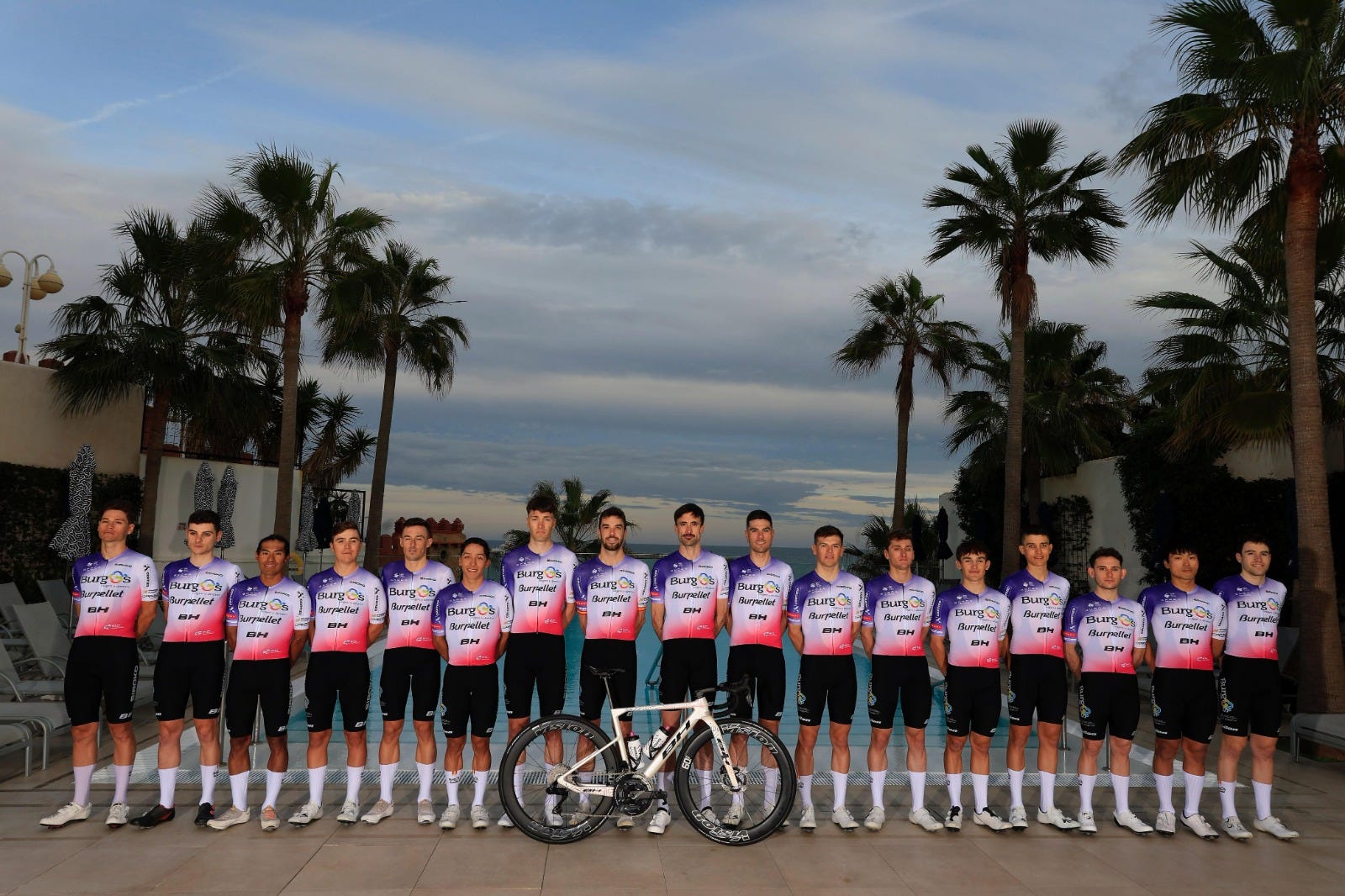 Macias on training camp with Burgos-Burpellet-BH, sixth from the left. Image: Burgos-Burpellet-BH
CM: It’s curious because my coach is a Spanish man and he was a professional. Some years ago and he told me to contact different teams to see if they are interested in you. After Volta Portugal in 2024, I got fourth place in a stage when I was 20 years old. So I talked with one of the directors from Burgos and he told me ‘I was looking at what you did in Volta Portugal before and you are really interesting for us because you are really young and you are doing things really well’.
After that, we didn’t talk anymore, I think. But in September [2024], he told me, ‘we are really interested in you, but now we are full. But in 2025, if you are going well, maybe we can sign a contract’.
In 2025, after my results, I was talking with another team also, but one of the directors from Burgos told me I can come here if I want. ‘If you are interested, tell us and we can sign’. And I think we signed after Tour de l’Avenir.
That was a really big step for me. I’m really happy for that because I really I was really looking for it. And like I told you last year, I was just looking for a big step in my career. And I think this is what I was looking for.
CM: I think maybe one of my goals for this year will be to win two races. Two races and a lot of top-tens and top-fives. But with two big races, I will be happy. I don’t know where, but I will be looking for it. And I’m sure that I need to get that goal.
CM: Yeah, if they tell me that I can go for sure, I will go. I think the Vuelta is one of the best races in the world. If they are asking me if I want to go for sure, I will go.
CM: In the last part of the year in 2025, I tried to talk with my ex-coach from the track because he is one of the best coaches in the world. He studied a lot for the sprint and he is also a really good coach for the gym. So I talked with him and I talked with my actual coach and we are trying to do a different kind of training to get a better sprint by doing less on the road.
For example, one year before, I was riding six hours. Maybe now I can ride five hours, but the next day I will be in the gym with a session where it’s not really hard, but it’s a gym session. So you are getting the resistance and you are getting the power in the gym.
So now I’m doing that and I got really better in my sprint by 150 watts. So I’m really proud of that and now I’m keeping working on that. The coaches are also really interested in my progress this year because it was really fast.
CM: It was a difficult thing because obviously you can see a sprinter with really, really big legs, but it doesn’t matter if they can’t arrive to the finish, to the sprint. So we were talking about, okay, we need to get better in sprint, but we need to get better also in the resistance to get a better ten minutes or five minutes than in the past. So now we are trying to do a little bit less long distances, more gym, maybe different efforts, a little bit shorter, but harder.
Also the gym, we are looking at the speed of each repetition. So it’s really important for the power and you will not get really tired for the next day to ride a long distance. So in that moment, you can see if you are getting better with your power, but you are not getting really tired to do another long distance.
So it’s a really interesting balance between resistance and power. I think the coaches are trying to get better in both things.
If you enjoyed this post, please consider sharing.
You could also…
And if you’re feeling super generous, you can Buy Me a Coffee