
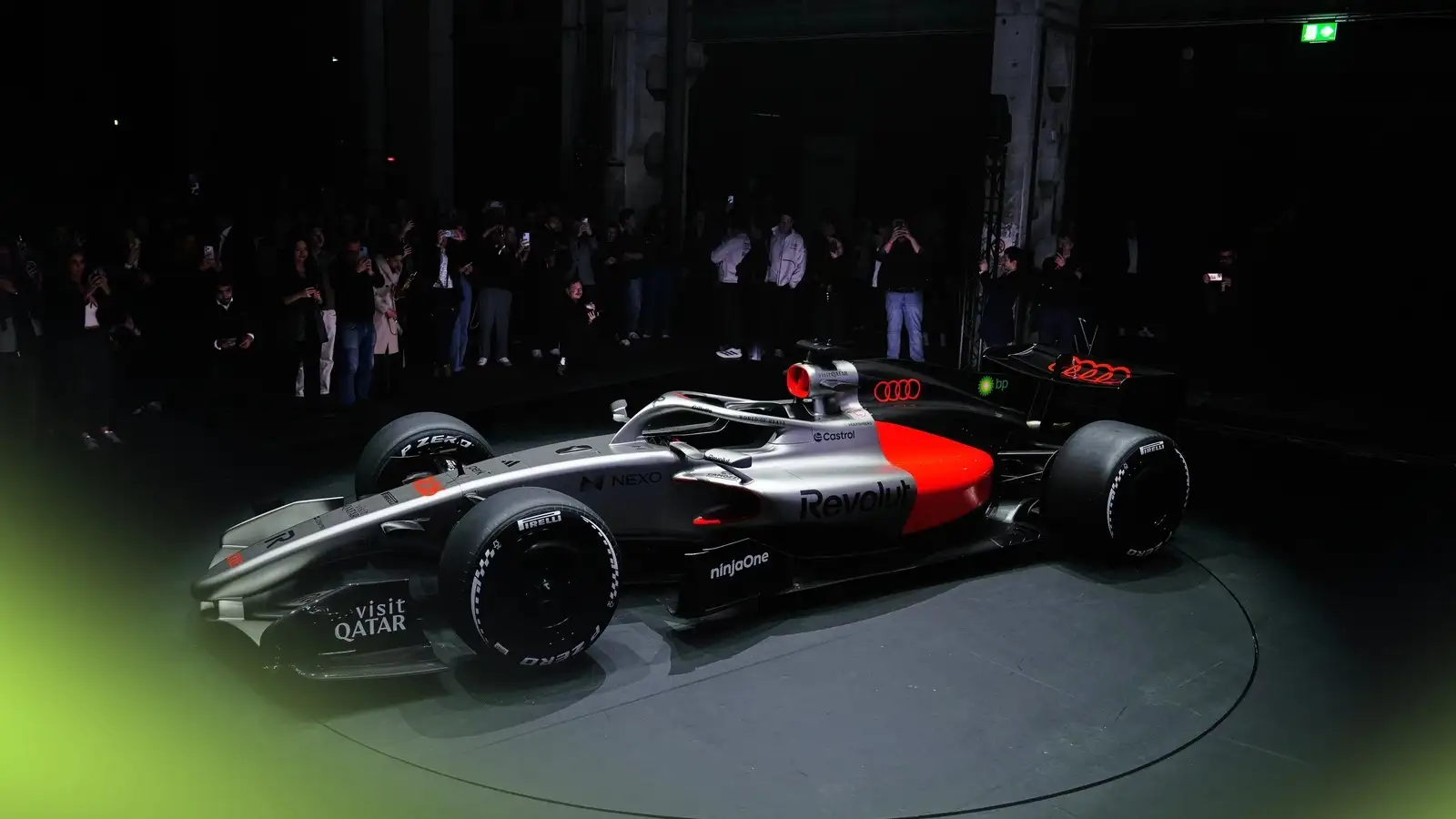
Audi boss Mattia Binotto has voiced concern over a potential loophole in F1 2026 power unit rules that could shape the championship.
Grey areas in the engine regulations-particularly around compression ratios have sparked concerns that F1 risks a repeat of previous rule changes when clever rule interpretations created runaway leaders.
F1 risks repeating past mistakes as 2026 engine rules raise early balance fears
Want more PlanetF1.com coverage? Add us as a preferred source on Google to your favourites list for news you can trust.
Binotto, who has worked in Formula 1 since the mid-1990s and witnessed both Brawn GP’s 2009 double-diffuser surprise and Mercedes’ hybrid-era dominance, said early technical advantages could define the season and make close racing much harder to achieve.
The Italian is concerned that F1 finds itself in a similar scenario ahead of the coming campaign as technical debate surrounding, specifically, engine compression continues behind the scenes.
Technical regulations mandate a compression ratio of 16:1, a measurement taken at ambient temperatures.
It has been alleged that two manufacturers, namely Mercedes and Red Bull-Ford, have designed their engines such that, when at normal operating temperature, that ratio increases.
The compression ratio is not measured during competition, meaning any change to that figure would not be detected and therefore would be considered legal.
A higher compression leads to both more power and improved fuel efficiency, both of which could offer a sizeable advantage – reports suggesting as much as 15bhp, which equates to around four tenths per lap.
“Compression ratio is clearly a key thermal efficiency enabling aspect of an internal combustion engine, so you always push it to the limit,” explained Andy Cowell, Aston Martin’s chief strategy engineer, who was with Mercedes during its era of domination.
“I’m sure every single power unit manufacturer is doing that.
“The FIA have the job to make sure that everybody interprets the regulations in a fair and equal way, which is what’s ongoing at the moment.”
The concern for Audi is that not everyone is pushing the performance envelope in the same manner and any performance advantage from manipulating the compression ratio will remain baked in for the coming year.
That’s despite regulations being in place to afford power unit manufacturers the chance to catch up, should their designs be found wanting.
There is a meeting between ‘technical experts’ and the FIA to discuss elements of the technical regulations on Thursday (January 22), though Binotto is not pessimistic about its ability to influence change.
“I don’t think there will be clarity or compromise,” he reasoned.
“The meeting, which has been set for January 22, is more to continue to discuss how can we improve or develop a methodology for the future to measure the compression ratios in operating conditions.
“Today we are doing it [measuring] in cool conditions with the engine disassembled – so you may wait until the end of the season to know if you are compliant.
“It’s simply we are trying, all together, to really develop a methodology where we can measure it in real time while the car is running.
“My hope in that meeting is not clarity on the regulation itself, but more to define a methodology for the future.”
The F1 2026 power unit rules, from an internal combustion perspective, are much the same as they were previously, a 1.6-litre six-cylinder turbocharged design – it is the hybrid element that has received much of the attention.
Under the regulations, manufacturers must submit their homologation dossiers to the FIA on March 1 with that serving as the official reference document from a regulatory perspective for the year ahead.
By locking down the engine design, the homologation process effectively crystallises any disparity between designs.
It should be noted that engine development is permitted, but improvements are subject to a detailed assessment and approval process.
Such upgrades are also only permitted to be introduced for the first grand prix of the season.
A break-glass style opportunity does exist. Termed Additional Development and Upgrade Opportunities (ADUO), manufacturers are allowed to address significant cost, performance, or reliability concerns.
But such developments must still be made under the power unit cost cap, preventing manufacturers from throwing money or resources at the problem to expedite a solution.
And that means that, by the time we found out whether the current situation has indeed created a performance gap among power unit manufacturers, it may be too late to solve it.
That could create a season where, far from a clean slate and fresh opportunities, it produces predictable outcomes with a handful of teams enjoying the competitive edge over the chasing pack.
Want to be the first to know exclusive information from the F1 paddock? Join our broadcast channel on WhatsApp to get the scoop on the latest developments from our team of accredited journalists.
You can also subscribe to the PlanetF1 YouTube channel for exclusive features, hear from our paddock journalists with stories from the heart of Formula 1 and much more!
Read next: Explained: F1’s complex power unit upgrade system