
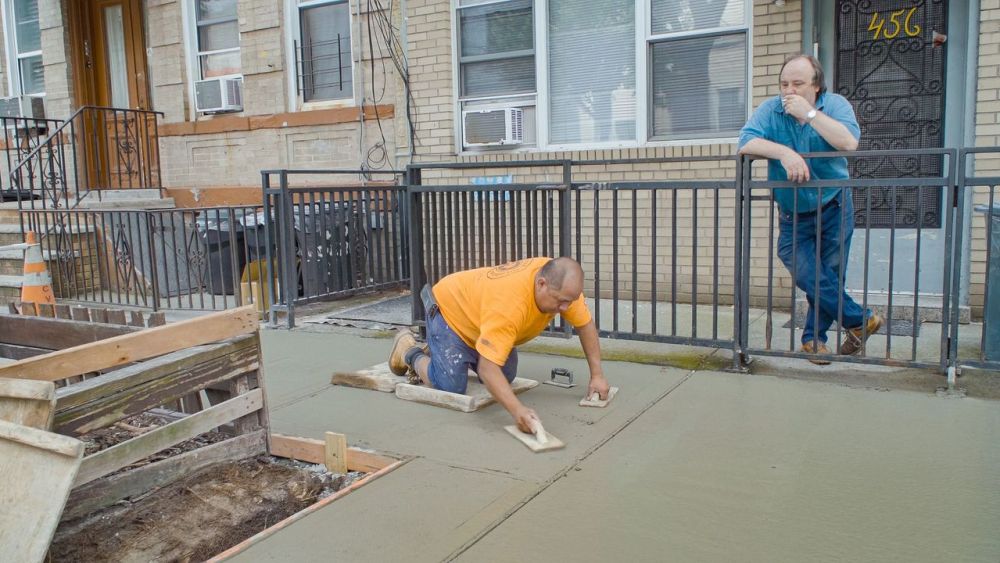
It’s tough to describe John Wilson’s new documentary, “The History of Concrete,” premiering on opening night at Sundance. On one hand, it’s as promised in the title: An examination of the building block of cities and societies that often goes unnoticed, and how its usage and degradation can stand as a metaphor for human nature. There’s a strong meta-element, as Wilson turns the camera on during the process of finding financing for the project, often unable to close the deal when the topic is, by design, dull. Along the way, his creative tank is fueled while talking with unique people he meets along the way, which recalls his work over three seasons of his HBO series, “How To With John Wilson.”
Wilson says that the genesis of “Concrete” came from home repairs, which he also documents in the film.
“It started fairly innocently when I was trying to figure out how to fix the foundation to my house,” he says. “I try to involve the audience with the very beginning of the creative process in this film, just by showing you where the germ of the idea originates, and then expands outward into this larger portrait of this substance and the people that use it. I really like the subject matter because it seemed extraordinarily hard to make it funny. That’s a challenge that I always like to take on.”
A challenge Wilson didn’t anticipate was the feedback he received about how his comedic voice, so sharpened and idiosyncratic on “How To,” might not be seen as fresh when pitching a new feature-length project.
“There was a lot of conversation when we first started taking this out to pitch it, from my agents or other industry professionals, who were telling me people want the new,” Wilson says. “They don’t want the exact same thing as the show. I initially resented that, because I felt like this was the best way to do things for me. This was something I had thought about a lot, and I felt it was like the most complete way to express this idea I was exploring.”
Yet Wilson was able to reconfigure how he paced his storytelling in a way that created a fresh canvas. Whereas episodes of “How To” were restricted to 28 minutes to examine issues such as “How to Make Small Talk” and “How To Be Spontaneous” through a roundabout series of interviews and excursions, Wilson changed the tempo for “Concrete.”
“Transitioning from a hard format to this other kind with no real time constraints, you don’t want to punish the audience,” he says. “But I got really excited, just like trying to think about how to tease out these storylines over a longer period of time. For the show, I would spend maybe a couple of weeks with a main character. With this, I was able to spend a couple of years, witnessing a longer character arc over the course of the production. I think materially it’s very similar to the show, but it also took a lot of effort to let the subject matter speak for itself.”
The scale of the project’s raw material ballooned as Wilson shot 140 hours in several countries, unsure about how the final version of his film might unfold. While it’s touched upon in the film, Wilson says that his fulfillment in life and in the project were inextricably tied together.
“My self-worth kind of plummeted, and that’s where I was living for most of the beginning of this project,” he says. “I tried to surround myself with people who were much more confident and assured in what they were doing. I feed off that energy in a way, but it’s isolating when you’re making something like this. It was usually just like me and one other person just driving to and from these shoots and, I don’t know … I’m still unpacking a lot of it, honestly.”
One kindred spirit who helped Wilson push through and complete his vision was Jack Macco, a gigging musician in Long Island whom Wilson met at a liquor store. With a wild mane of hair and a love of rocking out on local stages, Macco is a true character, but what makes him a focal point of the last stretch of the film are unexpected layers we won’t spoil here. But Wison was energized by Macco’s commitment to art and creativity.
“You could see him as a mundane example of ambition, which is nice, because he seems genuinely content in a lot of ways,” he says. “It’s something I wasn’t feeling at all when I was making the film. I was trying to absorb some of his enthusiasm and inner peace by spending time with him and getting to understand what motivates him. We see the rooms that he plays in Long Island’s dive bar scene. These places are really valuable. At a point in the film, Jack was the only thing keeping me going. He almost felt like my swimming buddy, and was one of the only bits of continuity I have in my life or with this project right now, creatively.”
This theme of people finding joy and happiness through their art often appears in the film, as Wilson interacts with an enthusiastic short film crew, extreme ultramarathoners and even the head of GumBusters, a New York City specialty cleaning company founded by a man who loves blasting old gum stains out of concrete.
As he’s gearing up for the “Concrete” premiere, Wilson says he’s put down his “big camera” for a minute, but is always documenting life in his native New York City. While the process of wrapping this film is still fresh, he is excited for future projects.
“I have a couple of ideas right now that I’m figuring out how to shop around, but I think none of them are as unsexy as concrete,” he says. “That’s also relative.”